Home
» News
»
Top Crypto News Aggregators and Research Tools for Professional Traders
Top Crypto News Aggregators and Research Tools for Professional Traders
Professional crypto trading is an information-management problem as much as a market-timing problem. Prices can move before a story reaches mainstream coverage, while on-chain activity, derivatives positioning, governance proposals, token unlocks, and social narratives can all change the risk picture at the same time. The challenge is not finding more information. It is building a workflow that separates fast alerts from deeper research and then verifies what matters before a trade is placed.
This guide is written for traders building that workflow from scratch. It explains what each category of tool is for, which leading platforms are useful in 2026, how to combine them, and which mistakes create the most noise. Features change quickly in crypto software, so the descriptions below are based on official product documentation and pages checked in September 2026.
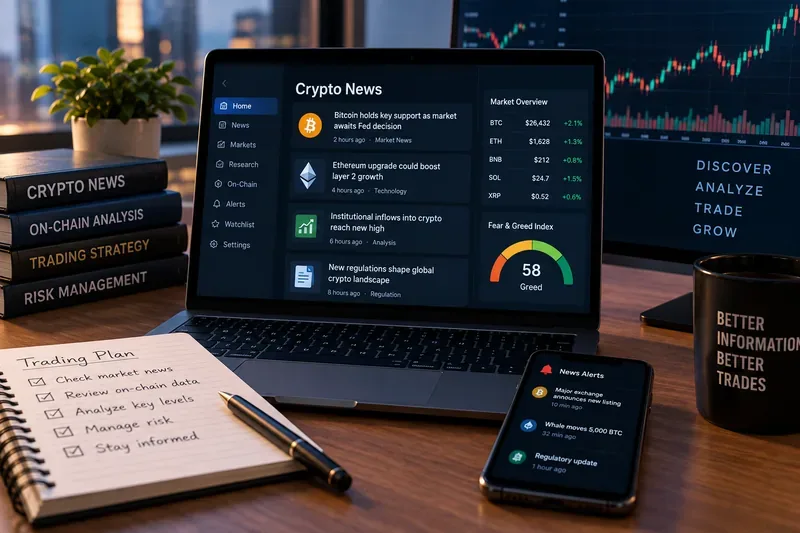
A professional research workflow separates news monitoring, on-chain checks, market analysis, alerts, and final risk review instead of relying on one feed.
Start with the right mental model: no single platform does everything
A news aggregator collects headlines or posts from many sources into one feed. Its main value is speed and filtering. A research platform goes deeper, combining structured market, protocol, on-chain, or fundamental data so you can test whether a headline is meaningful. An on-chain intelligence tool analyzes blockchain transactions and wallet activity. A narrative or attention tool measures what people are discussing and how quickly attention is shifting.
Professional traders typically need at least three layers:
Discovery: detect a breaking story, wallet movement, unusual market move, or narrative shift.
Verification: confirm the event using primary sources, blockchain data, protocol data, or market data.
Context: decide whether the event is large enough, credible enough, and relevant enough to affect a trade.
The best tool stack is therefore usually a combination rather than a single subscription.
Quick comparison: which crypto research tool is best for which job?
Address and entity profiles, transaction tracing, counterparties, visual analysis, and alerts
Coin Metrics
Institutional-grade market and network data
Network data, harmonized exchange data, derivatives data, indexes, APIs, and data visualization
1. CryptoPanic: a practical first layer for breaking crypto news
If you are new to professional research, CryptoPanic is one of the simplest ways to reduce tab overload. Its core product is a crypto news aggregator, which means it brings many crypto-related stories into a single interface. According to the platform's official About page, users can see trending stories and sentiment, follow coins, set price alerts, and use portfolio features. Its paid PLUS tier also supports faster refreshes and additional source customization.
The right way to use a news aggregator is as an alerting surface, not as a final source of truth. A headline saying that an exchange listed a token, a regulator issued guidance, or a protocol changed tokenomics should trigger a second step: open the original exchange announcement, regulator page, governance forum, or project documentation.
Best for: traders who need a fast market-news radar without constantly checking dozens of publications and social accounts.
2. Kaito Pro: search across crypto's fragmented information layer
Kaito is useful when the problem is not just breaking news but fragmented information. The platform describes Kaito Pro as an AI-powered crypto market-intelligence platform that indexes sources such as social media, governance forums, Farcaster, Telegram, Medium, podcasts, conference transcripts, and other datasets.
Its documented features include MetaSearch, sentiment analytics, smart alerts, dashboards, Token Mindshare, Narrative Mindshare, a Catalyst Calendar, an audio library, and an AI Copilot. “Mindshare” is a measure of how much attention a project or topic receives relative to the broader discussion. Kaito's documentation also explains its broader approach to crypto-native search and information discovery.
For traders, this is particularly useful before and during narrative rotations. If artificial-intelligence tokens, restaking, decentralized physical infrastructure, or another sector suddenly gains attention, Kaito can help identify whether the shift is broad, which projects dominate discussion, and what catalysts are driving the change.
Best for: narrative research, social-information discovery, catalyst tracking, and searching across information sources that are difficult to monitor manually.
3. Messari: structured screening before deep research
Messari is useful when you want to move from “what is happening?” to “which assets or protocols should I investigate?” Its Asset Screener documentation describes filtering across more than 30,000 assets and more than 50 metrics, with customizable tables and advanced filters. Messari also publishes structured protocol metrics through its API and maintains fundraising screeners and datasets.
A screener is a filtering tool that reduces a large universe of assets to a smaller group matching chosen criteria. For example, rather than reading random token discussions, a trader could first filter by sector, market capitalization, liquidity-related fields, protocol metrics, or fundraising data and then investigate the remaining candidates.
This is especially valuable for professional workflows because it makes the research process reproducible. The question changes from “what coin looks interesting today?” to “which assets meet my predefined conditions?”
Best for: asset screening, protocol fundamentals, sector comparison, fundraising research, and building repeatable research lists.
4. Glassnode: market structure through on-chain data
On-chain data is information derived from transactions and states recorded on a blockchain. It can reveal exchange balances, realized profits and losses, holder behavior, miner activity, and other structural information that is not visible from price charts alone.
Glassnode Studio combines charts, Workbench, dashboards, and alerts. Its official documentation describes Workbench as a way to compare metrics, apply formulas and functions, and create customized analyses. Glassnode also offers custom alerts that can notify users when tracked metrics reach specified conditions.
Glassnode is most useful when you already have a market hypothesis and want to test it. Suppose Bitcoin falls sharply while a headline feed becomes extremely negative. Instead of assuming the move is purely news-driven, you might inspect exchange inflows, realized losses, long-term-holder behavior, derivatives conditions, or other metrics to judge whether the move looks like forced selling, broader distribution, or short-term volatility.
Best for: cycle analysis, investor behavior, market structure, historical comparison, and metric-based alerts.
5. Nansen: following labeled wallets and Smart Money
Raw blockchain addresses are difficult to interpret because an address does not normally tell you who controls it. Nansen adds labels and entity groupings to make wallet activity easier to understand. Its official API documentation explains Labels, Entities, and Smart Money. Smart Money refers to curated wallets selected using performance-related criteria, while entity labeling attempts to connect addresses to known exchanges, funds, protocols, and other actors.
Nansen's Smart Money endpoints expose data such as netflows, DEX trades, perpetual trades, holdings, and historical holdings. The platform also supports Smart Alerts, which can be configured to monitor token transfers, wallet behavior, and other on-chain events.
This is useful when the key question is not only “what happened?” but “who is doing it?” Large token inflows can mean different things depending on whether they are associated with an exchange, a market maker, a fund, a project treasury, or a historically profitable trader.
Best for: wallet tracking, Smart Money flows, token discovery, whale monitoring, and behavioral context around on-chain moves.
6. Arkham: tracing entities, transactions, and counterparties
Arkham focuses heavily on entity-level blockchain intelligence. Its official platform documentation describes entity pages containing transaction history, holdings, balance history, profit and loss, exchange usage, and counterparties, plus a visualizer for network analysis.
Arkham's alerts documentation says users can build alerts based on criteria such as entity or address, sender or receiver, token, amount, U.S. dollar value, and chain, with delivery through email, Telegram, or webhooks.
That makes Arkham particularly useful for event-driven research. If a known fund transfers a large position, a project treasury moves tokens toward an exchange, or an address cluster changes behavior, Arkham can help map the transaction path and counterparties before you decide how much significance to assign to the event.
Best for: transaction tracing, entity profiles, counterparty analysis, large-wallet monitoring, and investigations around specific blockchain events.
7. Coin Metrics: deeper data for quantitative and institutional workflows
Coin Metrics is a strong fit for traders and research teams that need standardized data, APIs, and reproducible quantitative analysis. Its official product documentation covers network data, market data, indexes, reference data, data visualization, and programmatic access.
The Market Data Feed documentation includes historical and real-time information from centralized and decentralized spot and derivatives venues. Documented data types include trades, candles, order books, open interest, liquidations, funding rates, implied volatility, and option Greeks. Coin Metrics also provides network data sourced primarily from blockchain nodes and offers charting and formula tools for analysis.
This level of structure matters when a trading team wants the same data definition every day, automated monitoring, research notebooks, model inputs, or backtests. It is generally a heavier workflow than checking a retail dashboard, but that is precisely the point: professional research often requires data that can be queried and reproduced rather than manually copied from a screen.
Best for: quantitative research, institutional market data, derivatives analytics, network metrics, API-based pipelines, and reproducible data workflows.
How to build a professional crypto research stack step by step
Step 1: define the questions you actually trade
Before subscribing to anything, write down the decisions your research must support. A short-term event trader may care about exchange announcements, regulatory headlines, large wallet transfers, open interest, and liquidations. A swing trader may care more about sector momentum, on-chain accumulation, token unlocks, protocol usage, and macro catalysts. A systematic desk may care about clean APIs, historical consistency, and machine-readable data.
This prevents the common mistake of buying several sophisticated tools that answer questions you never use in your trading process.
Step 2: choose one discovery tool and one verification tool
A reasonable starter stack could pair CryptoPanic or Kaito for discovery with Glassnode, Nansen, Arkham, Messari, or Coin Metrics for verification and context. You do not need every platform on day one.
For example, a breaking headline about a token could be discovered in a news feed, verified against the project's official announcement, checked in Nansen or Arkham for wallet movement, and then compared with market structure or on-chain metrics in Glassnode or Coin Metrics.
Step 3: create watchlists around assets, entities, and events
Do not treat every token equally. Build separate watchlists for positions you hold, liquid assets you actively trade, high-impact wallets or entities, and upcoming catalysts such as governance votes, unlocks, upgrades, listings, or regulatory decisions.
Professional monitoring becomes much easier when the system answers “what changed in my universe?” instead of “what happened anywhere in crypto?”
Step 4: use alerts sparingly
Alerts are valuable only when they change behavior. An alert that fires 50 times a day becomes background noise. Set thresholds around events that would genuinely cause you to recheck a position: a large entity transfer, an abnormal netflow, a key on-chain threshold, or a scheduled catalyst.
Where possible, separate high-priority alerts from general research feeds. A dedicated Telegram, Slack, Discord, email, or webhook channel can help prevent important signals from getting buried.
Step 5: verify before trading
An aggregator, AI summary, social post, or wallet label can be wrong, incomplete, delayed, or misinterpreted. Before a position changes materially, trace the claim back to the primary source. For regulatory news, use the regulator's site. For protocol changes, use governance or official documentation. For transactions, inspect the blockchain data and entity assumptions. For market data, check venue and methodology.
Common mistakes professional traders should avoid
Treating headlines as confirmation: fast information is useful for discovery, not proof.
Following “Smart Money” blindly: a profitable wallet can hedge elsewhere, transfer for operational reasons, or change strategy.
Confusing attention with fundamentals: rising mindshare can precede opportunity, but it can also mark late-stage crowding.
Ignoring data definitions: open interest, active addresses, exchange balances, and volume can be calculated differently across vendors.
Over-alerting: too many notifications reduce reaction quality rather than improve it.
Using one data layer in isolation: price, news, social data, and on-chain data each have blind spots.
Skipping primary sources: an aggregator or analytics platform should shorten research time, not replace verification.
A simple self-check: is your research stack actually helping?
After two to four weeks, review your workflow using measurable questions. How many alerts led to a meaningful research action? How often did you discover an event before it was already obvious in price? Which dashboards did you actually open during trading hours? Which data sources changed a decision, and which simply confirmed what you already knew?
If a tool creates more tabs than insight, remove it. If two platforms answer the same question, keep the one with clearer methodology, better coverage, or more useful alerts. If a signal repeatedly appears valuable, formalize it in a watchlist, dashboard, or API workflow.
The goal is not to own the largest crypto research stack. It is to build a small, reliable information system that takes you from discovery to verification to decision with the least unnecessary noise. As of September 2026, CryptoPanic, Kaito, Messari, Glassnode, Nansen, Arkham, and Coin Metrics cover most of the major research layers a professional trader is likely to need, but features, access levels, and product names can change. Always confirm current capabilities in each provider's official documentation before designing a critical trading workflow.