Home
» News
»
Q4 Crypto Rebalancing Checklist: Position for Better Risk-Adjusted Returns
Q4 Crypto Rebalancing Checklist: Position for Better Risk-Adjusted Returns
“Maximum returns” sounds like the goal of portfolio rebalancing, but it is the wrong promise to build a Q4 plan around. Rebalancing cannot guarantee the highest return. What it can do is restore the amount of risk you intended to take, reduce accidental concentration, create a repeatable decision process, and make taxes, fees, liquidity, and custody part of the same portfolio review.
There is also a timely macro reason to do the work before year-end. The Federal Reserve scheduled its September 2026 FOMC meeting for September 15–16. At the time this checklist was prepared on September 16, investors still needed to verify the official statement rather than assume a particular rate path. The practical lesson is broader than one meeting: Q4 portfolio decisions should be based on confirmed policy information, not social-media predictions. Check the Federal Reserve’s September 2026 calendar and releases before changing risk because of a macro headline.
1. Start with what you own now, not what you wish you owned
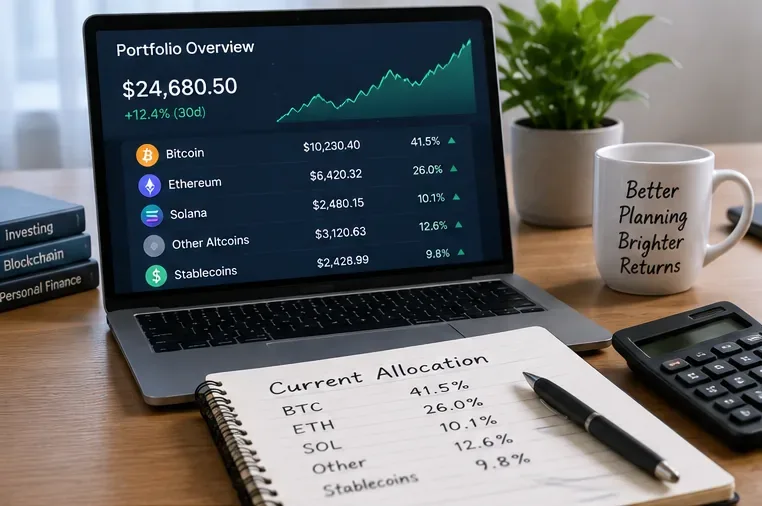
The first Q4 task is an inventory. Record every crypto position, stablecoin balance, exchange balance, self-custodied asset, staking position, lending position, liquidity-pool token, and any crypto exposure held through a brokerage product. Then calculate each position as a percentage of your total investable portfolio—not only your crypto account.
This distinction matters. A wallet that looks “diversified” because it holds 20 tokens may still be highly concentrated in one economic theme: smart-contract beta, memecoins, liquid staking, or a single ecosystem. Diversification means spreading exposure across assets that may behave differently, not simply increasing the token count. Investor.gov describes diversification as spreading investments to reduce overall portfolio risk and notes that diversification matters both across asset categories and within them. See the SEC’s guide to asset allocation, diversification, and rebalancing.
Step 1: Write down the current portfolio weights before deciding what to buy or sell. A rising asset can quietly become a much larger risk than originally intended.
Q4 inventory checklist
Current market value of each position
Portfolio weight as a percentage
Original thesis and whether it is still valid
Liquidity: how easily the position can actually be sold
Where the asset is held and who controls the private keys
Staking, lending, bridge, smart-contract, or counterparty exposure
Cost basis and holding period, where relevant for tax reporting
2. Define target weights before looking at price predictions
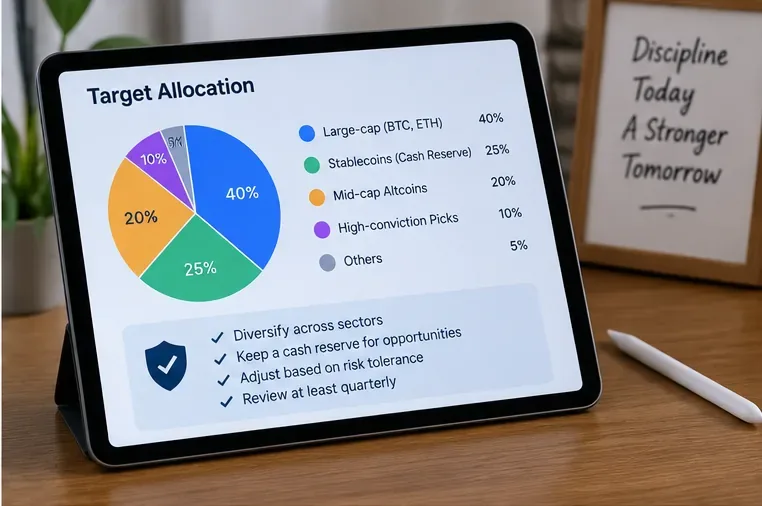
A useful target allocation begins with risk capacity and time horizon, not a forecast for Bitcoin, Ether, or any altcoin. Ask how much of the portfolio you can afford to expose to a 30%, 50%, or larger drawdown without being forced to sell. Then decide how much belongs in core crypto exposure, higher-volatility satellite positions, and liquid reserves.
There is no universal “correct” allocation. A portfolio designed for a long investment horizon may tolerate more volatility than money needed for a home purchase next year. A trader who depends on stablecoin liquidity for operating capital has different constraints from a long-term holder with outside income. Investor.gov’s 2026 investor guidance emphasizes that asset allocation depends on both risk tolerance and investing timeframe. Review the Investor.gov Tips for 2026 for the underlying principle.
Step 2: Set target weights from your risk budget first. The percentages shown are an illustration, not a recommended allocation for every investor.
Use ranges, not one magical number
Instead of demanding that a position remain exactly at 25%, consider a target band such as 22%–28%. A band reduces needless turnover while still telling you when drift has become meaningful. You can use calendar-based reviews—quarterly, semiannual, or annual—or threshold-based rules that trigger only when an allocation moves beyond a pre-set band. Investor.gov notes that both calendar and threshold approaches are commonly used and that rebalancing generally works best when it is relatively infrequent.
3. Separate portfolio drift from a broken investment thesis
Not every underweight asset deserves more capital. Traditional rebalancing assumes the underlying investment still belongs in the portfolio. Crypto adds extra failure modes: protocol exploits, token-unlock changes, governance capture, declining developer activity, unstable collateral, bridge risk, exchange delistings, or a business model that no longer works.
Before “buying the dip” to restore a target weight, ask a harder question: would you initiate the position today if you did not already own it? If the answer is no because the thesis is broken, rebalancing back up may simply increase exposure to a deteriorating asset.
Keep three labels
Status
Meaning
Q4 action
Thesis intact
The reason for owning it still holds.
Eligible for normal rebalancing.
Thesis uncertain
Material facts changed or remain unresolved.
Pause additions; define what evidence would restore conviction.
Thesis broken
The original reason for ownership no longer holds.
Evaluate an exit on risk, liquidity, tax, and execution grounds rather than automatically averaging down.
4. Rebalance with new cash before creating unnecessary taxable sales
There are three basic ways to rebalance: sell overweight positions and buy underweight positions, add new money to underweight positions, or redirect ongoing contributions. The second and third methods can reduce turnover because they may restore balance without selling winners.
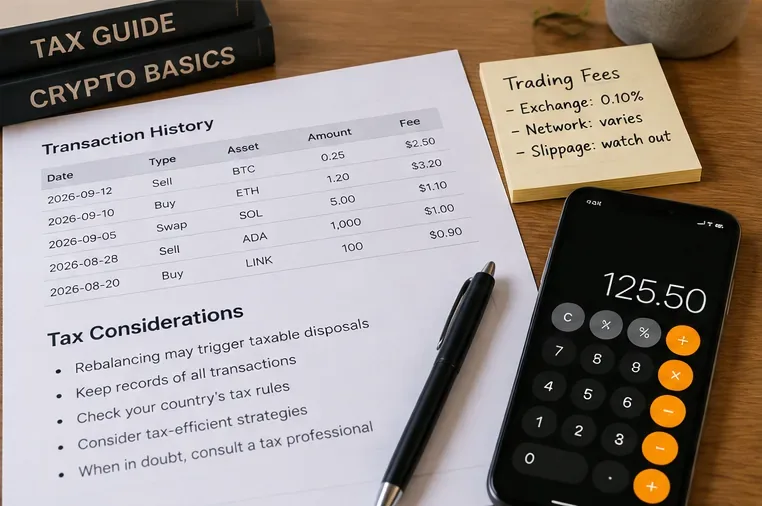
Taxes can materially change the economics. For U.S. federal tax purposes, the IRS treats digital assets as property. Selling or exchanging a digital asset can produce a capital gain or loss, and the holding period helps determine whether the result is short-term or long-term. The IRS also states that taxable digital-asset transactions must be reported even if no information return is received. Review the IRS digital-asset transaction FAQs. Tax rules differ by jurisdiction, so investors outside the United States should use their own tax authority’s guidance.
Step 3: Model taxes, fees, spreads, and network costs before executing a rebalance. A theoretically better allocation can be worse after friction.
Before any sale, estimate the full friction
Realized capital gain or loss
Trading fee
Bid-ask spread and expected slippage
Network or withdrawal fee
Bridge costs, if moving between networks
Lost staking rewards or lockup penalties
Any change in counterparty or custody risk
5. Review custody as part of rebalancing, not as a separate chore
A Q4 rebalance is a good time to ask whether your assets are stored in a way that still matches their purpose. Trading inventory may need quick access. Long-term holdings may prioritize stronger custody controls. DeFi positions introduce smart-contract and key-management risk. Leaving everything on one platform may create concentration even if the token allocation looks diversified.
The SEC’s December 2025 retail custody bulletin explains that crypto wallets store the private keys used to access crypto assets and advises investors to research third-party custodians, protect seed phrases, use strong passwords, and enable multi-factor authentication. Review the crypto asset custody basics bulletin.
Do not move funds merely because one custody model is fashionable. Self-custody removes some intermediary risk but adds operational responsibility. Third-party custody may be easier to use but introduces counterparty and access risk. The correct choice depends on your technical ability, transaction needs, estate plan, and risk tolerance.
6. Decide how much dry powder you actually need
Stablecoins and cash-like reserves can reduce the need to sell volatile assets during a sudden drawdown and can provide capital for future opportunities. But a stablecoin is not the same thing as insured bank cash. Different stablecoins carry different reserve, issuer, smart-contract, liquidity, and de-pegging risks.
Instead of treating “cash reserve” as a return forecast, define its job. Is it there for near-term spending, taxes, collateral, tactical buying, or simply to lower portfolio volatility? Once the purpose is clear, you can decide whether it belongs inside crypto at all.
7. Execute in stages when liquidity or volatility is poor
A target allocation does not require one large market order. If a token is thinly traded or the market is moving quickly, staged execution can reduce price impact. Limit orders may provide more price control, while market orders prioritize execution certainty. Neither approach is universally superior.
For larger positions, estimate market depth before trading. A token may show a large quoted market capitalization but still have shallow order books at the venue you use. For DeFi swaps, inspect expected price impact and route quality before confirming. For cross-chain assets, include bridge risk in the execution plan rather than viewing the bridge as a neutral pipe.
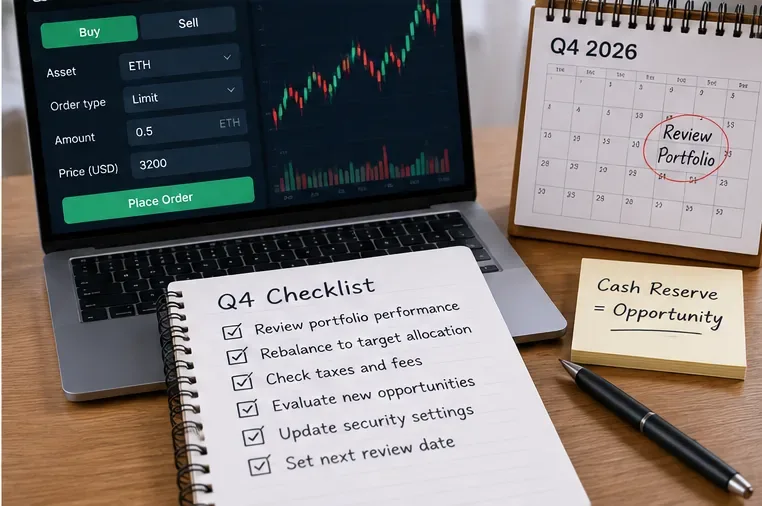
Step 4: Execute deliberately, then schedule the next review. Rebalancing is a process, not a one-time prediction about where prices go next.
8. Set rules for Q4 opportunities before the market gets emotional
Q4 often brings narratives about year-end rallies, tax-loss selling, new listings, protocol launches, macro pivots, or “altseason.” Some of those catalysts may matter; none should override the portfolio’s risk limits by default. The easiest way to avoid reactive decisions is to write the rule before the event.
Maximum position size for any single token
Maximum combined exposure to one ecosystem or theme
Minimum liquidity standard
Conditions required before buying a new token
Loss of thesis conditions that trigger a review
Maximum leverage, ideally zero unless leverage is explicitly part of a tested strategy
Minimum liquid reserve
This does not maximize every possible upside move. It is designed to prevent one speculative idea from determining the outcome of the entire portfolio.
9. Do not confuse rebalancing with performance chasing
One of the most common mistakes is to sell an asset because it lagged recently and move the proceeds into whatever just outperformed. That is not disciplined rebalancing; it is changing the target after seeing the result. A true rebalance starts with an allocation decided from goals and risk, then returns the portfolio toward that allocation when drift becomes large enough.
If your goals, financial situation, time horizon, or risk tolerance genuinely changed, then changing the target allocation may be appropriate. But write down what changed. That separates a real plan update from an emotional response to price.
10. Final Q4 crypto checklist
Inventory: list every position, venue, wallet, staking or lending exposure, and current portfolio weight.
Risk budget: define how much volatility and drawdown you can realistically tolerate.
Targets: set target weights and tolerance bands before making trades.
Thesis check: distinguish simple price drift from a genuinely broken investment case.
Taxes: estimate realized gains, losses, holding periods, and local reporting requirements.
Trading friction: include fees, spreads, slippage, gas, withdrawals, and bridge costs.
Custody: review where each asset is held and whether the storage method still fits its role.
Liquidity: verify you can exit a position at a realistic size without unacceptable price impact.
Dry powder: define the purpose of cash or stablecoin reserves instead of holding them by habit.
Macro check: use confirmed central-bank releases and economic data rather than forecasts presented as facts.
Execution: stage large or illiquid trades when appropriate.
Next review: put the next portfolio review date on the calendar immediately.
What a successful rebalance actually looks like
A successful Q4 rebalance is not proven by whether the portfolio rises the following week. It is successful when the portfolio once again matches a deliberate risk plan, when no single position has become accidentally dominant, when taxes and trading friction were considered before execution, and when custody and liquidity risks are understood.
That framework will sometimes cause you to trim an asset that keeps rising or to hold cash while other traders are fully invested. It may also prevent a concentrated winner from becoming a concentrated loss. The point is not to predict every Q4 move. It is to make sure that whatever the market does, your portfolio is taking risks you chose on purpose.
Educational information only. Crypto assets can be highly volatile and speculative, and no rebalancing method can guarantee returns or prevent losses.