Home
» News
»
Top 5 Undervalued Layer 2 Tokens With High Upside Potential in 2026
Top 5 Undervalued Layer 2 Tokens With High Upside Potential in 2026
Layer 2 investing has a frustrating trap: the network with the most users, transactions, or headlines is not automatically the token with the best economics. Some L2 tokens govern valuable ecosystems but capture little of the value those ecosystems create. Others have stronger fee, staking, or buyback links but carry heavy unlock schedules that can overwhelm demand.
That is why this list does not treat “undervalued” as a synonym for “down a lot.” As of September 16, 2026, the five tokens below stand out because there is a plausible gap between what their networks are building and what the token itself could capture if current plans work. The ranking is a research watchlist, not a prediction of near-term price performance.
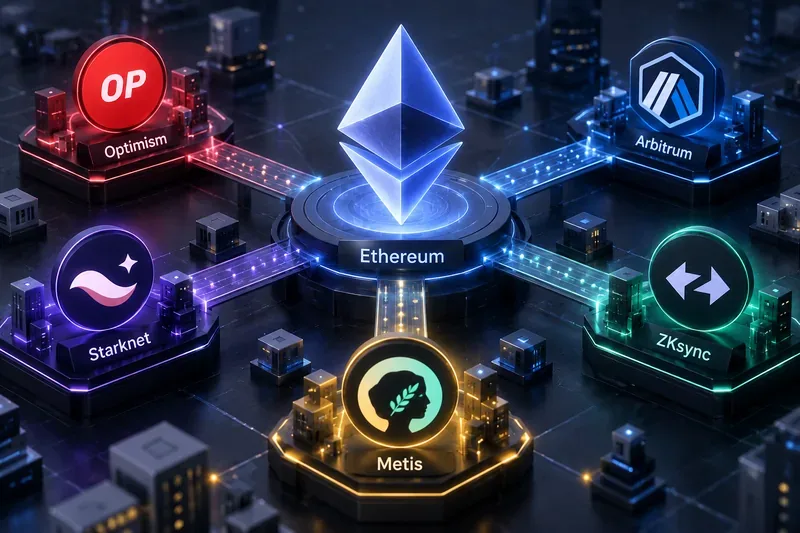
Ethereum connected to five Layer 2 ecosystems discussed in this watchlist: Optimism, Arbitrum, Starknet, ZKsync, and Metis.
How to Judge Whether an L2 Token Is Actually Undervalued
Start with the easiest filter: separate network quality from token quality. A rollup can process huge volume while its token has only governance rights. In that case, more activity does not necessarily create more token demand. The next step is to look for a direct economic bridge between usage and the token, such as gas payments, staking, protocol fees, buybacks, or governance control over meaningful cash flows.
Then check supply. Unlocks, emissions, treasury distributions, and staking inflation can dilute holders even while the network grows. Finally, ask whether the catalyst is already live or still a proposal. A live mechanism deserves more weight than a roadmap item because crypto governance can delay, modify, or reject planned changes.
Rank
Token
Main upside thesis
Main risk
1
OP
Superchain revenue is now linked to an approved token buyback program
Buyback execution has been uneven and OP supply is still expanding
2
ARB
Large, revenue-producing ecosystem with most original vesting already unlocked
Token value capture remains weaker than network economics
3
STRK
Native fees plus staking create direct protocol utility
Large scheduled unlocks and staking inflation
4
ZK
Fixed supply and a path toward native network economics
Several value-capture mechanisms are still governance-dependent
5
METIS
Direct staking role in decentralized sequencing
Smaller ecosystem and higher execution/liquidity risk
1. Optimism (OP): The Clearest New Value-Capture Experiment
OP ranks first because Optimism has moved beyond the old “governance token only” model. In January 2026, Optimism governance approved a 12-month program that allocates 50% of incoming Superchain revenue to OP buybacks. The official governance record shows that the proposal passed, and the later Optimism buyback communication thread reported 9,451,924 OP purchased across the first three disclosed monthly executions.
That matters because the Superchain is bigger than OP Mainnet. OP Stack chains can contribute revenue to Optimism, so the economic thesis is tied to a broader network of chains rather than one rollup. Optimism’s documentation also describes a Superchain interoperability model in which compatible OP Stack chains share common standards and can participate in a connected cluster. See the official interoperability explainer.
The catch is important: a buyback program is not the same as permanent fee distribution. The August 2026 communication thread showed that public updates had only documented three monthly executions at that point, even though the approved program covered 12 months. In addition, the Optimism Foundation reported 2.288 billion OP circulating as of August 6, 2026, or 53.3% of the 4.295 billion fully diluted supply. That leaves future supply to absorb. The OP thesis therefore works best if Superchain revenue keeps growing and buyback execution becomes more consistent.
ARB is the opposite type of opportunity: the network is already economically substantial, while the token’s direct value capture is still the missing piece. The Arbitrum Foundation H1 2026 progress update reported 2.7 billion lifetime transactions, about $70 billion in average monthly stablecoin transfer volume, $6.19 million in H1 DAO income, and $125 million in non-ARB treasury assets.
Supply pressure is also becoming easier to model. In its September 2026 update, the Foundation said roughly 9.23 billion ARB, or 92.3% of the original 10 billion supply, had been unlocked or was held in the ArbitrumDAO treasury as of August 17, 2026, with the original vesting schedule ending in March 2027. That removes one of the biggest uncertainties that weighed on ARB after launch.
Why is ARB not number one? Because governance remains its core utility. The DAO controls meaningful assets and income streams, but holders do not automatically receive those revenues. A previous ARB staking proposal explicitly noted that fee distribution had not yet been switched on. For ARB to re-rate on fundamentals rather than ecosystem reputation, investors should look for concrete governance decisions that connect DAO income, staking, or other protocol economics more directly to the token.
3. Starknet (STRK): Real Utility, Real Dilution
STRK has one of the clearest utility stories among major L2 tokens. Starknet’s official documentation says that, since network version 0.14.0 in September 2025, transaction fees are paid in STRK. The token is also used in staking and governance. That gives STRK three distinct demand channels: blockspace usage, network security, and decision-making. The details are documented in the official STRK documentation.
The upside thesis is straightforward: if Starknet usage and staking participation grow, the token is embedded in the protocol rather than sitting beside it. Starknet also allows delegation, while validators stake STRK to participate in the network’s security process.
The difficult part is supply. Starknet’s published schedule states that up to 127 million STRK can unlock on the 15th of each month from April 2025 through March 2027 for early contributors and investors. Staking rewards also introduce new issuance under the protocol’s minting curve. That means STRK can have improving utility and still underperform if new supply reaches the market faster than organic demand grows. For this token, the self-check is simple: watch whether fee demand and staking participation are accelerating faster than unlock-related selling pressure.
4. ZKsync (ZK): Fixed Supply With a Still-Developing Economic Role
ZK is interesting because the supply ceiling is unusually clear. ZKsync’s official token page states that ZK has a fixed maximum supply of 21 billion and no inflation. It currently powers governance, while future governance can expand its economic role. The same page says ZKsync Gateway has been designed with ZK as its native gas token, but activation would require future governance action. It also describes protocol-fee provisions in the Prividium architecture, with fee structure and allocation controlled by governance. See the official ZK token page.
The 2026 roadmap gives that optionality more substance. ZKsync has been pushing Prividium for institutional private-chain use cases, and in September 2026 it announced that Prividium Core was open-sourced. A network that can connect public and private chains could create new fee sources if institutional deployments move from pilots to production.
The risk is that much of the strongest token-economics story is still conditional. A design that “could” use ZK for gas is not the same as a live mechanism. ZK also has team and investor vesting through 2028. So the token looks most compelling when treated as an option on successful governance implementation, not as if future fee capture already exists today.
5. Metis (METIS): Smaller Scale, More Direct Sequencer Utility
METIS makes the list because its role is unusually concrete for a smaller L2 token. Metis uses a decentralized sequencer pool in which participants lock METIS to operate sequencer nodes. The Metis sequencer architecture explains that locked METIS is part of the proof-of-stake layer that manages sequencer rotation and governance. The operational guide currently requires at least 20,000 METIS for a sequencer, with rewards calculated on locked balances up to the documented cap.
This creates a direct reason for infrastructure operators to hold the token. It also gives METIS a different upside profile from larger governance-heavy L2 tokens: a smaller ecosystem can re-rate sharply if adoption improves, but it can also remain small if developer and liquidity growth stall.
Metis is therefore the highest-risk name in this list. Its decentralized sequencing model is technically differentiated, but smaller ecosystems generally face thinner liquidity, fewer applications, and greater dependence on a limited number of growth initiatives. Treat the potential upside and the execution risk as two sides of the same trade.
Why Some Popular L2 Tokens Do Not Automatically Qualify
A useful screen should be willing to exclude strong networks. The most common mistake is buying an L2 token simply because the chain has high total value locked, low fees, or a famous ecosystem. None of those facts proves that token holders receive economic value from network growth.
Another mistake is relying on fully diluted valuation without reading the unlock schedule. A low circulating market cap can look attractive while hiding years of future token issuance. Conversely, a token that has already absorbed most of its unlocks can become easier to value even if its headline market cap looks larger.
How to Use This Watchlist Without Chasing a Narrative
Work from easy checks to harder ones. First, confirm the token’s current utility in the protocol documentation. Second, read the latest governance proposals to separate live mechanisms from ideas. Third, map all major unlocks or emissions for at least the next 12 months. Fourth, compare network growth with token-specific demand: fees paid in the token, tokens staked, tokens bought back, or tokens required for infrastructure participation.
Only after those checks should price enter the discussion. Price can fall while fundamentals improve, but it can also fall because the market correctly anticipates dilution or weak value capture. “Down 80%” is not a valuation model.
Final Self-Check: Is the Upside Thesis Still Intact?
Before treating any of these five as undervalued, answer the following questions with current data rather than memory:
Is the token required for fees, staking, governance, or another live network function today?
Does higher network activity create measurable token demand, or only more revenue for a foundation or DAO treasury?
Are buybacks, fee routing, or staking rewards actually active rather than merely proposed?
How much supply is scheduled to unlock over the next 12 months?
Is network usage growing without unsustainable incentives?
What specific event would invalidate the thesis?
On this framework, OP currently has the clearest live experiment in linking Superchain revenue to token demand; ARB has the strongest mismatch between mature network economics and still-limited token capture; STRK has the most direct combination of fees and staking but substantial dilution; ZK has a fixed supply and promising economic optionality that still depends on governance; and METIS offers direct sequencer utility at the cost of much higher ecosystem risk.
No ranking is permanent. Layer 2 token economics are changing quickly, and governance can materially alter supply, fee routing, staking, or treasury policy. Re-run the same checks before acting on the thesis, especially after a major upgrade, token unlock, or governance vote.