Home
» News
»
AMM V4 Hooks Explained: How Custom Liquidity Pools Change the Trade-Offs
AMM V4 Hooks Explained: How Custom Liquidity Pools Change the Trade-Offs
Automated market makers (AMMs) traditionally ask users to accept a fairly fixed set of pool rules: a pricing model, a fee policy, and a liquidity mechanism defined by the protocol. Uniswap v4 changes that design space with hooks—external smart contracts that can run custom logic at specific points in a pool’s lifecycle. The result is not simply “a more advanced AMM.” It is a framework where two pools using the same underlying v4 core can behave very differently.
That flexibility creates real choices. A pool can keep the standard concentrated-liquidity behavior with no hook at all, or attach custom logic for dynamic fees, automated liquidity actions, access rules, specialized accounting, or other market designs. The trade-off is equally important: every extra rule adds code, assumptions, integration complexity, and potentially new security risks.
As of September 2026, Uniswap v4 has been live since January 2025. Uniswap describes v4 as a non-custodial, non-upgradeable, permissionless AMM protocol that uses a singleton PoolManager and hooks to customize pool behavior. For the protocol overview, see Uniswap Labs’ v4 overview and the Uniswap v4 whitepaper.
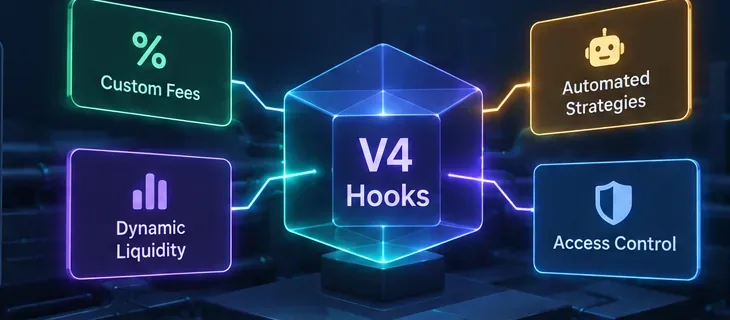
V4 hooks act as programmable extensions around a liquidity pool, allowing features such as custom fees, automated strategies, and access rules without replacing the core AMM.
What exactly is a v4 hook?
A hook is a smart contract attached to a Uniswap v4 pool when that pool is initialized. The hook can be configured to receive callbacks before or after particular pool actions. In the current v4 core interface, those lifecycle points include initialization, adding liquidity, removing liquidity, swaps, and donations. The official interface is visible in Uniswap’s IHooks.sol source.
The important distinction is that a hook does not replace the whole AMM. The v4 core still handles pool state and concentrated liquidity through the PoolManager. The hook adds behavior around selected actions. For example, a hook may inspect market conditions before a swap and choose a dynamic LP fee, or perform accounting after liquidity is modified.
Which callbacks a pool uses is fixed at initialization. In v4, hook permissions are encoded in the hook contract address through specific low-order bits. This unusual design lets the PoolManager determine which callbacks to invoke efficiently. The implementation details are documented in the official Hooks.sol library.
Why v4 can support custom pools without deploying a new AMM
Earlier AMM designs often required a team to fork or rebuild large portions of an exchange protocol when it wanted different fee logic, order behavior, or accounting. V4 separates the shared liquidity engine from optional customization. All pools are managed through a singleton-style PoolManager rather than deploying a separate core contract for each pool.
The whitepaper also introduces flash accounting, where intermediate token movements can be netted during an unlocked operation as long as final currency deltas settle correctly. Together, the singleton architecture and hooks make it easier to compose multiple pool actions and custom logic without duplicating an entire AMM codebase.
Four common hook choices—and what you give up
Pool design
What it can optimize
Main trade-off
Best fit when
No hook
Simplicity and lower custom-code risk
Less specialized behavior
Standard concentrated liquidity already fits the market
Dynamic-fee hook
Fees that react to volatility, volume, or other rules
Fee logic can be wrong, gameable, or expensive
Market conditions vary enough that one static fee is inefficient
Access-control hook
Eligibility, allowlists, or policy constraints
Less permissionless participation and more governance assumptions
A pool has explicit participation requirements
Custom-accounting hook
New settlement behavior, incentives, or specialized curves
Highest design and audit complexity
The product truly needs mechanics beyond standard concentrated liquidity
Option 1: no hook
A v4 pool does not need a hook. This is the simplest choice when the goal is ordinary concentrated liquidity with minimal custom behavior. The advantage is easier reasoning: there is less external code to inspect, fewer edge cases, and less uncertainty about what happens during swaps or liquidity changes.
The limitation is obvious: you do not get specialized pool behavior. If a market benefits from variable fees, automated position logic, or custom restrictions, a hookless pool cannot provide those features by itself.
Option 2: dynamic-fee hooks
V4 allows pools to use dynamic LP fees. A beforeSwap hook can, under the protocol’s dynamic-fee rules, return an LP-fee override for that swap. This makes it possible to design fee policies that respond to conditions such as volatility, order flow, or time.
The benefit is adaptability. A stable pair may want low fees during normal trading but different behavior when prices diverge. The risk is that the fee algorithm itself becomes part of market microstructure. Poor parameters can reduce volume, disadvantage LPs or swappers, or create opportunities for manipulation.
Uniswap Labs’ public hook repository includes a StablePairHook that uses dynamic fees for assets expected to trade near the same price. That repository is useful as a concrete example of how production-oriented hooks are separated from v4 core: Uniswap v4 hooks public repository.
Option 3: automated strategy hooks
Hooks can coordinate actions around liquidity changes or swaps, enabling systems that automate parts of an LP strategy. Examples may include rebalancing logic, time-based behavior, or integrations with other protocols.
This can reduce manual management, but “automated” does not mean “risk-free.” Strategy rules may perform poorly in fast markets, depend on external data, consume additional gas, or interact badly with other contracts. The relevant comparison is not automation versus no effort; it is predictable, inspectable rules versus operational complexity and model risk.
Option 4: access or policy hooks
A hook can enforce custom conditions before allowing an action to proceed. This can support allowlists, market-specific eligibility rules, or application-level policy controls.
That may be appropriate for a product with explicit access requirements, but it changes the openness of the pool. Users should understand who controls the rules, whether those rules can change, which external systems are trusted, and what happens if an authorization service fails.
Custom accounting is the most powerful—and easiest to misunderstand
One of v4’s more advanced features is custom accounting. Hooks can return token deltas that affect how value is accounted for around pool actions. The v4 whitepaper describes this as a way for hooks to implement functionality such as custom curves, hook fees, or other accounting behavior layered on top of the core system.
This is not the same thing as merely changing a displayed fee. Custom accounting can materially change the economics of an interaction. For sophisticated pool designers, that opens a large design space. For users and LPs, it means that “it is a Uniswap v4 pool” does not fully describe the economic rules. The attached hook must also be understood.
V3-style pool versus v4 hooked pool
Criterion
V3-style concentrated-liquidity pool
V4 pool with hooks
Core liquidity model
Concentrated liquidity
Concentrated liquidity plus optional custom logic
Fee behavior
Preset fee tiers
More flexible fee configuration, including dynamic fees
Pool customization
Mostly fixed at protocol level
Hook logic can modify lifecycle behavior
Audit surface
Mainly protocol plus integration
Protocol, integration, and hook contract
User due diligence
Understand pair, range, fee tier, token risk
All of the left, plus hook code and its dependencies
V4 should therefore be viewed as an extension of concentrated liquidity rather than a replacement for the fundamental LP trade-offs. LPs still face price movement, range selection, adverse selection, token risk, and smart-contract risk. Hooks add another dimension: custom rule risk.
Security: core audits do not automatically validate every hook
Uniswap v4 core went through extensive security review before launch. Uniswap Labs said at the January 2025 launch that the codebase had undergone nine audits, a large security competition, and a bug bounty. The launch details are available in Uniswap Labs’ v4 launch announcement.
That does not mean an arbitrary hook is safe. Hooks are external contracts created by independent developers. A hook can contain bugs, malicious logic, unsafe dependencies, poor access control, or economic assumptions that fail under stress. The official public-hooks repository explicitly distinguishes Uniswap Labs-maintained hook implementations from the broader universe of community hooks.
For a trader or LP, the useful question is therefore not simply “Is this v4?” but “Which hook is attached, what callbacks can it execute, who built it, has it been reviewed, and what additional contracts or oracles does it trust?”
How to choose a pool design for a real use case
If you mainly want standard liquidity
Prefer simplicity. A hookless v4 pool—or another well-understood pool design—can make sense when custom behavior does not solve a specific problem. Adding programmability simply because it is available creates complexity without necessarily creating value.
If you operate a volatile or specialized market
A dynamic-fee design may be useful if static fees consistently underprice or overprice liquidity risk. Evaluate the actual fee rule, data inputs, update frequency, gas overhead, and behavior during extreme conditions rather than focusing only on average fees.
If you are building a managed liquidity product
Automation hooks can make the user experience more coherent, but the strategy should be treated as a financial system, not just a convenience feature. Test failure modes such as stale data, rapid price gaps, reverted external calls, and conditions where rebalancing becomes expensive.
If participation must be restricted
An access-control hook can encode those requirements directly around pool actions. The cost is reduced permissionlessness and added trust in whoever controls or supplies the authorization logic. Document those controls clearly for users.
If you need a genuinely new market mechanism
Custom accounting offers the broadest design space, but it also deserves the most scrutiny. Use it when standard concentrated liquidity cannot express the desired economics—not merely to make the system appear more sophisticated.
What LPs and traders should inspect before using a hooked pool
Hook address: verify the exact contract attached to the pool.
Enabled callbacks: understand whether the hook runs before or after swaps, liquidity changes, initialization, or donations.
Fee rules: determine whether the LP fee is static or dynamic and what can change it.
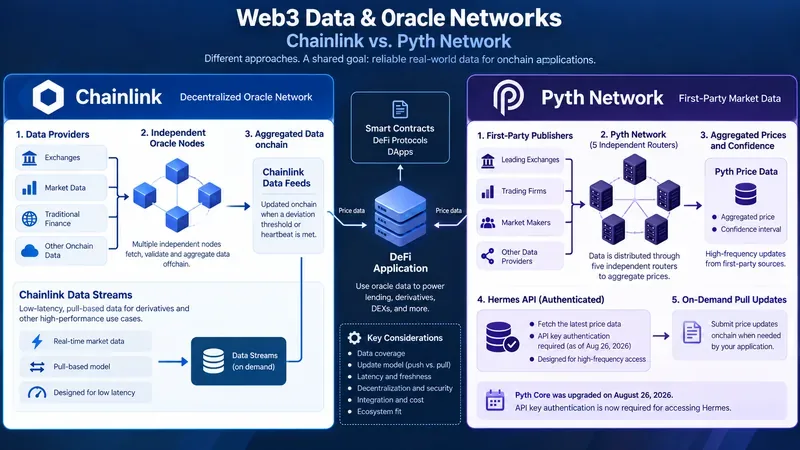
External dependencies: identify oracles, lending protocols, bridges, allowlists, or admin contracts the hook relies on.
Administrative control: check whether any party can change parameters, pause functionality, or influence external dependencies.
Audit and code status: distinguish audited, reviewed code from experimental examples.
Economic behavior: understand how the hook affects slippage, LP returns, token flows, and withdrawal conditions.
The practical takeaway
V4 hooks turn an AMM pool from a largely fixed product into a programmable component. That is valuable when a market has a specific need—adaptive fees, automation, access control, specialized accounting, or integration with another DeFi system. It is less compelling when standard concentrated liquidity already solves the problem.
The key trade-off is straightforward: more customization means more code and more assumptions to evaluate. Developers gain a broader design space, LPs can access more specialized strategies, and traders can interact with markets that behave differently from standard pools. At the same time, users must evaluate the attached hook as part of the pool itself.
For implementation-level details, use the current Uniswap v4 core repository, the v4 whitepaper, and the official v4 deployment list. Deployment addresses vary by network, so integrators should verify the current official mapping instead of assuming one address is universal.