Home
» Knowledge
»
How to Verify Crypto Founder and Developer Identities Without Doxxing Anyone
How to Verify Crypto Founder and Developer Identities Without Doxxing Anyone
Verifying a crypto founder or developer should mean checking whether public claims are consistent, attributable, and supported by independent evidence. It should not mean publishing a home address, exposing family members, buying leaked data, or trying to force a pseudonymous person into public view. In its strict sense, doxxing is the disclosure of private identifying information without consent. Responsible due diligence stays inside the boundary of information the person or organization has intentionally made public, and it records conclusions without amplifying sensitive details.
The practical goal is modest: decide whether a project has enough identity and accountability evidence for your risk level. A strong result does not guarantee that a team is honest, that a token will succeed, or that a wallet will be safe. It means you can explain what was verified, what remains unverified, and when you should pause instead of relying on a confident biography.
Scope note: This guide uses public-source checks and official documentation available in September 2026. Social platforms, repositories, company registers, and wallet interfaces can change. Never ask a founder or developer for a seed phrase, private key, password, one-time code, or a transfer of funds as proof of identity.
Start by defining the identity claim
“The founder is real” is too vague to verify. Break the claim into smaller questions. Is the person claiming to be the same public individual named on the project website? Do they control the developer account that commits to the project? Is the company named in a pitch actually registered? Does the person control the public wallet said to belong to the treasury or team? These are different claims and require different evidence.
Write the claim down before searching. This reduces confirmation bias, where attractive evidence receives more weight than contradictory information. Also record the date, exact handle, repository URL, company number, wallet address, and the source where each claim appeared. Use public identifiers rather than copying personal data into notes.
What a useful outcome looks like
Identity consistency: the same name, role, handle, or organization is linked across several public sources.
Control evidence: the person or team can demonstrate control of a public account, code-signing key, or wallet without exposing secrets.
Accountability evidence: there is a public legal entity, governance process, security contact, or other route for raising concerns.
Limit awareness: you can state what the evidence does not prove.
A social-media bio, conference photograph, or polished website may support a claim, but none is conclusive by itself. Investor.gov warns that fraudsters may copy names, handles, logos, and websites to impersonate legitimate professionals. That is why the starting point should be a project-controlled source and then independent cross-checks, not a single profile.
Phase one: cross-link public accounts without exposing private data
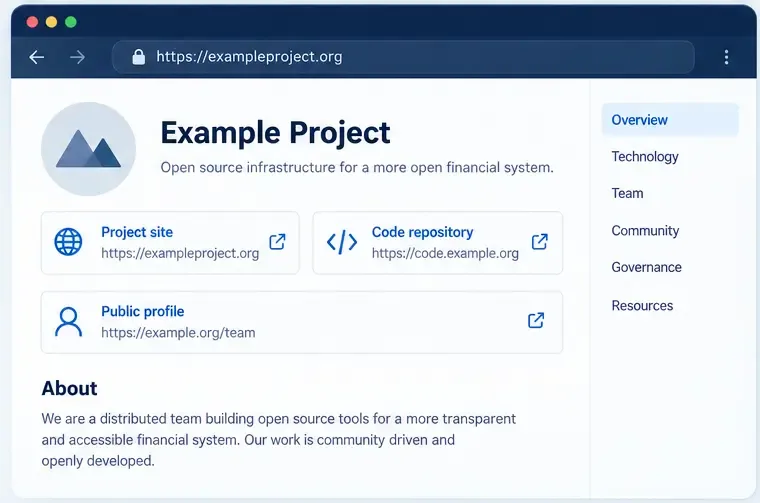
Open the project’s official website, documentation, repository, and public team page from links published by the project itself. Then compare whether the same public handle, role, and project description appear on the linked accounts. A genuine cross-link is more useful than a screenshot supplied in a chat because you can inspect the destination and its history.
Schematic interface illustration: compare only public links that the project itself publishes and that can be checked independently.
Check for small inconsistencies: a different spelling of the name, a newly created account, a repository that is not linked from the project’s own documentation, or a profile that claims a role the organization never mentions. These are prompts for more checking, not proof of fraud. People change employers, usernames, and affiliations, and open-source contributors may use pseudonyms for legitimate safety reasons.
Do not escalate into personal-data hunting. Avoid searching for private addresses, relatives, personal phone numbers, private social accounts, leaked databases, or data-broker reports. Do not publish a suspected legal name merely because it appears in an old document. If the team chooses a pseudonymous model, evaluate the project’s technical and governance safeguards rather than treating anonymity alone as a crime.
Phase two: verify work history and code attribution
Review the repository history for sustained, attributable work: meaningful commits, issue discussions, release notes, pull requests, security fixes, and a consistent technical role. Look for whether the claimed developer actually appears in the project’s history over time, rather than relying on a profile picture or a list of famous advisers.
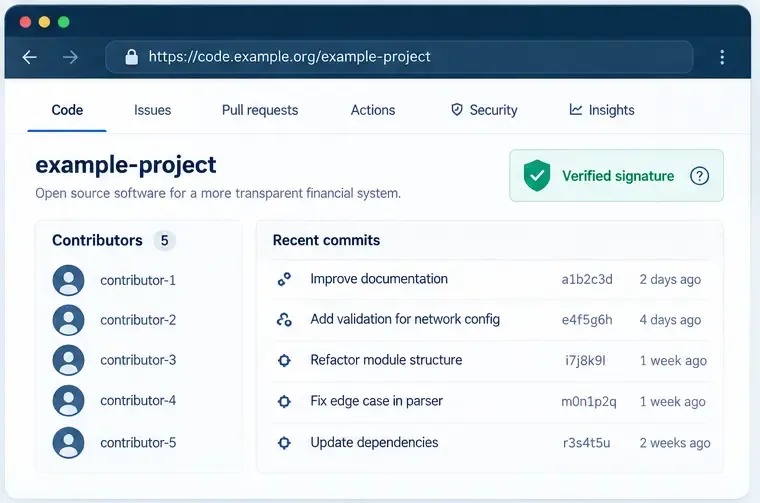
Schematic interface illustration: a verified commit signature is evidence about a signing key and commit, not automatic proof of a person’s legal identity.
GitHub documents verification for GPG, SSH, and S/MIME commit signatures. A verified status can show that a commit was signed by a recognized key under GitHub’s verification process. That is valuable evidence about the relationship between a key and a commit. It is not, by itself, proof that the key belongs to the specific legal person named in a marketing post, nor does it prove that the code is secure.
Use this distinction when scoring evidence. A long history of signed commits under a stable account is stronger than one unverified commit, but it remains technical attribution rather than government-issued identity proof. Read the actual changes, release tags, issue responses, and security disclosures. A developer can be genuine and still ship flawed code; a polished repository can also be maintained by someone other than the person claimed.
Questions that improve the result
Does the project link to the repository from an official documentation page?
Do commit authors, maintainers, and release notes tell a consistent story?
Are security reports acknowledged through a public channel?
Does a claimed employment or open-source history appear in sources controlled by the relevant organization?
Are you mistaking a copied contribution graph or a verified badge for proof of personal identity?
Phase three: check the legal entity and public accountability trail
If the project claims to operate through a company, obtain the legal name and registration number from a public source. Then search the relevant government register yourself. For example, the SEC’s EDGAR system provides public access to filings for companies subject to its reporting system, while the UK Companies House register provides company information, filing history, officers, and other records. These are examples, not universal proof for every jurisdiction or crypto project.
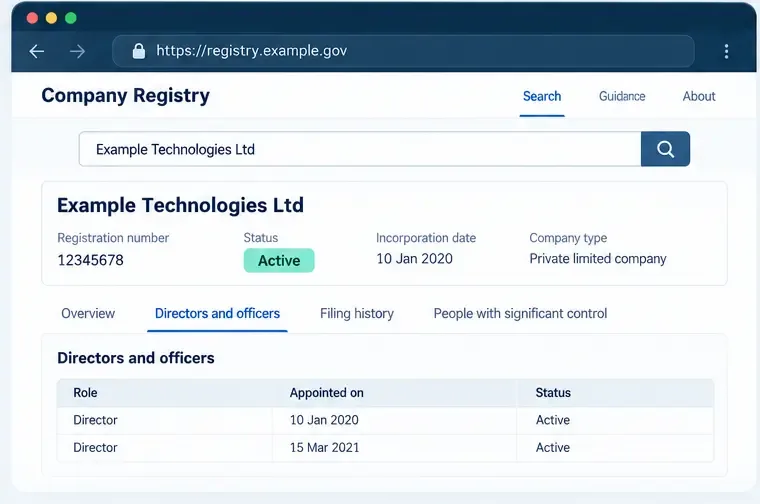
Schematic interface illustration: an official registry can confirm that a company record exists, but the filing still needs to be matched to the project’s own claims.
Match the register entry against the project’s published claims: legal name, jurisdiction, status, directors or officers, filing dates, and the type of activity described. An active company record proves that a record exists; it does not prove that the company is licensed to offer a particular financial product, that every website claim is accurate, or that a listed director personally runs the online account.
Be careful with addresses. A registered office may be a service address and is not a reason to repost a person’s residential location. Record only the minimum information needed to assess the project. If the project claims a license, search the regulator’s own register and check the exact legal entity, scope, and status. Company registration and regulatory authorization are separate questions.
Phase four: test control of public keys without creating a security risk
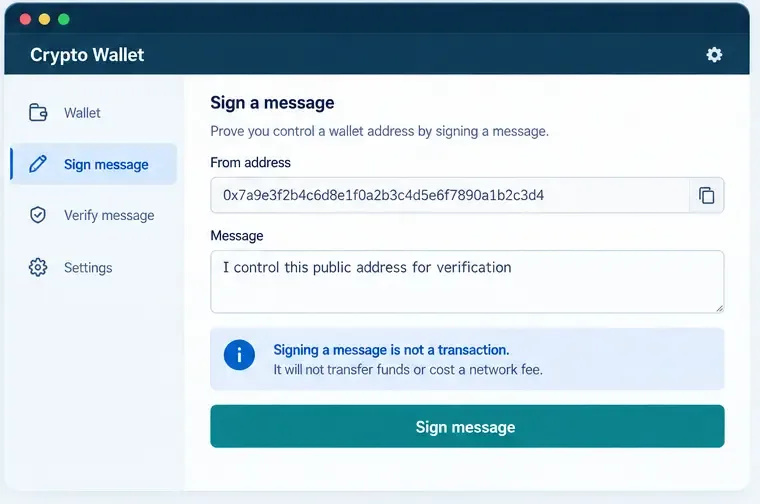
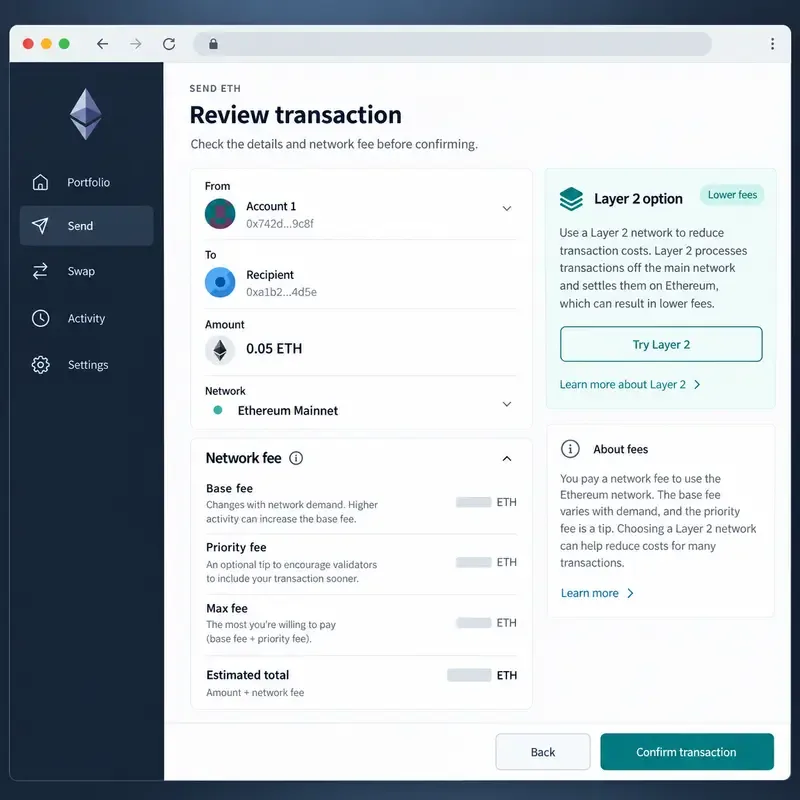
A founder may claim control of a treasury, deployment, or donation wallet. The cleanest public test is a narrowly worded message signed by the claimed address, followed by independent verification of the signature. Ethereum’s ERC-191 standard describes a format for signed data, and wallets or verification tools may implement message signing in different ways. Use a well-understood message and confirm exactly what the wallet is asking you to sign.
Schematic interface illustration: a narrowly worded message can test control of a public wallet address without requesting a seed phrase, private key, or fund transfer.
A safe test message should identify its purpose and avoid transaction-like instructions, approvals, permits, or arbitrary opaque data. For example: “I control public address 0x… for project identity verification on 2026-09-16.” The address should be stated in full in the actual verification record, not shortened in a way that creates ambiguity. A signature can prove control of a wallet at that time. It does not prove the person’s legal name, the source of funds, the safety of the contract, or the absence of undisclosed conflicts.
Never ask anyone to send funds, reveal a seed phrase, export a private key, disable security controls, or sign a transaction that moves assets. If a wallet prompt is unclear, reject it. Investor.gov warns that crypto fraudsters may use impersonation, social media, fake platforms, and demands for extra fees. Identity verification should reduce your exposure, not create a new opportunity to approve a malicious transaction.
How to weigh the evidence
Evidence
What it supports
What it does not prove
Official project links to a public profile
Account association and consistency
Legal identity or honesty
Long, attributable repository history
Technical involvement over time
Code quality or personal identity
Verified commit signature
Control of a signing key for a commit
Who controls the key in the real world
Government company record
Existence of a filed legal entity
Regulatory approval or sound finances
Wallet message signature
Control of a public wallet address
Ownership of a legal identity or safe intentions
Use a decision threshold rather than a binary label. For a small amount you can afford to lose, public cross-links and a coherent technical history may be enough to continue researching. For a substantial investment, custody arrangement, token sale, or role as a service provider, require stronger evidence: a clear legal entity, independently verifiable regulatory status where applicable, transparent governance, documented security practices, and a communication channel that is not controlled by one anonymous account.
When to stop and change your approach
Stop the process if the person pressures you to act quickly, insists that criticism is forbidden, sends you to a private chat for “exclusive” verification, asks for a fee before releasing a withdrawal, or presents screenshots instead of independently checkable records. These signals do not prove a specific crime, but they make the expected value of further engagement worse. Move from identity research to risk avoidance: do not connect a wallet, sign a message, transfer funds, or share personal documents.
Also change your approach when evidence conflicts. Do not fill gaps with guesswork or crowd-sourced accusations. Mark the claim as unverified, ask the project for a public explanation through an official channel, and preserve neutral notes. If money may already be at risk, contact the relevant exchange, bank, regulator, or law-enforcement reporting service through its official website. Do not confront or expose a suspected individual online.
Bottom line
Responsible crypto identity verification is a layered public-source check: define the claim, cross-link intentional public accounts, inspect sustained technical work, verify a claimed company or license in an official register, and use wallet signatures only to test control of a public address. The result should be a documented risk decision, not a public dossier.
The limit matters. No public checklist can guarantee that a founder is trustworthy, that a developer is competent, or that a project will not fail. If a project demands certainty while refusing ordinary accountability, the correct conclusion is not to investigate more aggressively. It is to reduce exposure or walk away.