Home
» Knowledge
»
Troubleshooting P2P Payment Disputes on Crypto Exchanges: When to Wait, Appeal, or Escalate
Troubleshooting P2P Payment Disputes on Crypto Exchanges: When to Wait, Appeal, or Escalate
P2P payment disputes usually become stressful for one simple reason: the crypto and the fiat payment do not move through the same rail. The exchange can hold the crypto in an order or escrow workflow, while the bank transfer, mobile payment, or other fiat transaction is processed by an outside payment provider. When one side says “paid” and the other says “not received,” the right next step depends on what can actually be verified.
The practical goal is not to “win” a chat argument. It is to preserve the safest reversible position while you determine what happened. In most cases, that means keeping the order on-platform, checking the actual payment account rather than trusting a screenshot, saving evidence, and using the exchange’s appeal process if direct communication does not resolve the mismatch.
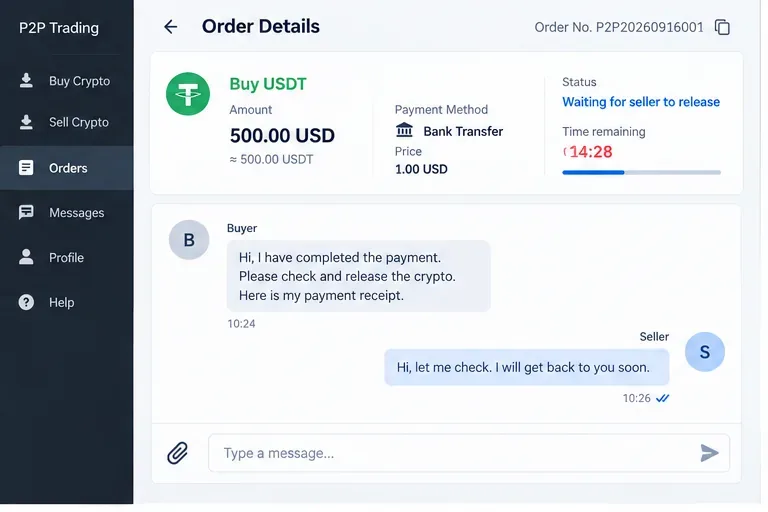
An order chat is useful for clarifying a delay, but the seller should verify the actual payment account before releasing crypto.
First decide what kind of dispute you actually have
Before choosing between waiting, appealing, or contacting an external payment provider, identify the mismatch. The most common cases are:
Buyer paid, seller says payment has not arrived.
Seller received something, but the payer name, amount, or payment method does not match the order.
Buyer marked the order as paid without completing payment.
Buyer paid, but the order timed out or was canceled.
The transaction appears complete, but a later chargeback, refund request, account freeze, or fraud report appears.
These situations look similar inside a chat, but they create different risks. A delayed bank transfer may justify waiting. A third-party payment may justify refusing to release and immediately escalating. A canceled order after payment may require support intervention because the ordinary release button may no longer be available.
Option 1: Wait and verify before escalating
Waiting can be reasonable when the payment was just sent, the payment rail is known to be delayed, and both parties are still responding inside the exchange chat. The advantage is that a routine settlement delay may resolve without a formal dispute. The disadvantage is that waiting too long can consume an appeal window or leave one side exposed if the order status changes.
For sellers, the critical rule is simple: verify the money in the actual receiving account. Do not release crypto solely because the buyer uploaded a screenshot or sent a transaction reference. OKX’s official anti-scam guidance specifically warns that screenshots can be fake or edited and says sellers should verify that the funds actually arrived before releasing crypto. It also advises raising a dispute if payment comes from a third-party account rather than the buyer’s verified identity. See OKX’s scam-protection guidance.
For buyers, waiting is safer when the bank shows the payment as pending rather than completed. If the payment has fully left your account, preserve the transaction record and keep the order open if the platform allows it. Do not cancel merely because the seller asks you to do so after you have paid. OKX’s current cancellation guidance explicitly states that buyers should not cancel an order if they have already paid the seller. See OKX’s P2P order cancellation guidance.
Option 2: Open an appeal when the facts no longer match the order
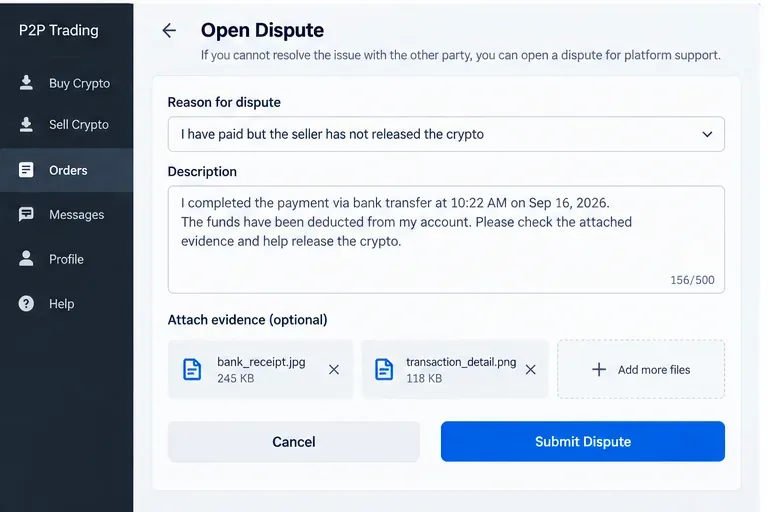
An appeal is usually the better choice when direct chat is not resolving the issue, the counterparty stops responding, the seller will not release after confirmed payment, the buyer marked “paid” without paying, or the payment details do not match the order terms. The advantage is that the platform can review order records, chat history, and submitted proof. The trade-off is that resolution can take time, and an appeal does not guarantee that losses will be recovered.
Binance’s current P2P appeal instructions direct users to the order’s help flow, encourage contact with the counterparty first, and then allow the user to submit an appeal with a detailed description and supporting screenshots. See Binance’s official P2P appeal guide.
Bybit likewise recommends using the order chat before appealing. Its help center states that ongoing orders can be appealed and that canceled or completed orders can be appealed within five calendar days under its current rules. It also warns that its mediation service does not guarantee recovery. See Bybit’s official P2P appeal instructions.
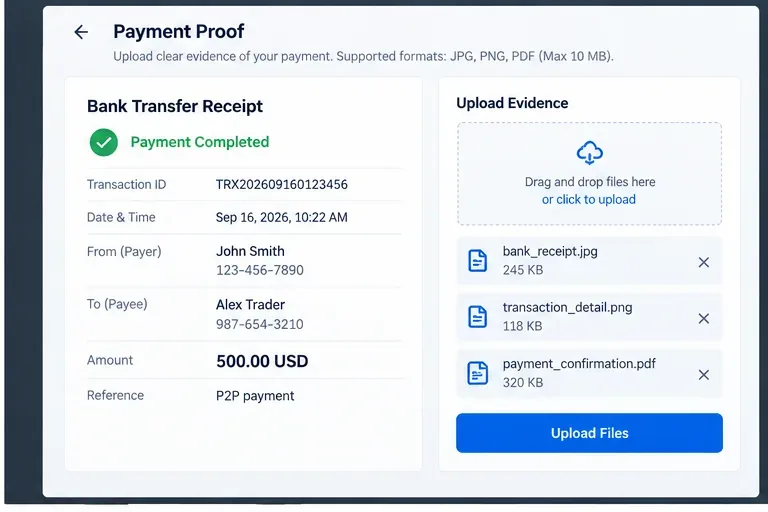
Useful evidence normally ties the payment to the order with the amount, date and time, account holder information, and transaction history.
What evidence is actually useful?
Good evidence proves the transaction path rather than merely repeating a claim. A screenshot saying “payment sent” is weaker than a transaction history that shows the account holder, transfer amount, recipient, date, time, and transaction status.
Bybit’s current appeal instructions are unusually specific: buyers may be asked for a video showing login to the banking app, the account holder name and account number, and the relevant transaction history. Sellers may also be asked to record their account and transaction history. KuCoin’s current P2P appeal process similarly asks users to submit bank statements and relevant screenshots, vouchers, or video proof. See KuCoin’s official P2P order appeal process.
A strong evidence package normally includes:
the P2P order number and order status;
the exact fiat amount and crypto amount;
the payment method selected in the order;
the payer and recipient names as shown by the payment provider;
date and time of payment;
transaction or reference number;
bank or payment-app transaction history showing whether the transfer is pending, completed, reversed, or refunded;
the complete on-platform chat relevant to the dispute.
Redact unrelated balances or transactions where possible, but do not crop away information the exchange specifically requests. If a platform asks for video evidence, follow its instructions rather than substituting a still image.
Option 3: Escalate outside the exchange when the problem is on the fiat side
The exchange can mediate the P2P order, but it does not control the banking system. If your bank shows a transfer as failed, reversed, frozen, duplicated, or sent from an unauthorized account, the bank or payment provider may be the only party that can explain the fiat transaction itself.
This option makes sense when the dispute cannot be resolved by proving the order status alone. For example, a seller may see a payment that later becomes subject to a fraud investigation, or a buyer may see funds debited even though the recipient bank has not credited them. Contacting the bank can establish whether the payment settled, is pending, or is being recalled.
The trade-off is that bank action does not automatically resolve the crypto side of the P2P order. Keep the exchange appeal open when appropriate and update support with any bank confirmation. Do not assume that starting a bank dispute will automatically recover crypto already released.
Third-party payments deserve a different response
If the name on the payment account does not match the verified P2P buyer, the risk is materially different from an ordinary delay. OKX states that third-party payments are not accepted in its P2P rules and warns sellers not to release crypto when a payment arrives from an account that does not match the buyer’s name. The reason is the possibility of triangulation fraud, where money comes from another person who may later report the payment as unauthorized.
Bybit also states that third-party payments are prohibited and, in appeal scenarios involving them, may direct the parties toward a refund rather than completing the order. That is a good example of why “I can see money in my account” is not always enough to justify release: identity matching matters too.
Waiting versus appealing: a practical comparison
Situation
Usually safer first move
Main benefit
Main trade-off
Payment was just sent and still shows pending
Wait briefly and communicate on-platform
Avoids unnecessary escalation
Do not wait past the platform’s appeal limits
Buyer says paid, seller cannot see funds
Seller verifies account; then appeal if unresolved
Prevents release based on screenshots alone
Review may take time
Payment is confirmed but seller will not release
Buyer submits appeal with transaction evidence
Creates a formal review trail
Outcome is not guaranteed
Payer name does not match buyer
Do not release; escalate promptly
Reduces third-party-payment risk
Refund or additional review may be required
Order canceled after buyer already paid
Use the canceled-order support or appeal route
Gives support a chance to reconcile payment and order status
Time limits may apply
Bank reports reversal, fraud, or account freeze
Contact both exchange support and payment provider
Addresses both crypto and fiat sides
Two separate investigations may proceed at different speeds
A useful appeal states the exact mismatch, provides a timeline, and attaches evidence that can be checked against the order.
Do not make these common dispute mistakes
Do not move the conversation to Telegram, WhatsApp, or private chat
Keeping communication in the exchange order chat preserves a record the support team can review. Bybit’s safety guidance explicitly recommends keeping communications on-platform and reporting suspicious behavior through the appeal process.
Do not release crypto because the buyer is pressuring you
A screenshot, SMS, or emailed receipt is not the same as cleared funds in your own account. Verify the balance and transaction history yourself.
Do not cancel after payment just to “restart” the trade
Once fiat has been sent, cancellation can make the dispute harder because the order state may no longer match the payment state. Use the exchange’s help or appeal route instead unless support specifically instructs otherwise.
Do not submit altered or incomplete evidence
Platforms may reject appeals or restrict accounts when users provide false information. Submit original records and follow the requested format.
How platform rules differ
There is no universal appeal window or workflow across exchanges. Bybit currently documents a five-calendar-day window for canceled or completed orders. Binance routes appeals through the P2P order’s Help and Customer Service flow. OKX allows disputes during qualifying P2P problems and says the handling time depends partly on both parties’ responses and the quality of submitted information. KuCoin requests detailed supporting evidence through its appeal form.
Because these rules change, check the help page for the exchange and region you are actually using. Some features and timelines may not apply to every jurisdiction or account type.
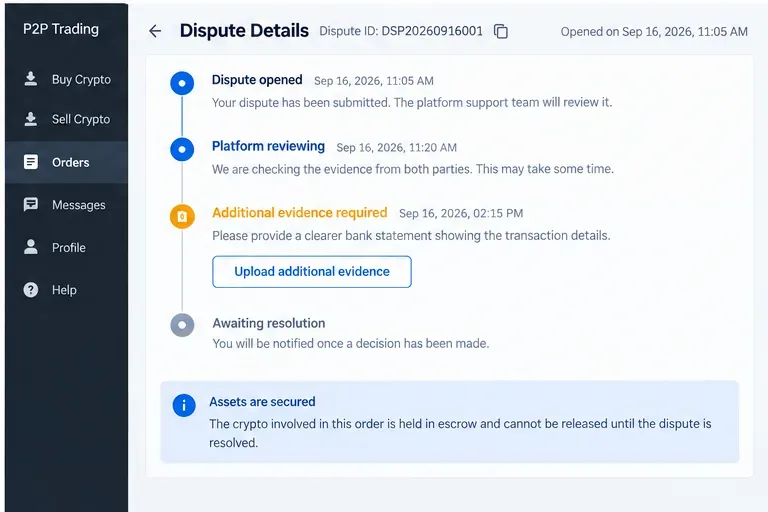
After filing, monitor the case for requests for additional evidence; slow responses can delay or weaken the review.
A decision framework for real disputes
If you are the seller, prioritize proof of receipt over speed. Release only after the payment is visible in the correct account and the payer details comply with the platform’s rules. If the buyer marked the order paid but you cannot verify receipt, keep the crypto locked in the order and use the appeal process.
If you are the buyer, prioritize preserving evidence that the payment actually left your account and went to the payment details shown in the order. If the seller does not release after a confirmed transfer, do not send a second payment. Appeal using the original transaction proof.
If you suspect fraud or a third-party payment, the priority changes from speed to containment. Do not release crypto, do not accept off-platform arrangements, and escalate through the exchange. If the banking side shows unauthorized activity, contact the payment provider as well.
If the issue is simply a processing delay, a short wait may be reasonable, but use a time limit based on the exchange’s appeal rules rather than waiting indefinitely.
Final check before you close the case
Before canceling an appeal or confirming that the dispute is resolved, verify the result independently. Buyers should confirm that the crypto is actually credited or the fiat refund is settled. Sellers should confirm that the payment is received, not merely pending, and that it came from an acceptable payer account. Both sides should save the final order status and any support decision for their records.
P2P disputes are easiest to troubleshoot when every step remains traceable: one order, one payment, one on-platform conversation, and evidence that matches the transaction. The best next action depends on whether the problem is a normal settlement delay, a mismatch in payment details, a canceled order, or a possible fraud event. Choosing between waiting, appealing, and external escalation based on that distinction is more reliable than treating every dispute the same way.