Home
» Knowledge
»
Fake Airdrops and Giveaway Scams: How to Keep Your Crypto Funds Safe
Fake Airdrops and Giveaway Scams: How to Keep Your Crypto Funds Safe
Fake airdrops and crypto giveaway scams succeed because they imitate something that can be legitimate: projects really do distribute tokens, reward early users, run community campaigns, and announce promotions. The safe outcome is not to become suspicious of every promotion. It is to build a repeatable verification process that lets you separate a plausible offer from a request that could expose your wallet, credentials, or funds.
A good safety process should give you three results. First, you should be able to decide whether an offer can be independently verified through official channels. Second, you should understand exactly what your wallet is being asked to sign or approve before you authorize anything. Third, if something has already gone wrong, you should know what to secure, document, revoke, and report without making the situation worse.
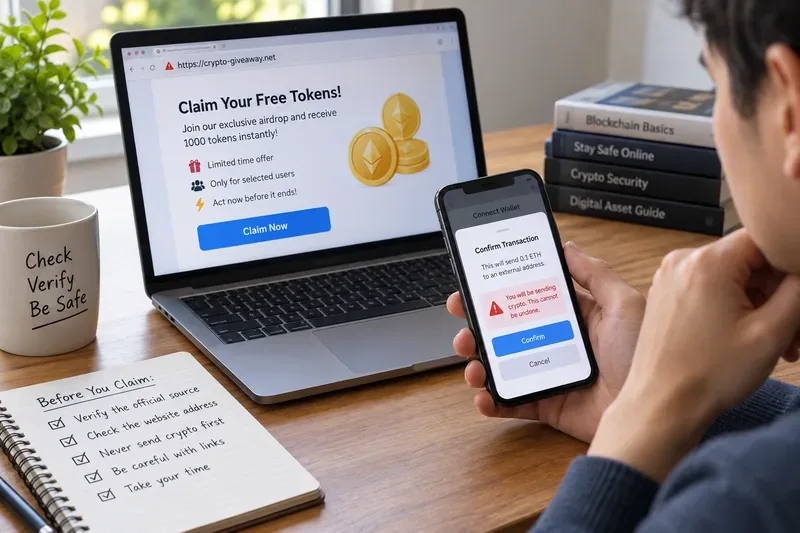
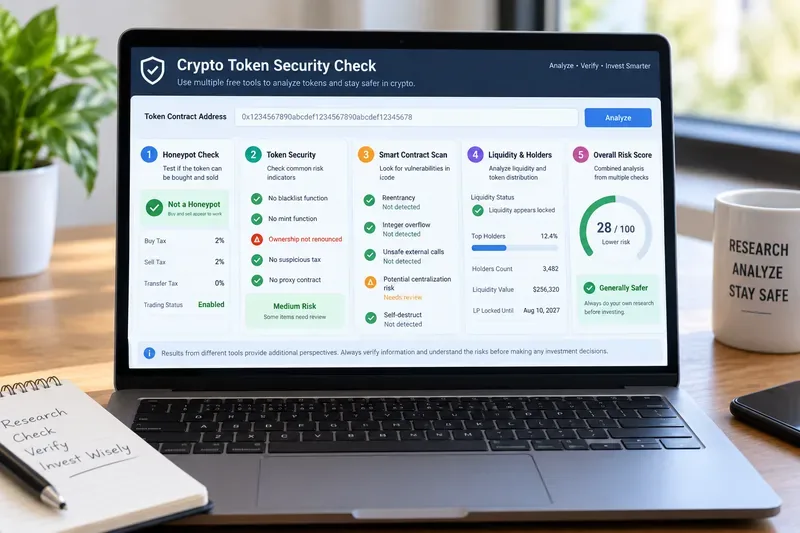
A suspicious “free token” offer becomes much easier to evaluate when you verify the source, inspect the URL, and read the wallet request before approving anything.
What fake airdrops and giveaway scams are trying to make you do
The surface story varies, but the end goal is usually simple: get you to send cryptocurrency, reveal a recovery phrase or private key, sign a harmful message, or approve a smart contract that can move tokens from your wallet.
The Federal Trade Commission warns that scammers often use promises of free money, prizes, or unusually large returns to create urgency and lower a victim's skepticism. It also advises against clicking unexpected links and notes that legitimate prizes should not require you to send money first. See the FTC's guidance on cryptocurrency scams and fake prize and sweepstakes scams.
In Web3, the request can be more subtle than “send us crypto and we will send back more.” A fake claim site may ask you to connect a wallet and approve a transaction that looks routine. MetaMask's official documentation explains that token approvals can give a decentralized application permission to move a specified token on your behalf, and malicious approvals may request excessive or even effectively unlimited access. Its safety guidance describes fake airdrops as a common lure for phishing and harmful approvals. See MetaMask's explanations of token approvals and Web3 safety.
What a successful verification process should prove
Do not judge an airdrop by how polished the page looks, how many replies a social post has, or whether a familiar logo appears. A useful verification process should produce evidence you can trace back to the project's official presence.
1. You can reach the promotion without using the message that advertised it
If an airdrop is real, you should be able to start from a source you already trust: the project's official website, documentation, verified application, or official social account that you reached independently. Do not use the link in an unsolicited direct message, reply, advertisement, search ad, or forwarded post as your only path to the claim page.
The key result is independent reproducibility. If the promotion exists only through the link a stranger gave you, or you cannot find any matching announcement through official channels, stop there.
2. The domain and claim destination match the project's verified information
Scam domains may use extra words, swapped letters, misleading subdomains, or visually similar characters. Read the full hostname before connecting a wallet. A page can copy branding perfectly while sending wallet requests from an unrelated domain or smart contract.
Do not treat a padlock icon or HTTPS as proof that a promotion is genuine. HTTPS means the connection is encrypted; it does not certify that the operator is trustworthy.
3. The economics make sense
A real token distribution may require a network transaction fee, depending on how the claim is implemented, but that is very different from being told to transfer crypto to “unlock,” “verify,” “activate,” or “double” a reward. The FTC specifically warns that demands to send cryptocurrency in advance to receive a prize or free money are characteristic of scams.
A useful rule is to ask what value is moving in each direction. If the alleged giveaway depends on you first sending meaningful funds to an address controlled by someone else, the risk is not a small technical detail; it is the core of the transaction.
Read the wallet request, not the button label
The most important moment often happens after you click “Claim.” A website button can say anything. The wallet confirmation is where you should look for what will actually be authorized.
Check whether the request is a simple wallet connection, a message signature, a token approval, an NFT approval, or an on-chain transfer. These are not equivalent actions. MetaMask notes that connecting a wallet is different from granting token allowances: an approval can authorize a dapp or contract to move tokens, while a connection alone does not automatically give it that power.
What you see
What to verify
When to stop
Connect wallet
Correct site and expected account
The domain is unfamiliar or came only from an unsolicited link
Sign message
Readable purpose and expected domain
The message is opaque, unrelated to the claim, or you do not understand it
Approve token spending
Token, spender, allowance amount, and why approval is needed
The spender is unknown or the allowance is broader than necessary
Send crypto
Recipient, amount, and business reason
You are told payment is required to receive a “free” reward or multiplied return
If you cannot explain the request in plain English, do not sign it yet. The correct response is not to guess. Close the prompt, verify the contract or application through official documentation, and continue only when the requested permission matches the function you intended to use.
Red flags that should change your approach immediately
Some signals are strong enough that you should stop interacting rather than spend more time trying to make the offer fit a legitimate explanation:
You are asked for a seed phrase, Secret Recovery Phrase, private key, or wallet backup words.
You must send cryptocurrency first to receive more cryptocurrency back.
The offer is available only through an unsolicited direct message, reply, or private group.
You are pressured by a countdown, “last chance” warning, or threat that your allocation will disappear within minutes.
The site asks for token approvals that do not match the asset being claimed.
The allowance is extremely large and there is no clear reason for it.
The project's official website and official channels do not mention the event.
Support personnel ask you to move the conversation to a private channel and share secrets or authentication information.
One red flag does not always prove fraud. For example, legitimate decentralized applications may request token approvals. The decision should depend on context: whether the application is genuine, whether the requested permission is necessary, and whether you understand the scope. The quality target is evidence-based confidence, not a checklist score.
Safer habits before you claim anything
Use a dedicated wallet for experimental dapps and token claims rather than exposing a wallet that holds the majority of your assets. Keep long-term holdings separate from accounts used to test new protocols. This does not make a malicious contract safe, but it can reduce the amount exposed if you make a mistake.
Also review token allowances periodically. MetaMask's official documentation recommends checking existing approvals and revoking permissions you no longer need. Revocation is an on-chain action on supported networks and normally requires a network fee, so it is better viewed as ongoing wallet hygiene than as a magical recovery mechanism.
Bookmark official project sites you use often. For high-value activity, verify contract addresses from official documentation rather than relying on names or token symbols, which can be copied. If a promotion is important enough to risk funds, it is important enough to verify from more than one independent official source.
If you already connected, signed, approved, or sent funds
Your response should depend on what actually happened. Simply visiting a page is different from entering a recovery phrase, granting an approval, or sending assets.
If you connected a wallet but did not sign or approve anything
Disconnect the site from your wallet interface if you no longer trust it, close the site, and review whether any separate transaction was submitted. Connection alone generally does not equal token-spending permission, but you should verify your wallet activity rather than assume nothing happened.
If you granted a suspicious token approval
Review and revoke the relevant allowance using a method supported by your wallet or network. MetaMask's official guide explains the distinction between disconnecting a dapp and revoking a smart-contract allowance; disconnecting the site does not necessarily cancel an on-chain token approval. See its guide to revoking smart-contract allowances and token approvals.
If significant assets remain at risk, consider moving unaffected assets to a fresh wallet whose recovery phrase and private keys were never exposed. Do not reuse a seed phrase that may have been compromised.
If you exposed a seed phrase or private key
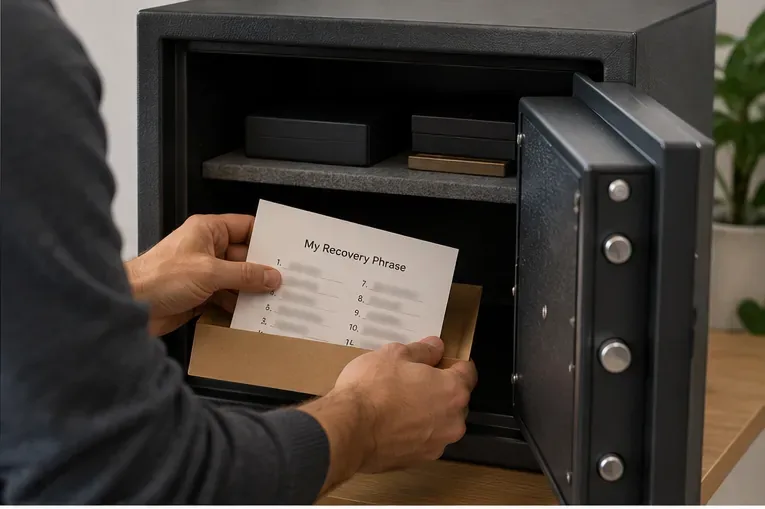
Treat the wallet as compromised. A seed phrase cannot be made secret again after another party has obtained it. Create a fresh wallet using trusted software or hardware and move remaining assets when it is safe to do so. Do not rely on changing a wallet password; a local password does not invalidate a stolen recovery phrase or private key.
If you sent cryptocurrency to a scammer
Act quickly, preserve transaction hashes, recipient addresses, screenshots, messages, usernames, websites, and timestamps. Contact the exchange, wallet provider, or service involved if one was used. The FTC advises victims to contact the cryptocurrency company involved and report the transaction as fraudulent, although cryptocurrency transfers can be difficult or impossible to reverse.
In the United States, the FBI asks cryptocurrency scam victims to report relevant transaction details to the Internet Crime Complaint Center. Its guidance emphasizes wallet addresses, amounts, dates, and transaction IDs, and also warns about follow-up “recovery” scams. See the FBI's IC3 cryptocurrency reporting guidance.
How to judge whether your safety process is working
The goal is not to become faster at clicking through wallet prompts. It is to make fewer decisions based on urgency, branding, or social proof. Your process is working when you can consistently answer these questions before taking an irreversible action:
Where did I independently verify that this airdrop or giveaway exists?
Am I on the exact official domain?
What will this signature or transaction authorize?
Which token, contract, spender, and amount are involved?
Why does this permission need to exist for the stated claim?
What is the maximum amount I could lose if my assumption is wrong?
If you cannot answer those questions, change your approach: stop, verify from official sources, reduce the amount exposed, or skip the claim entirely. Missing an airdrop is usually a limited opportunity cost. Signing a malicious approval or exposing a recovery phrase can put much more at risk.
Limits of any anti-scam checklist
No checklist can guarantee that a smart contract, website, or project is safe. Legitimate sites can be compromised, official social accounts can be hijacked, wallet interfaces can change, and some malicious transactions are difficult for non-specialists to interpret. Security warnings are useful signals, not substitutes for understanding the action you are authorizing.
For unfamiliar or high-value transactions, consider waiting for independent confirmation from the project's official team and security community, using a separate wallet with limited funds, or obtaining technical review before signing. The strongest habit is simple: treat every wallet signature as an authorization decision, not as a routine button press required to reach a reward.