Home
» Knowledge
»
Bybit Copy Trading: How to Follow and Copy Top-Performing Crypto Traders
Bybit Copy Trading: How to Follow and Copy Top-Performing Crypto Traders
Imagine this clearly hypothetical example: Jordan has 500 USDT available for speculative crypto trading and is considering allocating 100 USDT to Bybit Copy Trading. Jordan does not want to choose a Master Trader simply because one profile shows the highest recent return. Instead, the goal is to understand what is actually being copied, compare performance and risk metrics, set limits, and know when to stop.
That distinction matters because copy trading is not a shortcut around risk. Bybit describes Copy Trading as a portfolio-management tool that lets Followers copy trades made by Master Traders. For Copy Trading Classic, the copied market is currently USDT perpetual contracts. Bybit also states that past Master Trader performance does not guarantee future results, and a Follower's return can differ because of factors such as slippage and different entry points. The current product overview is available in Bybit's official Copy Trading introduction.
What Bybit Copy Trading actually does
When you begin copying a Master Trader, eligible trades opened after you start following can be mirrored in your Copy Trading account according to the copy mode and parameters that apply to your setup. You do not retroactively inherit the trader's earlier positions. Bybit's follower guide also says that one account can follow up to 10 Master Traders at the same time.
As of September 2026, Bybit's Copy Trading Classic FAQ says Followers need Individual KYC Level 1 or Business KYC, and USDT is the supported investment asset for this product. Product availability and requirements can vary by jurisdiction, so check what your account actually displays before funding anything. See the official Copy Trading Classic FAQ for current eligibility details.
Step 1: Open Copy Trading and confirm you are in the right product
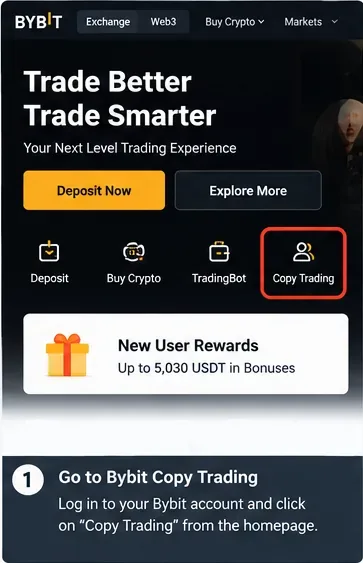
Step 1 — Open Copy Trading from your Bybit account. The screen shown is an illustrative interface example, not a record of a live account or test.
Jordan first signs in through the official Bybit website or app and opens Copy Trading. This sounds basic, but it prevents a common mistake: following links from social posts, private messages, or search ads and assuming the landing page is genuine.
Before proceeding, Jordan checks that the product is Copy Trading Classic for USDT perpetuals rather than a different Bybit product. That matters because Copy Trading Pro and TradFi Copy Trading have different mechanics and documentation. This guide focuses on the Classic follower workflow described in Bybit's official follower setup guide.
Step 2: Browse Master Traders, but do not rank them by ROI alone
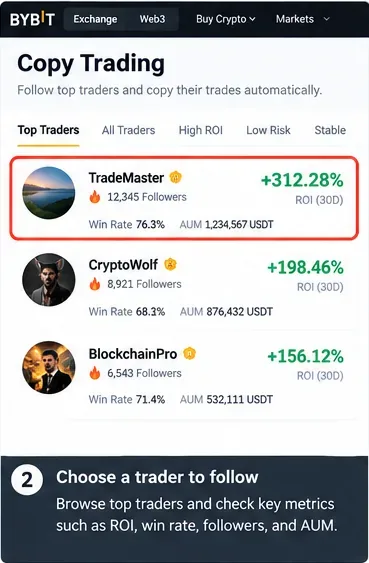
Step 2 — Browse Master Traders and compare several metrics. All names and numbers in this image are fictional examples and are not endorsements or verified performance results.
Suppose Jordan sees three Master Traders. One has a very high 30-day ROI, another has a lower ROI but smaller drawdowns, and a third has a long trading history with steadier results. The tempting choice is the first one. A better process is to ask what produced the return and what risk accompanied it.
Bybit publishes definitions for performance metrics such as ROI, Master's P&L, win rate, follower P&L, average P&L per trade, and maximum drawdown. In its official explanation, maximum drawdown measures the largest unrealized loss over the stated period; a smaller drawdown can indicate that the strategy experienced less severe declines during that window. You can review the definitions in Bybit's Master Trader performance guide.
Jordan therefore treats a leaderboard as a discovery tool, not as a ranking of what will perform best next. High ROI may come from leverage, concentration, a short favorable period, or a style that does not match Jordan's tolerance for losses.
A practical comparison checklist
Metric or behavior
What Jordan asks
Why it matters
ROI
Over what period was it earned?
A short burst of performance may not describe a full market cycle.
Maximum drawdown
How large was the worst decline?
Return without drawdown context hides part of the risk.
Win rate
Are winning trades small while losses are large?
A high win rate is not automatically a profitable or low-risk strategy.
Trading history
Is there enough history to observe different conditions?
More observations can reveal whether results depend on one market regime.
Open positions and style
Does the trader use leverage or concentration Jordan understands?
The Follower inherits exposure to the trader's decisions.
Profit-sharing ratio
What percentage of eligible profit is shared?
This affects the Follower's net result.
Step 3: Open the trader profile and examine the risk behind the headline
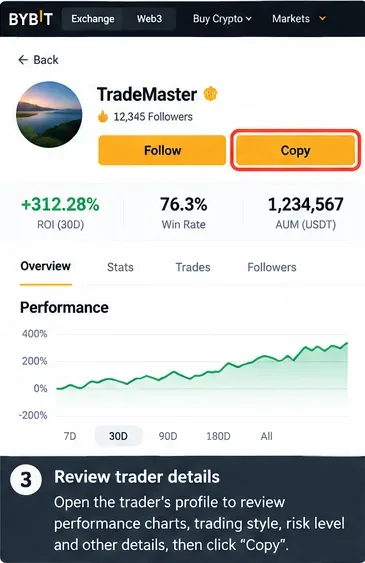
Step 3 — Open a Master Trader profile and inspect the history and risk metrics before copying. The profile data shown is hypothetical and should not be interpreted as real Bybit performance.
In the hypothetical example, Jordan narrows the list to one trader but still does not press Copy immediately. Jordan checks the performance chart, recent trades, drawdown, trading frequency, and whether the strategy seems understandable.
Bybit notes that follower and Master Trader results can diverge. Slippage, execution timing, different balances, and copy settings can change the Follower's entry price and position size. This means a displayed Master Trader ROI should never be treated as a promised follower return.
Jordan also checks the profit-sharing ratio. Bybit's current Copy Trading Classic documentation states that the percentage varies by Master Trader rank. The platform's official profit-sharing guide explains how the system calculates and settles profit share. The exact ratio visible on the profile should be reviewed before copying because it affects net profitability.
Step 4: Choose an investment amount and understand the copy mode
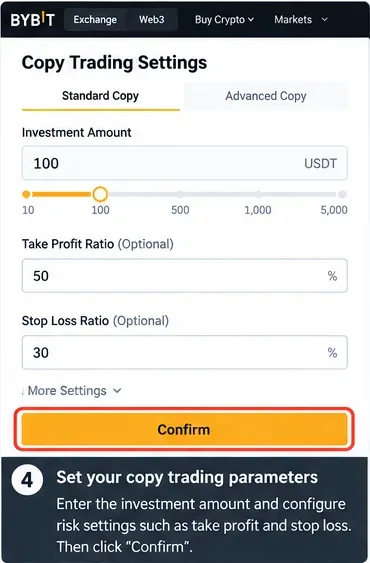
Step 4 — Set an investment amount and review the copy parameters before confirming. The layout is illustrative; use the labels and options shown in your live Bybit account as the authoritative interface.
Jordan has 500 USDT available but chooses 100 USDT for this illustrative trial. This is not a recommendation for a specific allocation. The point is to define the maximum capital exposed to the strategy before the first copied trade arrives.
Bybit currently documents two main modes in Copy Trading Classic: Smart Copy Mode and Advanced Copy Mode. Smart Copy aims to mirror the Master Trader's portfolio risk using a proportional relationship between the Follower's and Master's available balances. Advanced Copy lets the Follower configure a fixed margin for each copied trade. Bybit explains these settings in its official copy-mode and parameter guide.
Jordan therefore decides based on intent rather than convenience. If the objective is to mirror the Master's relative sizing more closely, Smart Copy is the relevant mode to study. If Jordan understands position sizing and wants a fixed margin per order, Advanced Copy offers more control but can produce a position structure that differs from the Master's when order sizes vary.
There is another important limitation: SyncMaster. Bybit says that when a Master Trader has enabled Forced Sync, Followers may be unable to modify certain USDT perpetual parameters and may only be able to enter the investment amount or set Copy Stop Loss under the available settings. If Jordan sees a SyncMaster or Forced Sync notice, the correct response is to read what is being synchronized before proceeding, not to assume the settings are fully customizable.
Step 5: Review the final setup before starting
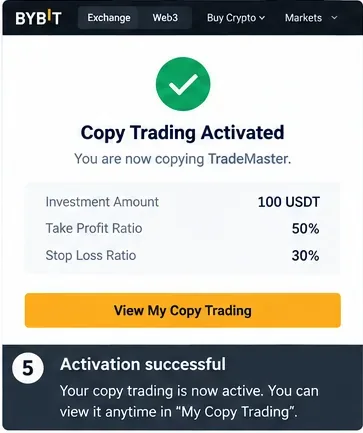
Step 5 — Confirm only after the investment amount, risk settings, and profit-sharing terms match your plan. The displayed values are hypothetical.
Before Jordan confirms, the setup gets one last review: investment amount, copy mode, any available take-profit or stop-loss controls, the Master's profit-sharing ratio, and the acknowledgement required by Bybit.
This is where Jordan asks a useful question: “If this trader has a bad week immediately after I start, is the amount at risk still acceptable?” If the answer is no, the position is too large regardless of the trader's historical ROI.
Bybit's documentation also warns that if a Master Trader's position in a trading pair is liquidated, corresponding follower positions in the same direction can be closed. Because these are perpetual derivatives, leverage can amplify both gains and losses. Copying does not remove liquidation risk.
Step 6: Monitor your own copied results, not just the Master's profile
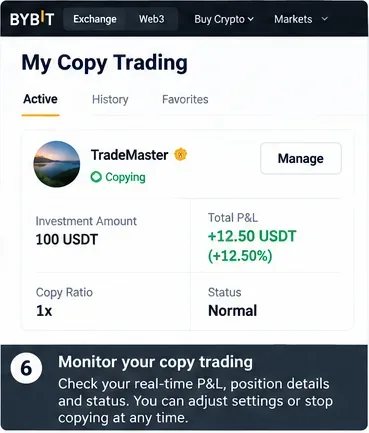
Step 6 — Use the follower dashboard to track your own copied positions and P&L. The profit shown here is fictional and is not a claimed result.
After copying begins, Jordan watches the Follower dashboard rather than repeatedly checking only the Master's headline ROI. Bybit's Follower User Center displays information such as cumulative investment, equity, P&L, ROI, current copy trades, and follow history. The formulas and dashboard definitions are documented in the official Follower User Center guide.
This distinction is important. Jordan's actual result can differ from the Master's because Jordan started later, may have different parameters, and may receive different execution prices. A good monitoring routine therefore focuses on the Follower's own equity and drawdown.
Step 7: Adjust, reduce, or stop when the strategy no longer fits
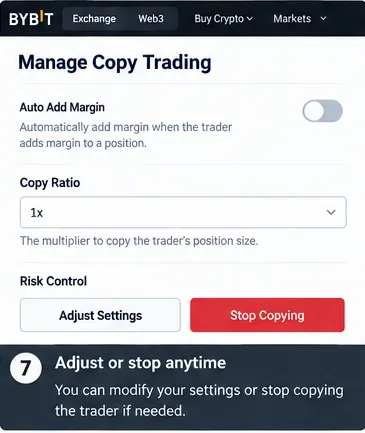
Step 7 — Reassess the strategy after it is live. Adjustment or stopping is a risk-management decision, not an admission that the original choice was wrong.
Jordan sets review rules before emotions take over. For example, Jordan may decide to reconsider the relationship if the trader's behavior changes materially, drawdown rises beyond the range Jordan expected, leverage becomes uncomfortable, or the strategy no longer matches the original reason for following it.
Bybit lets Followers edit copy settings, adjust investment, set available TP/SL controls, close copied positions, and cancel copying through the follower workflow. Reducing or stopping is therefore part of normal risk management. It should not be delayed simply because a Master Trader previously appeared near the top of a leaderboard.
One subtle point is that stopping copying and closing positions are not always the same action. Before making a change, read the confirmation screen carefully so you know whether existing positions remain open or are being closed.
Step 8: Use mobile access for monitoring, not impulsive changes
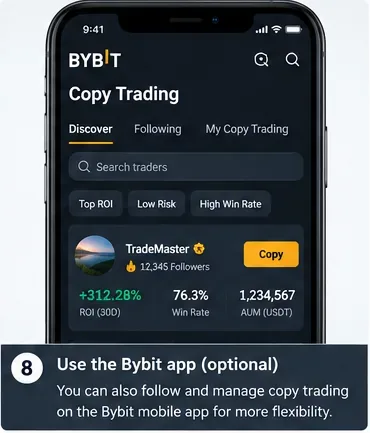
Step 8 — Mobile access can make monitoring convenient, but the same review process should apply before changing settings or following another trader. The screen and statistics are illustrative.
The Bybit app can make Copy Trading easier to monitor away from a desktop. Jordan uses mobile access for status checks and alerts, but not as a reason to react to every short-term fluctuation. Frequent switching between Master Traders can turn a structured copy strategy into performance chasing.
How Jordan decides whether the setup is working
After several review periods, Jordan does not ask only, “Am I in profit?” A stronger evaluation looks at whether the result matches the assumptions made at the beginning.
Is the Master Trader still using a strategy Jordan understands?
Is the realized and unrealized drawdown within the amount Jordan was prepared to tolerate?
Are Jordan's copied entries and results reasonably aligned with expectations, allowing for slippage and timing differences?
Is profit sharing materially changing the net return?
Has the trader's leverage, concentration, frequency, or risk profile changed?
Would Jordan still choose this trader today if the recent P&L were hidden?
If the answer to the final question is no, recent gains may be anchoring the decision more than the underlying strategy.
Common mistakes when choosing “top-performing” traders
Chasing the highest recent ROI
A trader can rank highly after a concentrated winning period. That does not tell you how the strategy behaves during an adverse market. Pair ROI with drawdown, history, and position behavior.
Assuming copy trading reproduces the same percentage return
Bybit explicitly warns that Followers may not achieve the same ROI because entry points, execution, balances, and slippage can differ. A copied signal is not a guaranteed duplicate result.
Allocating too much before observing the strategy
The hypothetical Jordan starts with only part of the available speculative capital because uncertainty remains even after careful analysis. The appropriate amount depends on your financial situation and risk tolerance; this example is not personalized investment advice.
Ignoring profit sharing and derivatives risk
Profit sharing reduces the net amount retained from profitable copy trading periods, while USDT perpetual positions can use leverage and can be liquidated. Both belong in the decision before you press Copy.
Bottom line
Bybit Copy Trading can automate the mechanical task of following a Master Trader's USDT perpetual activity, but it does not outsource the decision about how much risk you should take. The useful workflow is: verify the product, compare several Master Traders, examine risk as well as return, choose an investment amount and copy mode deliberately, monitor your own follower results, and change course when the original assumptions no longer hold.
In Jordan's hypothetical case, the most important outcome is not whether the 100 USDT ends in profit. It is whether every step was based on a defined risk budget, understood settings, and observable evidence rather than a leaderboard headline. That process cannot eliminate losses, but it makes the decision more transparent and easier to reassess.