Yield aggregators promise a simple idea: deposit an asset once, let a vault automate the repetitive work, and receive a share of whatever yield the strategy can generate. The attraction is obvious. Manually claiming rewards, swapping them, adding liquidity again, moving between lending markets, and deciding when gas costs justify another transaction can turn a passive-looking DeFi position into an active job.
As of September 2026, the most useful development is not a single new “magic” yield product but the continued standardization of vault architecture. ERC-4626 defines a common interface for tokenized vaults with one underlying ERC-20 asset, while finalized extensions such as ERC-7540 add asynchronous deposit and redemption flows and ERC-7575 extends the model to multi-asset vault designs. These standards can make integrations more consistent, but they do not make a vault safe or profitable by themselves.
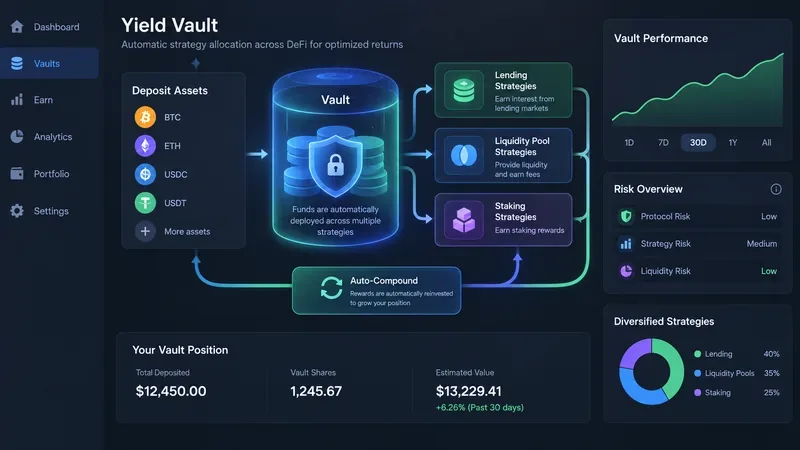
A yield aggregator can bundle deposits into a vault, deploy them through one or more strategies, harvest rewards, and reinvest the proceeds; the illustration shows that workflow rather than a specific protocol interface.
What a yield aggregator actually automates
A yield aggregator is a DeFi application that places user funds into one or more smart-contract strategies and automates tasks that would otherwise require repeated manual transactions. Depending on the vault, the strategy may lend assets, provide liquidity, stake tokens, harvest incentive rewards, swap those rewards, add them back to the position, or move capital among approved opportunities.
The basic accounting model is usually share-based. You deposit an underlying asset and receive vault shares representing your proportional claim on the vault. ERC-4626 formalizes this pattern by defining standard deposit, mint, withdraw, redeem, preview, and accounting functions. The share price can rise as the strategy earns yield, although losses, fees, slippage, bad debt, impermanent loss, token depegs, or protocol incidents can push the economic value the other way.
Yearn's current V3 vault contracts illustrate the architecture clearly. The official Yearn V3 vault repository describes an ERC-4626-compliant vault that can distribute depositor funds among strategies using the same underlying asset. The code also states an important limitation: the vault itself does not guarantee the safety of the strategies selected for it. Automation is therefore a management layer, not a substitute for due diligence.
Where the extra return is supposed to come from
Yield aggregators do not create yield from nothing. They package and automate yield sources that already exist elsewhere in DeFi. A lending strategy may earn borrower interest and token incentives. A liquidity strategy may earn trading fees plus liquidity-mining rewards. A staking strategy may receive protocol emissions or validator-related rewards. A leveraged strategy may borrow against collateral to increase exposure, which can magnify gains and losses.
Auto-compounding can improve efficiency when rewards are frequent and transaction costs are meaningful. Instead of every depositor paying separately to claim and reinvest, the vault can aggregate the operation and spread execution costs over a larger pool. Beefy's official vault documentation, for example, explains that its vaults can harvest farm rewards, trade them into the required assets, and reinvest them so the position compounds automatically.
That is why an aggregator's advertised annual percentage yield, or APY, can exceed the simple annual percentage rate, or APR, of the underlying farm. APY includes an assumption about compounding. The difference matters most when rewards are earned continuously or frequently and can be economically reinvested. It matters less when yields are low, rewards are sporadic, fees are high, or the underlying rate falls soon after deposit.
Why “maximum returns” should not mean “highest APY”
A headline APY is not the same thing as a realized return. It is often an annualized estimate based on current or recent conditions. Incentive emissions can decline, token prices can change, utilization rates can fall, and the cost of swapping rewards can rise. A vault showing an unusually high APY may simply be taking exposure to a volatile reward token or a thin liquidity pool.
A more useful comparison starts with the return path. Ask what produces the yield, what assets the vault must hold, which outside protocols it depends on, and what happens when conditions change. A 12% yield from a mature overcollateralized lending market and a 40% yield from a newly launched farm are not interchangeable products merely because both appear in the same vault interface.
It is also important to separate strategy return from token return. If a vault compounds more LP tokens but one of the LP assets falls sharply, the position can still lose value in dollars. If a stablecoin vault earns 8% but the stablecoin loses its peg, the yield may be overwhelmed by the asset loss. If a leveraged vault earns a strong rate but crosses a liquidation threshold during volatility, compounding becomes irrelevant.
The layers of risk inside an automated vault
1. Vault contract risk
The vault itself can contain implementation bugs, accounting errors, upgrade risks, or privileged roles. Standardization helps developers and integrators reason about common interfaces, but it does not prove that a particular implementation is secure.
2. Strategy risk
The strategy contract decides how the deposited asset is used. A vault that can switch among strategies may add allocation risk: a strategy that was acceptable when you deposited could later receive more capital, less capital, or be replaced depending on the protocol's governance and permissions.
3. Dependency risk
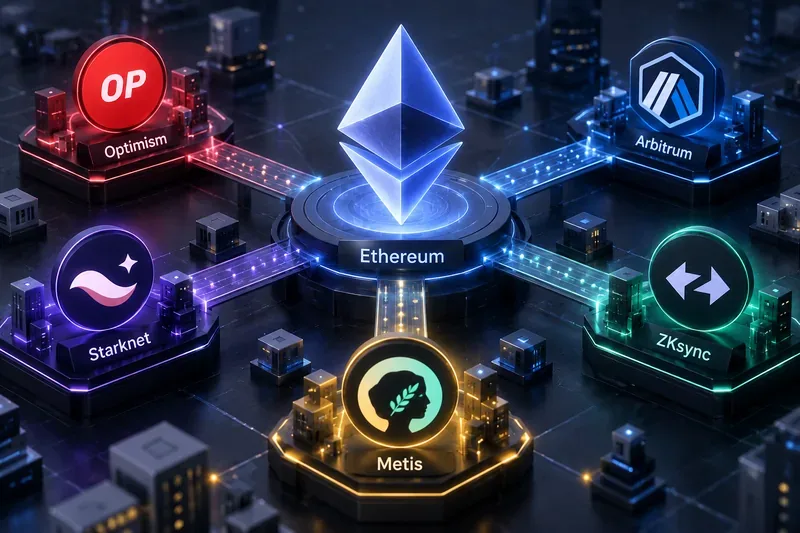
Most aggregators sit on top of other DeFi protocols. A lending vault depends on the lending market. An LP vault depends on the exchange pool, its tokens, and often a reward distributor. A cross-chain vault may introduce bridge or messaging risk. The aggregator can therefore inherit vulnerabilities from contracts it did not write.
4. Share-pricing and slippage risk
Tokenized vaults convert between assets and shares. The ERC-4626 specification warns integrators not to treat conversion functions and preview functions as interchangeable because fees and slippage can cause materially different outcomes. OpenZeppelin's ERC-4626 implementation guide also documents the well-known inflation or donation attack problem affecting empty or nearly empty vaults and discusses mitigations such as virtual assets and shares.
5. Liquidity and exit risk
“Withdraw anytime” can mean different things operationally. Some strategies hold highly liquid assets and can redeem quickly. Others need to unwind LP positions, repay loans, wait for an unstaking period, or process an asynchronous request. ERC-7540 exists specifically because some vault use cases cannot complete deposits or redemptions atomically. Users should therefore check the actual exit mechanics rather than assume every vault behaves like a spot wallet balance.
How fees change the economics
Aggregator fees can include performance fees, management fees, withdrawal fees, swap costs, underlying protocol fees, and implicit trading slippage. A vault can still be attractive after fees if automation increases net compounding efficiency, but the correct comparison is net return after all layers of cost.
For a simple example, suppose an underlying farm produces a 10% gross APR. If a vault takes a performance fee from harvested profits, pays swaps to convert reward tokens, and occasionally incurs slippage, your realized yield will be lower than the gross source yield. Auto-compounding may add some return back by reinvesting rewards earlier, but it cannot guarantee that the compounding benefit exceeds every cost in every market environment.
This is why fee disclosures should be read together with harvest frequency and strategy design. A high-frequency strategy on an expensive chain may spend more on execution. A large pooled vault can sometimes amortize those costs more effectively than a small individual position.
Single-strategy vaults versus multi-strategy vaults
Single-strategy vaults are easier to understand because the capital path is relatively direct: one deposit asset, one strategy, one main yield source. The tradeoff is concentration. If the underlying farm becomes unattractive or risky, the vault may need a strategy migration.
Multi-strategy vaults can spread capital across several opportunities and rebalance as conditions change. That can reduce dependence on a single source of yield, but it adds complexity. Users must understand who controls allocations, what limits are placed on each strategy, whether changes require governance or trusted roles, and how losses are reported back to the vault.
Neither structure is automatically superior. The better fit depends on whether you prioritize transparency and simplicity or broader allocation flexibility.
A practical checklist before depositing
Identify the underlying asset. Know whether you are exposed to a stablecoin, volatile token, LP token, liquid-staking token, or another vault share.
Trace the yield source. Confirm whether returns come from lending interest, trading fees, staking, token incentives, leverage, or a combination.
Read the strategy contract and protocol documentation. Do not rely on the APY number alone.
Check withdrawal mechanics. Look for lockups, queues, asynchronous redemption, liquidity limits, withdrawal fees, or conditions that can delay an exit.
Review fee layers. Include aggregator fees, underlying protocol fees, swaps, bridge costs, and expected slippage.
Check governance and privileged roles. Determine who can add strategies, change allocations, pause deposits, upgrade contracts, or move funds.
Look at audits and incident history. An audit is useful evidence, not a guarantee. Confirm whether the exact contracts or strategy family you plan to use were covered.
Use a position size that reflects smart-contract risk. DeFi yield is not equivalent to an insured bank deposit.
How to judge whether the automation is working for you
The simplest test is not whether the displayed APY rises. It is whether your net position is improving relative to a reasonable alternative after fees, token-price changes, and risk. Track the number of underlying assets represented by your shares, the dollar value of the position, changes in the source yield, and any new dependencies added to the strategy.
If the vault's return falls while complexity rises, a simpler position may become more attractive. If gas costs are high and your position is small, pooled automation may save enough execution cost to justify a performance fee. If the vault adds leverage, cross-chain exposure, or low-liquidity reward tokens, the higher projected yield should be evaluated against those additional failure modes.
Bottom line
Yield aggregators are best understood as automation engines for DeFi strategies, not machines that manufacture returns. Their main advantages are operational efficiency, pooled transaction costs, automatic harvesting and reinvestment, and—in some designs—allocation across multiple strategies. Standards such as ERC-4626 make the vault layer easier to integrate, while ERC-7540 and ERC-7575 broaden the design space for asynchronous and multi-asset products.
The tradeoff is layered risk. A depositor is exposed not only to the vault contract but also to strategy logic, the underlying protocols, the assets involved, liquidity conditions, governance, fees, and sometimes bridges or leverage. The most useful way to pursue higher returns is therefore not to sort vaults by APY from highest to lowest. Start with the source of yield, understand how the automation changes that exposure, calculate the likely net return, and decide whether the added complexity is worth it.