Home
» Knowledge
»
Forex Lot-Size Calculator by Risk Percentage: A 40-Pip Worked Example
Forex Lot-Size Calculator by Risk Percentage: A 40-Pip Worked Example
A forex lot-size calculator turns three decisions into a position size: how much account equity you are willing to risk, where the stop-loss belongs, and how much each pip is worth in your account currency. The stop distance is central: for the same dollar risk, a wider stop usually means a smaller position.
Here is the short worked example. A hypothetical $10,000 account risks 1%, or $100, on a EUR/USD trade. Entry is 1.0850 and the stop is 1.0810, a 40-pip distance. If one standard lot has an approximate value of $10 per pip in a USD account, the position is 0.25 standard lots, or 25,000 euros. That estimates a $100 loss at the stop before spread, commission, slippage, and financing. The 1% is an arithmetic example, not a recommendation about how much anyone should risk.
Lots = risk budget ÷ (stop distance in pips × pip value per lot in the account currency)
For unit-based platforms, the same idea is expressed as units rather than lots: divide the risk budget by the expected loss per unit at the stop. The first currency in a pair is the base currency; the second is the quote currency. The account currency matters because the pip value may need to be converted from the quote currency. Brokers may display order size in units, lots, or contract quantities, so confirm the contract specification and minimum trade increment in the platform you use.
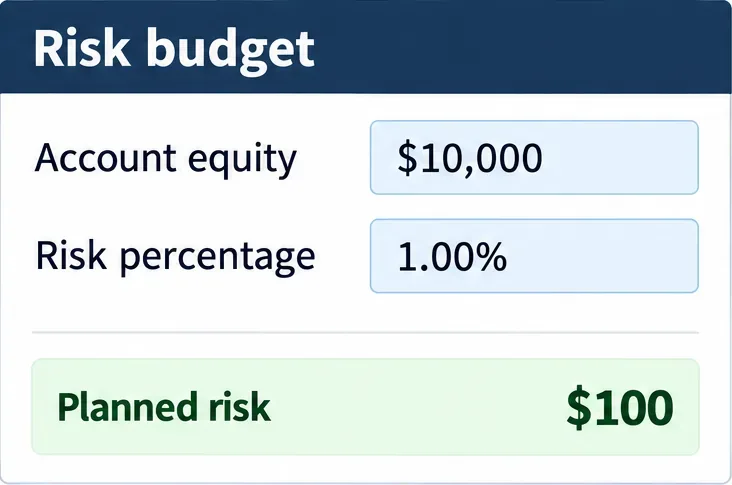
The first calculator step multiplies the chosen account equity by the illustrative risk percentage to find the cash risk budget.
Worked example: $10,000 account, 40-pip stop
Choose the account value and percentage. For this example, use $10,000 of equity and 1%. The calculation is $10,000 × 0.01 = $100. If a trader instead entered 0.5%, the cash risk budget would be $50. The percentage should be a deliberate personal limit; no percentage makes a trade safe or profitable.
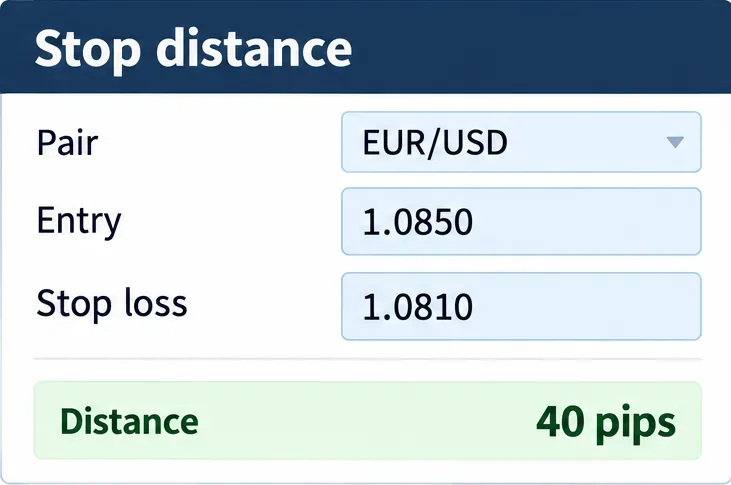
Measure the stop distance. For a hypothetical long EUR/USD trade, use an entry of 1.0850 and a stop at 1.0810. The price difference is 0.0040. For most non-yen pairs, one pip is 0.0001, so 0.0040 ÷ 0.0001 = 40 pips. If the trade is short, measure the absolute distance between entry and stop instead of subtracting in a fixed direction.
Find pip value in the account currency. EUR/USD is quoted in U.S. dollars. With the conventional 100,000-euro standard lot, a 0.0001 price move is approximately 100,000 × 0.0001 = $10 per pip. This familiar standard-lot relationship is a convention, not a guarantee that every broker or product uses the same contract size. Some platforms let customers enter individual currency units instead.
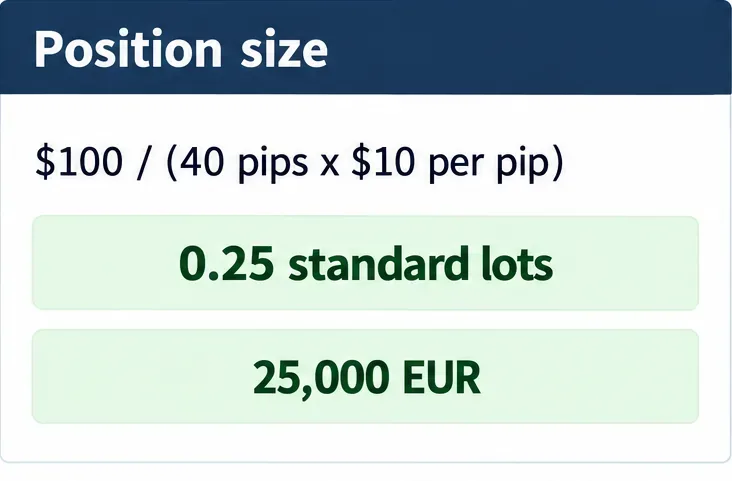
Divide the risk budget by the stop loss in money. A 40-pip stop on one standard lot would be about 40 × $10 = $400 before costs. Divide $100 by $400: $100 ÷ $400 = 0.25 standard lots. At 100,000 euros per standard lot, that is 25,000 euros of base currency.
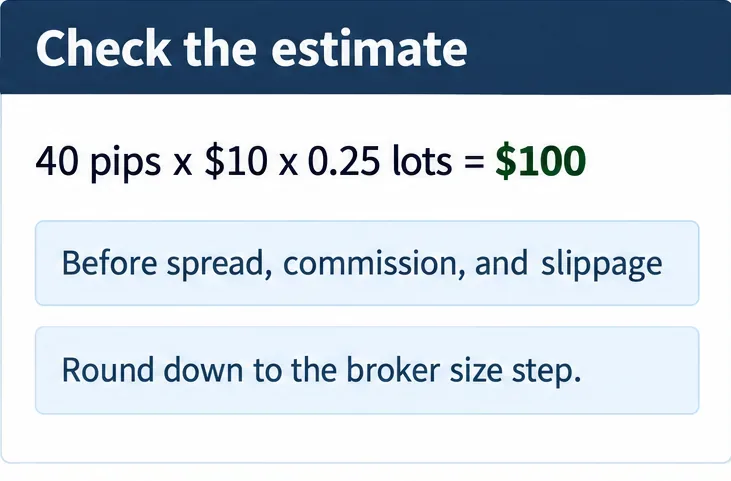
Recheck the estimate. Forty pips × about $10 per pip × 0.25 lots = about $100. If the platform’s size increment is coarser than 0.25 lots, round down to a permitted size or skip the setup; rounding up can exceed the intended budget.
For most non-JPY currency pairs, a 0.0040 EUR/USD gap equals 40 pips; yen pairs commonly use a 0.01 pip increment.Dividing the cash risk budget by the stop loss per standard lot gives the estimated position size.
Which sizing choice fits your situation?
Choice
Useful when
Trade-off to check
Risk percentage of equity
You want the cash risk estimate to scale as account equity changes.
Open gains or losses change equity; decide whether your process uses current equity or closed-trade balance and apply it consistently.
Fixed cash risk
You prefer a stable dollar amount for each trade.
A fixed amount becomes a larger percentage after the account declines and a smaller percentage after it grows.
Lot-based calculator
Your platform requires standard, mini, or micro lot entries.
Lot definitions and order increments depend on the broker, product, and platform; verify the specifications.
Unit-based sizing
Your platform accepts currency units and you need finer size increments.
Convert units into the platform’s display convention before placing the order so you do not confuse units with lots.
Stop placement also involves a choice. A fixed pip distance is quick to calculate and compare, but it can put a stop at a level unrelated to the reason for entering. A structure-based or volatility-aware stop may fit a trading method better, but its distance changes from trade to trade and therefore changes the lot size. The practical sequence is to decide where the trade idea is invalidated, measure that distance, and then size the position to the chosen cash-risk limit. Do not move a stop closer solely to justify a larger lot if the tighter stop no longer fits the plan.
What changes the answer?
Account currency differs from the quote currency: convert pip value using the relevant exchange rate. For a USD/JPY trade in a USD account, for example, the pip value is in yen and must be converted to dollars. Use a calculator that identifies both the pair and account currency, and check that its exchange-rate input is current.
Yen pairs or fractional pip displays: many yen pairs use 0.01 as a pip, while some platforms show an additional fractional pip or “pipette.” Enter the stop in pips using the platform’s definition, not simply the last displayed decimal.
Spread and commission: the theoretical example measures entry-to-stop price movement and excludes costs. A wider spread or commission increases the trade’s real cost. Check whether the sizing calculator includes those charges or only the price distance.
Execution and gaps: a stop-loss is an exit instruction, not a guaranteed maximum-loss amount. Fast markets or low liquidity can produce execution away from the trigger price. Leave room in the budget for this uncertainty rather than assuming the calculated loss is exact.
Margin: required margin is the collateral needed to open or maintain a leveraged position; it is not the same as the planned loss at the stop. A broker may allow a position whose margin requirement appears affordable even though its loss exposure is too large for the trader’s risk limit.
Before submitting an order, verify the arithmetic, account-currency conversion, costs, and permitted size increment.
A quick pre-trade check
Is the balance or equity figure the one your risk rule calls for?
Did you choose the stop based on the trade plan before calculating size?
Does the stop distance use the correct pip convention for this pair?
Is pip value expressed in the same currency as the risk budget?
Does the order size fit the broker’s contract size, increment, and minimum?
Have you accounted for spread, commission, possible slippage, and other open positions?
In the example, changing only the stop distance shows why the calculator matters: with the same $100 budget and approximate $10-per-pip value per standard lot, a 20-pip stop implies 0.50 lots, while an 80-pip stop implies 0.125 lots. Both target the same planned loss before costs, but they are not interchangeable trade plans. The wider stop has a smaller position and the nearer stop has a larger position; the suitable stop depends on the setup, not on which result looks more attractive.
Forex is leveraged and carries substantial risk. A position-size calculation can make the planned exposure clearer, but it cannot predict a market move, prevent slippage, or ensure that a stop executes at its trigger price. Investor.gov warns that forex losses can be substantial and, depending on the arrangement, may exceed the initial amount deposited. Review your broker’s product terms and jurisdiction-specific protections before trading.
Sources and definitions
For pip conventions, including common yen-pair and fractional-pip examples, see OANDA’s pip guide. For the common relationship between standard, mini, and micro lots and unit-based order sizes, see OANDA’s lot-size help page; these are platform conventions and should be checked against the product being traded. For stop-order limitations, see OANDA’s stop-loss overview. For general retail forex and leverage risks, consult Investor.gov’s forex bulletin.