Home
» Knowledge
»
Coins vs. Tokens: What Is the Difference in Cryptocurrency?
Coins vs. Tokens: What Is the Difference in Cryptocurrency?
Coin and token are often used as if they mean the same thing, but the distinction matters when you are choosing an asset, paying a network fee, checking a project, or designing a blockchain product. In the most useful technical sense, a coin is the native asset of a blockchain, while a token is an asset created on top of an existing blockchain or ledger.
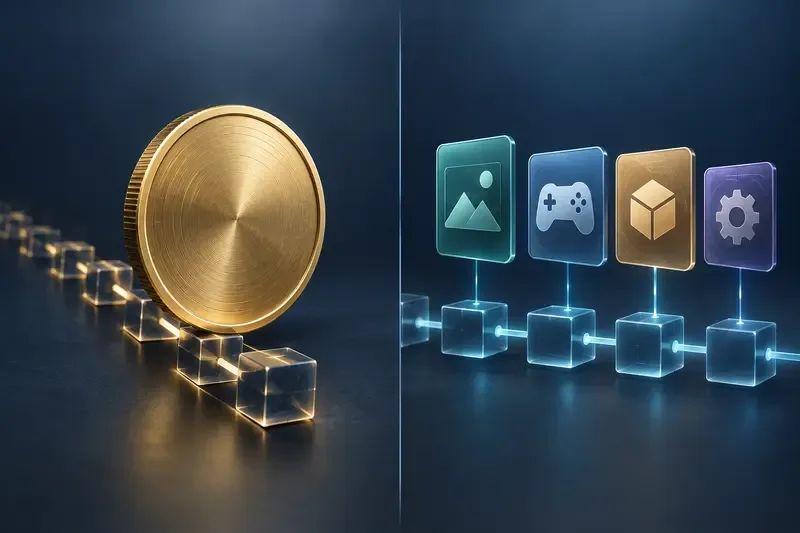
A conceptual comparison: the coin is shown with its own blockchain, while multiple tokens are shown using a shared blockchain platform.
That rule is a starting point, not a guarantee about an asset's quality, price, decentralization, or legal status. Some projects use the word “coin” for branding, and many general-audience sources use “cryptocurrency” for both categories. To make a sound comparison, look at where the asset is recorded, what pays for transactions, who controls its rules, and what the asset is meant to do.
The short answer: native asset versus application-layer asset
A coin belongs to the base protocol of its own network. Bitcoin (BTC), ether (ETH), and SOL are commonly described as coins because each is native to a particular blockchain. A native asset can be used to transfer value, but it may also pay transaction fees or help secure the network. Ethereum's official documentation identifies ether as Ethereum's native cryptocurrency and explains that users pay gas fees in ETH and validators stake ETH to help secure the network. You can review the description in Ethereum's official overview of ether and the Ethereum network.
A token is normally defined by a smart contract or token program that runs on an existing network. It can represent a stable-value asset, a governance right, an in-app credit, a claim recorded by an issuer, a collectible, or another digital asset. On Ethereum, the ERC-20 standard provides a common interface for fungible tokens, including functions for balances, transfers, total supply, and spending approvals. The original specification is available in Ethereum Improvement Proposal 20.
Comparison point
Coin
Token
Where it originates
Native to its own blockchain
Created on an existing blockchain or ledger
Who defines its behavior
Base protocol and network governance
Smart contract, token program, issuer, and host network
Typical fee role
Often pays the network's transaction fee
Usually requires the host network's native coin for fees
Typical examples
BTC, ETH, SOL
ERC-20 assets, SPL tokens, stablecoins, NFTs
Main tradeoff
Greater protocol responsibility and infrastructure complexity
Faster issuance and programmability, but added contract and issuer risk
How the technical models differ
Coins are part of the network's base accounting
A native coin is handled by the blockchain's core rules. Bitcoin's developer documentation describes a transaction as spending specific unspent transaction outputs, or UTXOs, denominated in satoshis. The receiving wallet treats an output as spendable only when the required cryptographic conditions are met. This is different from calling a contract that maintains a separate token balance table. The technical details are documented in Bitcoin Core's developer guide to transactions.
Native coins often have a second job: keeping the network operational. Depending on the protocol, coins may pay validators or miners, compensate block producers, deter spam, or participate in staking. This makes the coin's economics closely tied to network usage and security. It does not mean every coin has the same supply model or that a coin is automatically more decentralized than a token.
Tokens are defined by contracts or token programs
Tokens usually add a layer of application-specific logic. An ERC-20 contract can record balances and provide standardized transfer and approval functions. The standard is valuable because wallets, decentralized exchanges, and other applications can interact with many contracts through a familiar interface. However, the standard does not by itself prove that a token is safe, solvent, fairly distributed, or free of privileged controls.
Other networks use different designs. Solana's official token documentation describes a token mint, token accounts, mint authority, freeze authority, and instructions for minting, transferring, approving delegates, burning, and changing authority. In other words, “token” is not synonymous with “Ethereum token.” The exact program, account model, permissions, and wallet compatibility depend on the network. See Solana's official SPL Token Basics documentation before treating an SPL asset as equivalent to an ERC-20 asset.
Which is cheaper or easier to create?
For a team that wants to represent an in-app balance, loyalty unit, governance right, or stable-value claim, issuing a token is usually the more practical route. The team can use an established chain's consensus, wallets, explorers, and developer tools instead of building validators, node software, fee markets, and security assumptions from scratch. Standard interfaces can also make integration easier.
The tradeoff is dependence. A token inherits the host network's availability, congestion, transaction fees, technical changes, and standards. The project may also depend on a contract owner, upgrade authority, mint authority, freeze authority, bridge, custodian, or administrator. A token can be easy to launch but difficult to operate responsibly.
Creating a native coin for a new blockchain offers more control over monetary policy, transaction rules, fee design, and consensus. That flexibility is justified only when the project genuinely needs its own settlement environment or security model. It brings substantial costs: protocol engineering, audits, validator incentives, wallet and exchange support, monitoring, incident response, and the challenge of attracting enough independent network participation. A new coin is not automatically a better product simply because it has its own chain.
Which one should you use for a particular need?
To pay a network fee: hold the native coin of the network you are using. An Ethereum token transfer still generally needs ETH for gas, while a Solana token transaction uses SOL for network fees under Solana's fee model.
To use a decentralized application: use the token required by that application, but keep enough native coin to approve and settle transactions. Confirm the network and contract address before sending.
To hold a stable-value representation: a token may be the relevant instrument because stablecoins are commonly issued as tokens on existing networks. Evaluate reserves, redemption terms, issuer controls, chain support, and counterparty risk separately from the token label.
To participate in governance or an application economy: a token can be appropriate when its rights are clearly defined. Read the contract, governance rules, distribution schedule, and voting limitations rather than assuming the token gives ownership of the project.
To build a normal Web3 application: start by testing whether an established token standard on a suitable network meets the requirement. Consider a native coin only if the application needs network-level control that a contract cannot provide.
To seek long-term exposure to a blockchain network: analyze the native coin's role in fees, security, supply, and governance. A token connected to an application is a different economic claim, even when both assets trade in the same market.
What are the biggest risks when comparing coins and tokens?
The first risk is confusing the symbol with the asset. A ticker can be copied, reused, or displayed on multiple networks. Verify the blockchain, contract address, token standard, and official project documentation. Sending an asset to the wrong network or an incompatible address can make recovery difficult or impossible.
The second risk is underestimating administrative powers. Check whether an authority can mint more units, pause transfers, freeze accounts, change fees, upgrade the contract, blacklist addresses, or withdraw assets. These powers may be legitimate for a regulated or operational product, but they create a different risk profile from a system designed to minimize unilateral control.
The third risk is treating interoperability as a guarantee. A token standard can improve compatibility inside one ecosystem, but bridges and wrapped assets add another layer of contracts and custodianship. A representation of BTC on another chain is not the same as native BTC on the Bitcoin network; its value and redeemability depend on the mechanism that backs and moves it.
Finally, neither label answers the investment question. Coins and tokens can both be volatile, illiquid, concentrated, exploited, frozen, delisted, or affected by legal and regulatory developments. The category helps you understand the architecture; it is not a quality rating.
A practical checklist before you buy, use, or build one
Identify the exact network and whether the asset is native or contract-issued.
Record the official contract address or mint address; do not rely on a ticker alone.
Find the asset's fee path: which native coin is required for transfers and approvals?
Check liquidity, custody, bridge design, redemption terms, and concentration of ownership.
Match the asset to the purpose: payment, fee, security, governance, utility, collectible, or representation.
Test a small transaction only after confirming the network, destination, and wallet compatibility.
Bottom line
Coins are native to a blockchain and often support its fees and security. Tokens are created within an existing network and can represent many programmable forms of value or rights. A coin is usually the better fit when you need the network's base asset; a token is usually the better fit when you need an application-specific asset without launching a complete blockchain. The right choice depends on control, security, cost, interoperability, and purpose—not on the label alone.
Verification note: The technical descriptions and links in this article were checked against the linked primary documentation on September 16, 2026. Blockchain standards, software documentation, contract permissions, and project terms can change, so verify the current official documentation before taking action.