Home
» Knowledge
»
Binance Launchpad and Launchpool: How to Participate and Earn New Tokens
Binance Launchpad and Launchpool: How to Participate and Earn New Tokens
Binance Launchpad and Launchpool can both give users early access to newly introduced crypto assets, but they are not the same activity. Launchpad may use a structured token sale in which eligible users commit BNB and receive a pro-rata allocation. Launchpool is generally a farming program: you lock an eligible asset such as BNB or a designated stablecoin and receive project tokens as airdrop rewards. The practical goal is not simply to press a button. It is to finish with a verified account, a clear understanding of what is locked or spent, a record of the event terms, and a plan for what you will do with the new token.
Binance’s current educational guide describes Launchpad as the broader token-launch platform and Launchpool as one mechanism within it. The exact asset list, reward pool, dates, caps, distribution schedule, and regional eligibility can change from one project to another. Read the live project page and its announcement before committing funds. The official Binance Launchpad and Launchpool guide was updated on June 29, 2026, while Binance’s support article for Launchpool was updated on March 25, 2026.
Launchpad vs. Launchpool: what is the real difference?
Criterion
Launchpad
Launchpool
Primary action
Commit BNB, or another asset if the event says so, toward a token sale.
Lock supported assets to farm airdrop rewards.
What happens to the committed asset?
A portion of the committed asset may be deducted to pay for the allocated tokens.
The locked asset remains yours and is returned when you unlock or when the event finishes, subject to the project terms.
How allocation is determined
Usually by your eligible commitment relative to the total commitment, with a user cap.
By your share of the relevant pool and the time or hourly balance used for the calculation.
Main uncertainty
Your final allocation may be much smaller than the amount you committed.
The reward may be modest, while the locked asset can change in market value.
Binance’s Launchpad subscription explanation says the final allocation is based on the ratio of a user’s committed BNB to the total committed BNB and that a maximum allocation cap can apply. By contrast, the live Launchpool page says rewards are distributed according to each user’s proportion of the total locked amount, with airdrops accumulated hourly. These descriptions are useful for understanding the mechanism, not for predicting a particular return.
A four-part process for participating responsibly
1. Confirm that the account and jurisdiction are eligible
Start with identity verification and regional availability. Binance’s support documentation says Launchpool participation requires a completed identity verification process and residence in an eligible jurisdiction. It also warns that country and region restrictions are not exhaustive and can change as local rules evolve. Do not try to bypass a restriction with a VPN, another person’s account, or inaccurate identity information. If the event is unavailable in your account, the correct result is to stop rather than improvise.
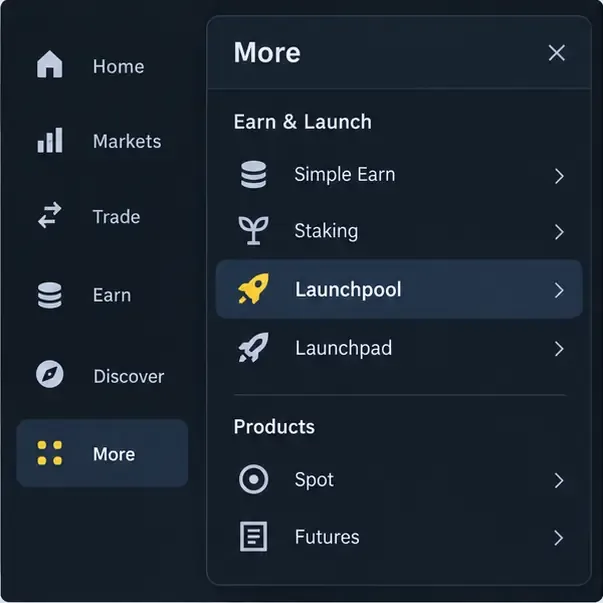
The entry point shown here is an illustrative interface: open the relevant Binance menu and choose the current Launchpool or Launchpad area available to your account.
Also check whether the event is available through the web interface, the mobile app, or a supported Earn product. Binance states that some BNB held in designated Simple Earn products can automatically count for Launchpool and HODLer Airdrops, while BNB pledged as collateral for certain Binance Loans is excluded. This is a detail worth checking because “holding BNB” and “holding eligible BNB” are not always identical.
2. Read the project page before moving funds
Do not treat a headline APY or a large reward pool as the whole offer. Open the project details and record:
the farming or subscription start and end times, including the displayed time zone;
the supported asset or pool, such as BNB, FDUSD, USDC, or another specifically named token;
the reward pool and how it is divided among pools;
the minimum and maximum amounts, if any;
the distribution, claim, unlock, and listing arrangements;
jurisdiction exclusions, KYC rules, and any event-specific conditions.
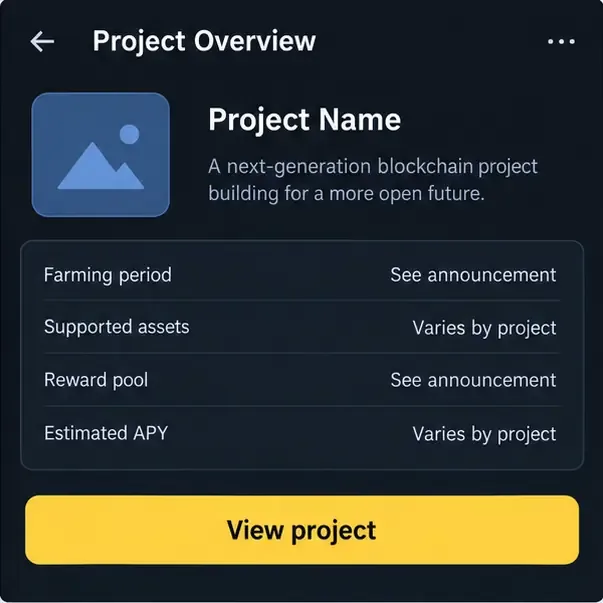
Review the event’s farming period, supported assets, reward pool, and estimated APY; each value can vary by project and should be taken from the current announcement.
For Launchpool, Binance says balances and total pool balances may be captured multiple times each hour to calculate hourly average balances. That means entering just before the end is not equivalent to participating throughout the full event. It also means the displayed estimate can change as the total pool grows. For Launchpad, the average BNB balance or other eligibility measurement may be recorded during a defined preparation period, and the commitment window comes later. The event announcement controls the details.
3. Choose whether the mechanism fits the money you are willing to expose
Use Launchpool when retaining ownership of the underlying asset matters and you accept that the reward depends on pool participation and time. Choose a stablecoin pool, where available, if your main concern is reducing direct exposure to BNB price movements; this does not remove stablecoin, exchange, liquidity, or token risks. Use Launchpad only when you understand that the committed asset may be exchanged for the new token and that your allocation may be capped or diluted by demand.
Do not buy BNB solely to chase a headline reward without comparing the likely reward with the downside of the asset. A simple stress test is useful: ask what happens if BNB falls during the event, the new token falls after listing, or the reward is smaller than expected. If that outcome would force you to sell at an uncomfortable time, reduce the amount or skip the event.
4. Lock, commit, monitor, and verify the result
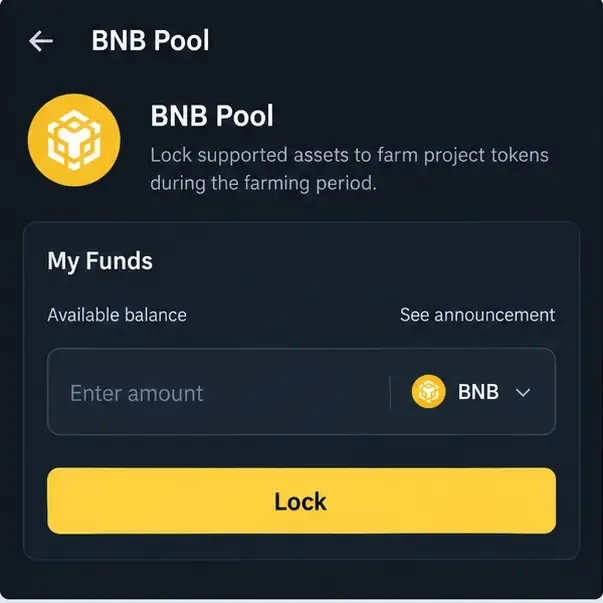
For a Launchpool event, select the project, choose an eligible pool, enter an amount, and confirm the lock. The page should show the position in “My Funds.” Binance’s support guide says you can use “Unlock” to redeem assets at any time, although early exit ends further earning on the amount removed. Accrued rewards may be claimable before the event ends, and unclaimed rewards plus locked assets are automatically transferred to the Spot Account after the locking period, subject to the stated processing time.
Enter only the amount you intend to expose, confirm the selected pool and asset, and then use the Lock control shown on the project page.
For a Launchpad event, follow the project’s subscription steps, review the maximum commitment and final allocation rules, and confirm the transaction only after checking how much BNB could be deducted. The support explanation says Binance calculates final allocations after the commitment period and then transfers both the new tokens and any remaining BNB to the Spot Wallet.
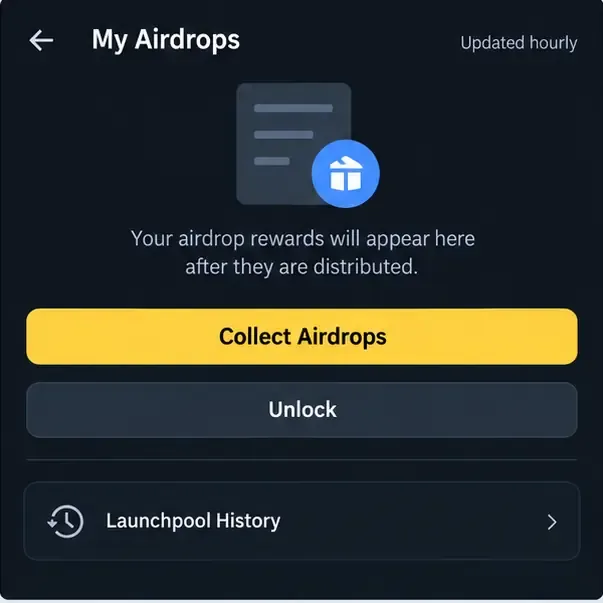
After joining Launchpool, verify the hourly reward area, collect available airdrops when appropriate, and use the history view to reconcile the result.
How to judge whether participation worked
A successful process has observable signs. Your account passes eligibility checks; the correct project and pool appear; the locked or committed amount matches your confirmation; the reward balance updates according to the event’s schedule; and the final assets arrive in the expected Spot Wallet or other stated destination. Save the official announcement, confirmation screen, and transaction history. If the amount, asset, or timing does not match, stop adding funds and contact Binance Support through the official site.
Measure the result in both tokens and dollars, but do not confuse an airdrop quantity with profit. The new token can lose value, have limited initial liquidity, or be subject to vesting and unlock schedules. Include the opportunity cost of holding BNB or a stablecoin, trading fees if you later sell, and any tax reporting obligations in your jurisdiction. A positive token balance is not proof that the strategy was profitable.
When should you change your approach?
Change from BNB to a stablecoin pool: when you want less direct BNB price exposure and an eligible stablecoin pool offers acceptable terms.
Reduce the position: when the pool becomes crowded, the estimated reward falls, or the event’s downside exceeds your planned risk.
Unlock early: when you need the underlying funds, the asset’s market risk has become unacceptable, or the remaining reward no longer compensates for the exposure.
Skip the event: when your region is restricted, the project information is unclear, or participation would require borrowing or concentrating too much of your portfolio.
Important limits and safety checks
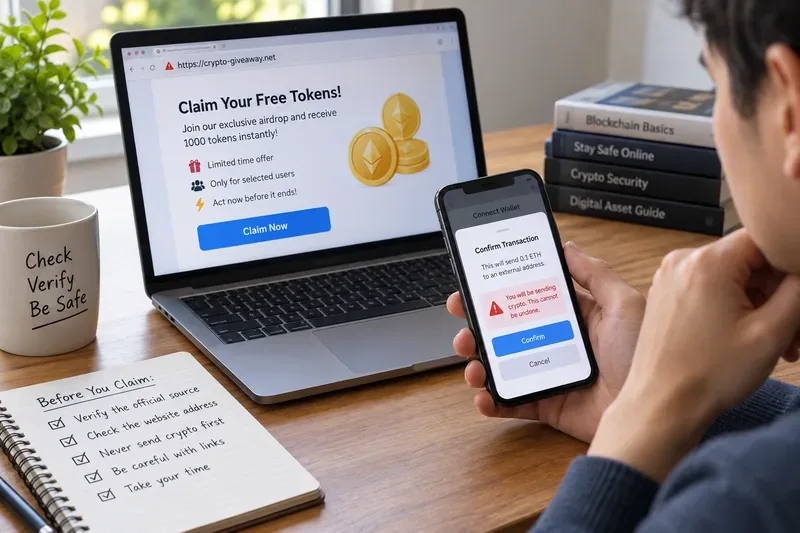
Launchpad and Launchpool do not guarantee a return. Binance itself warns that virtual-asset prices can be volatile and that users are responsible for their own investment decisions. Platform access, eligible products, reward calculations, and regional rules can change. A project’s appearance on a launch platform is not a guarantee of long-term adoption or token performance. Use only the official Binance domain or app, ignore unsolicited links and direct messages, enable account security controls, and never share a password, passkey, or one-time code.
Before confirming, use this short checklist: “Am I eligible? What exactly is locked or spent? When is the snapshot or farming window? What is the maximum loss I can tolerate? Where will the reward arrive? What will I do if the token drops?” If you can answer all six from the official event information, you are in a better position to decide. If you cannot, waiting is a valid outcome.
For the latest event-specific terms, consult Binance’s Launchpool support article, the live Launchpool page, and the individual project announcement before participating.