Home
» Project analysis
»
Undervalued DeFi 3.0 Gems Ready for a Massive Breakout? 5 Protocols to Research in 2026
Undervalued DeFi 3.0 Gems Ready for a Massive Breakout? 5 Protocols to Research in 2026
Updated September 14, 2026. “DeFi 3.0” is not an official technical standard, and “undervalued” is not a fact that can be proven from a project’s documentation alone. A protocol can have rising deposits, real revenue, better token mechanics, or strong integrations and still be overpriced. The useful question is narrower: which DeFi protocols have verifiable operating progress that the market may not be fully rewarding yet?
This article uses that question to build a research watchlist. It separates what is verified from what depends on market conditions and what remains unknown. None of the projects below is guaranteed to rally, and “massive breakout” should be treated as a scenario to investigate, not a forecast.
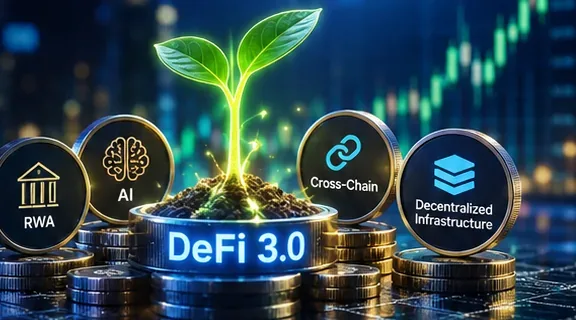
A conceptual view of DeFi 3.0 themes: real-world assets, automation, cross-chain infrastructure, and growth built on usable financial products.
What “DeFi 3.0” Means in This Article
There is no universal DeFi 1.0/2.0/3.0 taxonomy. Here, DeFi 3.0 is shorthand for a newer phase in which protocols are trying to move beyond short-lived liquidity incentives toward modular infrastructure, institutional distribution, tokenized real-world assets, sustainable fee models, and products that can be embedded inside mainstream financial apps.
Common misconception: a protocol becomes “DeFi 3.0” simply by adding a new token or marketing label. That is not a useful test. The better evidence is product architecture, recurring usage, integrations, revenue quality, and a token model that can plausibly capture value.
Action: ignore the label at first. Ask whether the protocol solves a recurring financial problem and whether usage would still make sense without unusually high token subsidies.
What “Undervalued” Can and Cannot Tell You
Undervaluation is a relative judgment. To support it, an investor normally compares a token’s market value with variables such as protocol revenue, active capital, growth, circulating supply, dilution, fee capture, governance rights, competitive position, and future cash-flow potential. Primary project sources are excellent for product facts and token mechanics, but they do not establish a fair market price.
Common misconception: high TVL or assets under management automatically means the token is cheap. It does not. Capital can be temporary, subsidized, low-margin, or weakly connected to the token.
Action: before buying, calculate the token’s current market capitalization and fully diluted valuation using live market data, then compare those figures with current revenue, supply growth, and token-holder economics. Re-check the numbers on the day you act.
Five DeFi 3.0 Gems Worth Researching
Protocol / Token
Verified 2026 Evidence
Why the Valuation Thesis Is Interesting
What Could Break the Thesis
Morpho / MORPHO
More than $14B in deposits reported for August 2026; Morpho Midnight launched with fixed-rate, fixed-term credit.
Credit infrastructure is expanding into fintech, institutions, RWAs, and embedded finance.
Protocol growth does not automatically create proportional value for MORPHO holders.
Pendle / PENDLE
Yield tokenization remains the core product; sPENDLE now connects governance participation with buybacks funded by protocol fees.
Yield markets can benefit from stablecoins, RWAs, restaking, and tokenized fixed-income products.
Demand can fall when speculative yield opportunities or high-rate markets cool.
Maple / SYRUP
Maple’s transparency page showed about $4.65B AUM and $22.15M trailing-12-month revenue when checked in September 2026.
Institutional credit, real revenue, and rules-based token buybacks create a clearer fundamental framework.
Credit losses, counterparty stress, regulation, or slower loan demand can damage returns.
Verified: Morpho reported that total deposits crossed $14 billion in August 2026. Its newer Morpho Midnight product went live in July as a noncustodial, fixed-rate, fixed-term credit protocol. The project has also disclosed integrations and distribution through major fintech and institutional channels. See the Morpho August 2026 update and the Morpho Midnight launch announcement.
Why the thesis is interesting: Morpho is increasingly positioning itself as an open credit network rather than a single lending app. That matters because infrastructure can be embedded into wallets, exchanges, fintech products, and institutional workflows without every end user needing to know the protocol exists.
What is conditional: adoption of Morpho products is not the same thing as token-holder cash flow. MORPHO is a governance token. Governance can activate and adjust a fee switch, with protocol documentation describing a cap of up to 25% of interest paid by borrowers, but the existence of that mechanism does not mean holders currently receive a fixed economic claim. Review the Morpho governance documentation.
What is unknown: whether future fees, governance decisions, token distribution, and market expectations will justify a higher valuation.
Action: track three things together: deposit and loan growth, actual fee-policy changes approved by governance, and MORPHO circulating-supply expansion. Do not treat deposit growth alone as a buy signal.
2. Pendle (PENDLE): A Picks-and-Shovels Bet on Onchain Yield Markets
Verified: Pendle tokenizes yield-bearing assets into Principal Tokens (PT) and Yield Tokens (YT), allowing users to trade principal and future yield separately. Its documentation says team and investor tokens were fully vested by September 2024. It also describes emissions declining until April 2026 and then moving to a 2% annual terminal inflation rate. See the Pendle tokenomics documentation.
A second verified change is the sPENDLE model. Pendle says 80% of Pendle V2 yield and swap fees are allocated to PENDLE buybacks, with up to 100% of repurchased tokens distributed to active sPENDLE holders. Details are in the sPENDLE documentation.
Why the thesis is interesting: Pendle is not dependent on a single yield source. Stablecoin yields, restaking, RWA yield, tokenized Treasury products, and structured DeFi markets can all create demand for trading future yield. That makes Pendle closer to market infrastructure than a one-cycle farm.
What is conditional: buybacks are meaningful only if fee generation remains healthy. Yield-trading demand can shrink if onchain rates compress or users stop paying for leverage and yield exposure.
What is unknown: whether future fee growth will outpace the market’s expectations already embedded in PENDLE’s price.
Action: watch protocol fee generation, the amount and frequency of buybacks, sPENDLE participation, and the diversity of active yield markets. A broader revenue base is more important than one temporary high-yield pool.
3. Maple (SYRUP): Onchain Institutional Credit With Measurable Revenue
Verified: Maple’s public transparency page showed approximately $4.65 billion in assets under management and $22.15 million in trailing-12-month revenue when reviewed in September 2026. It also publishes token-buyback records. Check the current figures directly on the Maple transparency page.
Maple also launched syrupUSDG on Robinhood Chain in July 2026 and said it had originated more than $22 billion in loans since 2022. The protocol describes its lending as overcollateralized institutional credit. See the official syrupUSDG announcement.
Why the thesis is interesting: Maple gives investors a relatively direct fundamental checklist: assets managed, loan originations, revenue, net interest margin, treasury assets, and buybacks. In August 2026, Maple said its first buyback under the MIP-021 rules-based framework used 10% of monthly net revenue. That is a clearer token-economic link than many governance-only models.
What is conditional: credit businesses look strongest during benign periods. The durability of Maple depends on underwriting, collateral quality, liquidation mechanics, borrower concentration, and the ability to manage redemptions through stress.
What is unknown: how much future growth is already reflected in SYRUP’s valuation and how credit losses would behave in a severe market shock.
Action: compare market capitalization with annualized protocol revenue and buyback spending, then read the latest loan-book and reserve disclosures. Also review the SYRUP tokenomics for supply and emission assumptions.
4. Euler (EUL): A High-Optionality Infrastructure Play, Not a Proven Fee-Capture Story
Verified: Euler V2 is modular lending infrastructure built around configurable vaults and credit markets. Its documentation describes a system where market creators can choose collateral rules, oracles, interest-rate models, caps, liquidation settings, governance, and other parameters. See the Euler V2 lite paper.
EUL is the governance token, but there is an important caveat: Euler’s current documentation says Fee Flow auctions are inactive and protocol fees are set to 0%. That fact materially weakens any claim that EUL is already a revenue-sharing token. See the official EUL overview.
Why the thesis is interesting: modular lending can serve markets that monolithic protocols handle poorly, including specialized collateral, permissioned assets, and customized credit products. Euler has also documented support for lending markets built around permissioned tokenized securities.
What is conditional: the token thesis improves only if usage scales and governance eventually adopts economically meaningful fee mechanisms.
What is unknown: whether those mechanisms will be activated, how large they would be, and whether EUL holders would capture enough value to justify a re-rating.
Action: treat EUL as the most optionality-driven name on this list. Monitor vault growth, borrow demand, governance proposals, and any verified change to the 0% protocol-fee setting before assigning a fee-based valuation.
5. Ethena (ENA): A Synthetic-Dollar Ecosystem Expanding Into Consumer Finance
Verified: Ethena describes USDe as a synthetic dollar backed by crypto assets and corresponding short derivatives positions rather than a conventional fiat-backed stablecoin. Its documentation explicitly notes that the risk profile is different from USDC or USDT. Review the Ethena overview.
On September 3, 2026, Ethena Pay announced a consumer-facing “internet money” application. The launch article said more than $30 billion had moved through Ethena’s mint-and-redeem systems since USDe launched and that USDe had exceeded $15 billion at its peak. See the Ethena Pay launch announcement.
Why the thesis is interesting: if USDe becomes infrastructure for savings, payments, trading collateral, and embedded applications, ENA may gain strategic importance through governance, staking, and ecosystem incentives.
What is conditional: ecosystem growth does not guarantee proportional ENA value capture. Ethena’s token documents describe governance, sENA rewards, and restaking-related utility, but specific reward programs can change over time.
What is unknown: how regulation, derivatives-market structure, custody arrangements, and funding-rate regimes will affect USDe during future stress periods.
Action: separate the USDe adoption thesis from the ENA token thesis. Check current ENA unlocks, sENA reward rules, protocol revenue, backing composition, and risk disclosures independently before deciding whether the token is undervalued.
Four Misconceptions That Can Ruin a DeFi “Gem” Thesis
“A fast-growing protocol must have a fast-growing token.”
False. Many protocols intentionally separate product usage from token economics. Growth can accrue to users, liquidity providers, borrowers, curators, or a treasury without flowing directly to token holders.
Action: draw a one-line value-flow map: user pays fee → who receives it → what portion reaches the treasury → what portion, if any, buys or rewards the token.
“Low price per token means cheap valuation.”
False. A $0.20 token can be more expensive than a $200 token if its supply is vastly larger. Unit price says almost nothing about valuation.
Action: use market capitalization, fully diluted valuation, circulating percentage, and scheduled unlocks instead of token price alone.
“Buybacks guarantee price appreciation.”
False. Buybacks can improve token demand, but the effect depends on their size relative to market capitalization, new issuance, unlocks, liquidity, and selling pressure.
Action: calculate annualized buybacks as a percentage of circulating market cap and compare that with expected annual dilution.
“TVL is revenue.”
False. TVL, deposits, or AUM measure capital using a protocol. Revenue measures what the protocol actually earns. The two can move very differently.
Action: track both capital and monetization. Prefer a thesis where usage growth is accompanied by stable or improving revenue quality.
A Practical DeFi 3.0 Valuation Checklist
Product-market fit: Is the protocol solving a recurring problem such as credit, yield trading, settlement, payments, or asset management?
Organic usage: Would users still participate if token incentives fell sharply?
Revenue: Are fees recurring, measurable, and economically meaningful?
Token linkage: Does the token govern fees, receive buybacks, earn protocol rewards, secure infrastructure, or merely vote?
Dilution: What percentage of supply is circulating, and what unlocks or emissions remain?
Balance-sheet risk: Does the protocol take credit, leverage, custody, oracle, bridge, or derivatives risk?
Concentration: Is growth dependent on one chain, one borrower, one asset, one market maker, or one distribution partner?
Security: Have the exact deployed contracts been audited, and are admin keys, upgradeability, and emergency powers clearly documented?
Valuation: What are market cap, FDV, revenue multiple, and buyback yield at the current price?
Catalyst: Is the expected event verified and dated, or merely a community rumor?
Action: score every project before looking at a price chart. If the thesis cannot survive a 30% token drawdown or a six-month delay in the catalyst, it is probably speculation rather than fundamental research.
Which Names Have the Cleanest Fundamental Setup?
Based only on verifiable operating evidence, not current market price, Maple, Morpho, and Pendle currently offer the clearest fundamental narratives in this group. Maple has visible revenue and buybacks. Morpho has very large and expanding credit usage plus a new fixed-term product. Pendle has a mature yield-trading product and an explicit fee-funded buyback mechanism for active sPENDLE participants.
Euler has strong infrastructure optionality but weaker current token value capture because fees are presently set to zero. Ethena has substantial ecosystem scale and an expanding consumer-finance thesis, but investors need to distinguish USDe adoption from ENA economics and understand the additional risk created by a synthetic-dollar model.
Action: use this ranking only as a starting point. Re-rank the projects using live market caps and circulating supplies. A stronger business can still be the worse investment if its token is priced far more aggressively.
Bottom Line
The most promising DeFi 3.0 opportunities in 2026 are not necessarily the smallest tokens or the newest narratives. The better candidates are protocols where real usage, improving distribution, sustainable economics, and token-holder incentives are beginning to converge.
Morpho, Pendle, Maple, Euler, and Ethena each offer a different version of that convergence. None is objectively “undervalued” without a live valuation comparison, and none is “ready for a massive breakout” in a way that can be verified in advance. What can be verified is whether the product is growing, whether revenue is real, whether token supply is manageable, and whether holders have a credible path to economic value.
Action: update the numbers immediately before investing, read the latest governance proposals and risk disclosures, and size any position around the possibility that the catalyst fails. In DeFi, avoiding a bad token model can matter as much as finding a great protocol.
This article is for informational purposes only and is not financial advice. Crypto assets and DeFi protocols can lose substantial or all value, and smart-contract, market, liquidity, governance, credit, custody, and regulatory risks can change quickly.