Home
» Project analysis
»
Best DePIN Hidden Gems Before the Next Bull Run: 5 Tokens Worth Researching
Best DePIN Hidden Gems Before the Next Bull Run: 5 Tokens Worth Researching
Short answer: if you are looking for DePIN “hidden gems” before another crypto bull run, the most interesting research candidates are not necessarily the smallest tokens. The better starting point is to find networks where real-world usage can create measurable demand for the token. As of September 14, 2026, five projects stand out for different reasons: GEODNET (GEOD) for precision-location infrastructure, Hivemapper (HONEY) for mapping, DIMO (DIMO) for vehicle data, WeatherXM (WXM) for weather data, and io.net (IO) for decentralized GPU compute.
This is a research shortlist, not a prediction that any token will outperform. “Hidden gem” is also a subjective label: a project can have strong technology and still be a poor investment at the wrong valuation. No one knows when the next bull run will begin, how long it will last, or whether DePIN will lead it. The practical goal is to identify projects with a credible link between infrastructure usage and token economics, then check valuation, liquidity, emissions, unlocks, and execution before considering a position.
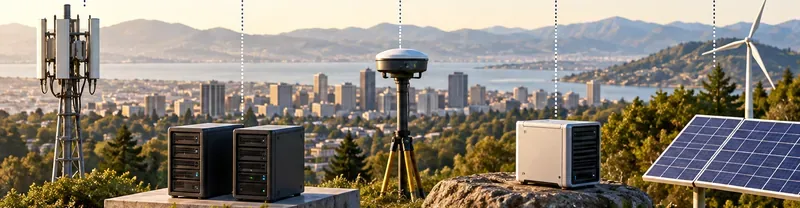
Physical infrastructure such as connectivity equipment, compute servers, precision-positioning receivers, and energy hardware illustrates the real-world assets that DePIN networks can coordinate.
What DePIN means—and what makes a token investable
DePIN stands for Decentralized Physical Infrastructure Network. Instead of one company owning every physical asset, a DePIN protocol coordinates independent participants who contribute hardware, connectivity, sensors, compute, storage, mapping data, or other real-world resources. Tokens are often used to reward supply, govern the network, or pay for services.
That description sounds attractive, but it creates a common investing mistake: assuming that a useful network automatically creates a valuable token. It does not. A network may grow while token emissions grow faster. Customers may pay in dollars without creating meaningful buy pressure. Hardware operators may immediately sell rewards to cover costs. A token can also be richly valued long before revenue catches up.
For this shortlist, the key question is therefore token capture: when customers use the network, is there a defined mechanism that can increase token demand, reduce token supply, or otherwise connect usage to token economics?
Quick reference: five DePIN projects worth researching
Project
Token
DePIN niche
Why it stands out
Main risk to check
GEODNET
GEOD
Precision GNSS / RTK positioning
Commercial positioning data plus a stated revenue-linked buyback-and-burn mechanism
Hardware emissions, competitive RTK market, and whether revenue growth keeps pace with incentives
Hivemapper
HONEY
Street-level mapping
Map usage requires Map Credits created by burning HONEY; most consumed HONEY is permanently burned under current rules
Contributor emissions, mapping-data demand, hardware adoption, and competition from incumbent mapping providers
DIMO
DIMO
Connected-vehicle data
Permissioned vehicle-data infrastructure across many automakers; DIMO Credit was designed to be created by burning DIMO
Token-capture rules can evolve through governance; automotive integrations are operationally demanding
WeatherXM
WXM
Hyperlocal weather data
Commercial data licensing is designed to require WXM while station operators earn WXM for quality data
Ten-year token distribution, station-supply growth, and converting network coverage into paying data demand
io.net
IO
Decentralized GPU compute
Its 2026 Incentive Dynamic Engine ties supplier economics to real usage and includes a revenue-funded burn mechanism
GPU-cloud competition, utilization, customer concentration, execution, and the fact that compute is a crowded DePIN trade
How to use this table: do not treat the order as a ranking. GEOD and HONEY have relatively explicit usage-to-token mechanisms; DIMO and WXM offer differentiated data-network theses; IO offers the highest exposure here to the AI-compute narrative. The right candidate depends on which demand story you think can become durable.
1. GEODNET (GEOD): a location-data thesis tied to robotics
GEODNET is building a global Real-Time Kinematic, or RTK, network. RTK uses fixed GNSS reference stations to send correction data that can improve satellite positioning from meter-level accuracy toward centimeter-level precision under appropriate conditions. That matters for drones, surveying, agriculture, construction equipment, autonomous machines, and robotics.
The investment case is unusually easy to understand for a DePIN project because the network has an identifiable commercial product: precision location data. GEODNET’s official RTK documentation shows customers connecting rovers to regional servers through NTRIP and receiving correction streams, while its network documentation describes token incentives for deploying and maintaining reference stations. See the official GEODNET RTK service documentation and the GEODNET network and tokenomics page.
The token-capture mechanism is the bigger reason GEOD belongs on this list. GEODNET’s current site states that 80% of data revenue is used to buy back and burn GEOD. Its support documentation also says data payments are converted to GEOD for buyback and burn, while GEOD has uses tied to data services, equipment discounts, and network features such as staking. The official explanation is available in GEODNET’s token-utility documentation.
Best fit for: investors who want DePIN exposure to robotics and machine positioning rather than consumer crypto apps.
What could go wrong: token incentives may attract station supply faster than commercial demand develops; RTK is an established industry with centralized competitors; and a buyback formula only matters if revenue becomes material relative to the token’s market value and ongoing emissions. GEODNET also has a one-billion-token maximum supply and a scheduled mining-reward system, so dilution and circulating supply still matter.
2. Hivemapper (HONEY): mapping with a direct burn-and-mint loop
Hivemapper coordinates drivers who collect fresh street-level imagery using approved camera hardware. The network processes that imagery into mapping products and features such as traffic signs, lane information, and other road observations. Customers and developers can then consume the resulting data.
The core reason HONEY deserves attention is not simply that decentralized mapping sounds compelling. It is the way data consumption reaches the token. Hivemapper’s current documentation states that developers use Map Credits to consume network products, and Map Credits are generated by burning HONEY. Under MIP-15, 75% of HONEY burned for map consumption is permanently burned, while 25% can be reminted as consumption rewards, subject to a weekly cap. See the official HONEY burn-and-mint documentation.
Hivemapper also publishes a maximum supply of 10 billion HONEY and allocates 40% of the maximum supply to contributor rewards. That means the bull case and the dilution risk exist at the same time: greater mapping activity can improve the network, but investor returns depend on customer-driven burns eventually becoming significant relative to issuance. The allocation and utility mechanics are documented in Hivemapper’s HONEY overview.
Best fit for: investors who prefer a data marketplace where token burn is explicitly connected to customer consumption.
What to monitor: paid Map Credit usage, fresh road coverage in commercially valuable regions, adoption of Bee hardware, developer products built on top of the map, and the relationship between HONEY burned and HONEY issued to contributors.
3. DIMO (DIMO): the vehicle-data infrastructure bet
DIMO is a vehicle-data network designed to let vehicle owners grant applications permission to use telemetry and vehicle identity data. The current DIMO site says its platform supports more than 50 vehicle brands and provides developers with permissioned access to signals such as location, odometer, battery or fuel information, tire pressure, and diagnostic data through APIs and SDKs. That creates potential use cases across fleets, maintenance, insurance, rentals, charging, vehicle commerce, and AI agents operating around transportation.
For a practical look at the product, start with the official DIMO platform overview. DIMO also publishes developer tooling for TypeScript, Python, and C#, which matters because DePIN demand does not emerge from tokens alone—it needs applications that can actually consume the data.
The token-capture thesis is more nuanced than HONEY or GEOD. In 2024, the DIMO Foundation introduced DIMO Credit, also called DCX, as a stable unit for network fees. The Foundation described DCX as being creatable only by burning DIMO, with the amount burned depending on DIMO’s market price. That design is documented in the DIMO Foundation’s governance explanation of DIMO Credit. Because DIMO is governed by proposals and its economic design can evolve, investors should verify current fee mechanics before relying on an old burn assumption.
Best fit for: investors who believe owner-controlled vehicle data can become an infrastructure layer for mobility services rather than remain locked inside automaker silos.
What to monitor: active connected vehicles, developer adoption, paid API activity, vehicle-brand coverage, DIMO Credit usage, current reward emissions, and any governance changes to token utility.
4. WeatherXM (WXM): a focused bet on hyperlocal weather data
WeatherXM is narrower than many crypto infrastructure projects, which is exactly why it can be interesting. The network rewards owners for deploying weather stations and contributing quality-controlled local weather data. Commercial users can license network data, creating a straightforward potential demand source from agriculture, insurance, logistics, energy, research, and other weather-sensitive businesses.
According to the official WeatherXM tokenomics documentation, WXM has a total supply of 100 million tokens, with rewards distributed over a ten-year schedule. The documentation states that commercial customers who want to use the network’s data or services must acquire WXM, while station owners receive WXM for contributing data. WeatherXM’s current reward system also evaluates factors such as data quality and proof of location; see the official reward mechanism.
This is a classic two-sided DePIN challenge. The network needs enough stations in useful locations to make its data valuable, but adding stations without adding customers can increase token distribution without creating equivalent demand. The investment thesis improves if commercial licensing grows faster than the economic cost of incentivizing supply.
Best fit for: investors who want a specialized environmental-data thesis with a capped supply and an explicit commercial licensing role for the token.
What to monitor: paying data customers, station quality rather than raw station count, commercial coverage gaps, changes to reward formulas, and the pace of scheduled token distribution.
5. io.net (IO): the higher-beta AI compute candidate
Decentralized GPU compute is one of DePIN’s most competitive categories, so IO is not “hidden” in the same sense as a tiny sensor network. It is included because its economic redesign gives investors something concrete to monitor beyond AI hype.
io.net aggregates GPU supply from independent providers and makes that compute available for AI and other workloads. In June 2026, the network launched its Incentive Dynamic Engine, or IDE, replacing the old fixed-emission approach with a demand-driven model. The current official io.net tokenomics page says supplier rewards are targeted in U.S.-dollar terms and funded by real usage; after suppliers are paid, at least 50% of remaining revenue is burned. The project’s tokenomics paper says the redesign is intended to connect IO supply more directly to network activity rather than fixed inflation.
This is the most important part of the IO thesis: if real compute utilization grows, the economic system is designed to react to actual demand. io.net has also published network and revenue milestones through its official updates, but investors should distinguish company-reported figures from independently audited financial statements. The io.net 2026 update archive documents the launch of IDE and other network developments.
Best fit for: investors willing to accept higher competitive risk in exchange for direct exposure to decentralized AI compute.
What to monitor: paid GPU utilization, revenue after supplier payouts, actual token burns, enterprise-customer concentration, GPU quality, uptime, and competition from Aethir, Akash, centralized clouds, and emerging GPU marketplaces.
Why Grass is on the watchlist but not in the top five
Grass is a major DePIN bandwidth and public-web-data network with millions of participants, and it is closely tied to the AI-data narrative. Its official site says institutions use the network to route requests for publicly accessible web data through unused residential bandwidth. That is a real service model, not merely a token concept.
However, the token-investment link deserves extra scrutiny. In July 2026, Grass announced that its Stage 2 participant rewards would be distributed in USDC rather than through new GRASS emissions, explicitly stating that the distribution would not change circulating GRASS supply. See the official Stage 2 rewards update. That may be positive for dilution, but it also means investors should not automatically assume network growth creates direct GRASS demand. The token can still have governance, staking, or ecosystem roles, but the value-capture path needs to be examined separately from user growth.
That is a useful lesson for all DePIN investing: a huge network is not enough. Ask how economic activity reaches the token.
A practical checklist before buying any DePIN token
Confirm the customer: Who pays for the network’s service, and why is the service better or cheaper than centralized alternatives?
Trace one dollar of revenue: Does customer spending buy, burn, lock, stake, or otherwise create demand for the token?
Measure dilution: Check total supply, circulating supply, unlock schedules, contributor rewards, treasury emissions, and investor allocations.
Separate supply growth from demand: More nodes, stations, cameras, or GPUs can look impressive while utilization remains weak.
Check hardware economics: If operators lose money without token appreciation, supply can disappear during a bear market.
Check concentration: One large customer, one hardware supplier, or one geography can create hidden dependency risk.
Check liquidity before market cap: A small token may look cheap while having shallow order books, large spreads, or limited custody options.
Re-read governance: DePIN tokenomics are unusually changeable. Burn rates, rewards, fees, and staking rules can be modified.
Avoid price-per-token comparisons: A $0.05 token is not inherently cheaper than a $50 token. Market capitalization and fully diluted valuation matter more than the unit price.
Size for failure: Even a strong DePIN project can suffer hacks, regulation, hardware issues, customer churn, token dilution, or a prolonged crypto downturn.
How to choose among these five
If your thesis is...
Research first
Why
Robotics and precision location become major infrastructure markets
GEODNET
RTK correction data has established industrial use cases, and GEODNET publishes a revenue-linked buyback-and-burn design.
Fresh maps can take share from centralized mapping stacks
Hivemapper
Customer map consumption is explicitly connected to HONEY burn through Map Credits.
Vehicle owners and developers need a neutral data layer
DIMO
The network already exposes normalized, permissioned data across many vehicle brands.
Hyperlocal environmental data becomes commercially valuable
WeatherXM
WXM connects station incentives with commercial weather-data licensing.
AI demand keeps pushing GPU utilization higher
io.net
Its 2026 tokenomics redesign makes real compute usage central to supplier payouts and token burns.
The biggest mistake: buying the narrative instead of the cash flow loop
Crypto bull markets reward simple stories. “AI compute,” “robotics,” “mapping,” and “machine economy” can all attract capital quickly. But DePIN projects are unusually measurable compared with many token categories because physical infrastructure creates observable operating questions: How many customers use it? How often? What do they pay? How much supply is idle? What does it cost to reward contributors? What portion of spending affects the token?
That makes the best hidden-gem research process less glamorous but more useful. Start with the customer, follow the money through the protocol, then compare that economic activity with token supply and valuation. Only after that should you consider the bull-run narrative.
Bottom line
If you want a compact DePIN watchlist for the next market expansion, GEOD, HONEY, DIMO, WXM, and IO cover five different infrastructure theses with identifiable real-world products. GEOD and HONEY have particularly visible mechanisms linking service usage to token reduction. DIMO and WeatherXM offer specialized data networks with potentially defensible datasets. io.net offers higher-beta exposure to GPU demand with a more usage-linked economic model than its original emission system.
None should be bought simply because a new bull run might happen. Before investing, verify the latest circulating supply, unlock calendar, liquidity, protocol revenue or usage, current governance rules, and the token’s fully diluted valuation. Those figures move faster than protocol documentation and can materially change the risk/reward even when the underlying project remains healthy.
Research principle: in DePIN, the strongest token thesis is usually the one where you can explain—in one sentence—how a real customer paying for a real service creates economic value that reaches the token.