Home
» Ecosystem
»
Withdrawal Network Selection Mistakes: How to Verify Chain, Token Contract, and Memo Fields
Withdrawal Network Selection Mistakes: How to Verify Chain, Token Contract, and Memo Fields
A crypto withdrawal can look ready to send while still containing a critical mismatch. The address may be valid, the token ticker may be familiar, and the sending platform may even accept the entry. None of those facts alone proves that the receiving platform can credit the transfer.
Consider a clearly hypothetical example. Maya wants to withdraw USDC from one platform to another. The receiving platform gives her a USDC deposit address on Ethereum, but the sending platform defaults to a different network that also supports USDC. Later, she prepares an XRP deposit and sees an additional destination-tag field. Her safest approach is to treat the chain, token identity, address, and memo or tag as separate checks rather than one combined “looks right” check.
First check: the receiving network is the source of truth
Verified: major exchanges explicitly instruct users to select the same network used by the receiving wallet or platform. Kraken’s withdrawal documentation says to choose the same network as the receiver and warns that an incompatible network can lead to permanent loss. Coinbase likewise warns that withdrawals to an unsupported or incorrect network may be permanently lost. See Kraken’s withdrawal instructions and Coinbase Exchange withdrawal guidance.
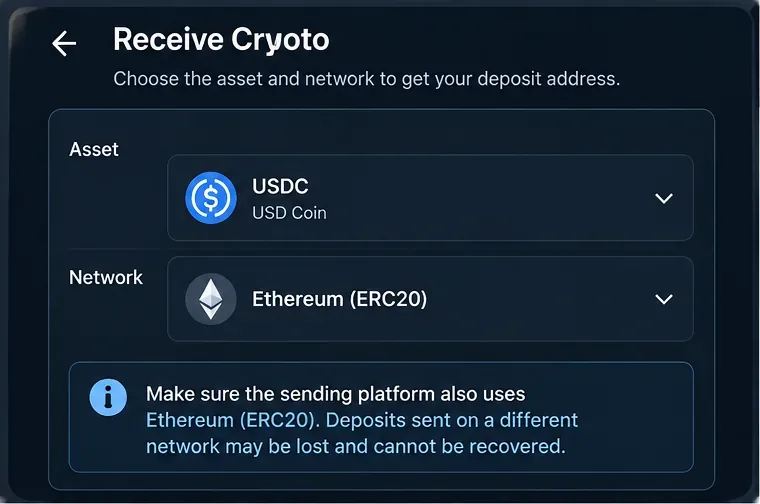
Action: start on the receiving side. Select the asset, read the exact network name shown for that deposit, and only then choose the matching network on the sending side. Do not choose a network merely because it is cheaper or faster unless the receiver explicitly supports that asset on that network.
Illustrative example: the receiving side specifies both the asset and network. The sender should match both fields rather than relying on the address format alone.
A valid-looking address does not prove the network is correct
This is especially important across EVM-compatible networks. Ethereum, Base, Arbitrum, Optimism, Polygon, and other EVM networks can use the same hexadecimal account-address format. A string beginning with 0x can therefore look structurally valid on several networks even though the receiving service only supports the deposit on one of them.
Depends on the platform: some exchanges use one deposit address across several supported EVM networks; others show network-specific instructions or maintain separate support policies. The visual shape of the address cannot tell you which policy applies.
Action: verify the network label in the recipient’s current deposit page or official support documentation. If the sender calls the network “Ethereum (ERC-20)” and the receiver calls it “Ethereum,” that may be the same route, but do not assume similarly named networks are interchangeable when the recipient has not said so.
Second check: verify the token contract or token identifier when it is relevant
The symbol alone is not enough to identify a token. USDC is a useful example because it exists natively on many blockchains. Circle states that USDC was natively supported on 38 blockchain networks as of September 16, 2026. Circle also publishes the chain-specific contract or token identifier for supported networks on its official supported-blockchains page.
For example, Circle lists native USDC on Ethereum at 0xA0b86991c6218b36c1d19D4a2e9Eb0cE3606eB48 and native USDC on Base at 0x833589fCD6eDb6E08f4c7C32D4f71b54bdA02913. The ticker is the same, but the chain and contract are not.
Verified: ERC-20 tokens are smart-contract tokens on Ethereum; the contract tracks balances and implements the token interface. The Ethereum ERC-20 documentation describes this model.
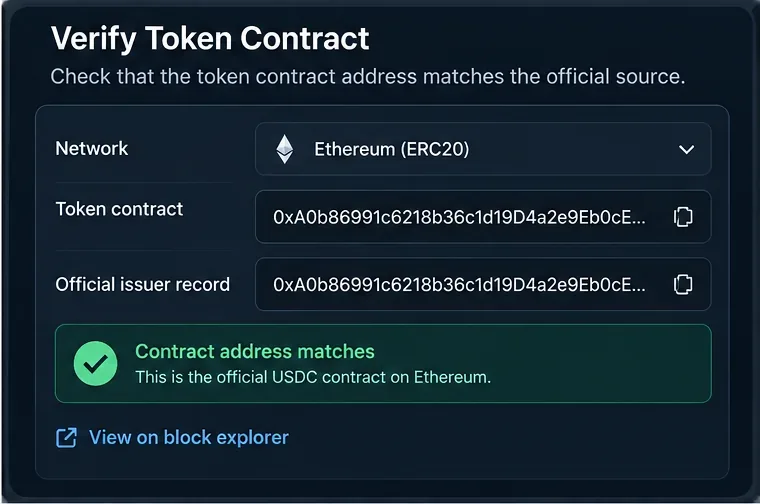
Action: when a wallet, bridge, DEX, portfolio tool, or receiving service asks you to identify a token contract, compare the full contract address against the issuer’s official documentation for the exact network. Do not rely only on ticker, logo, search-engine snippets, or a contract copied from social media.
Illustrative example: contract verification is a chain-specific identity check. Compare the full address with the issuer’s official record, not just the token symbol.
When contract verification is not a field you should invent
A centralized exchange withdrawal form often asks only for asset, network, destination address, amount, and—when applicable—a memo or tag. The exchange may manage token-contract details internally. If the platform does not request a contract address, do not paste one into another field.
Depends on the workflow: contract verification matters most when manually importing a token, checking a self-custody wallet balance, using a bridge or DEX, or confirming that two services mean the same token variant. It may be invisible in a normal exchange withdrawal flow.
Action: treat the official contract as a verification reference, not as data to enter unless the receiving application explicitly requests it.
Third check: memo and destination-tag fields identify the recipient within a shared address
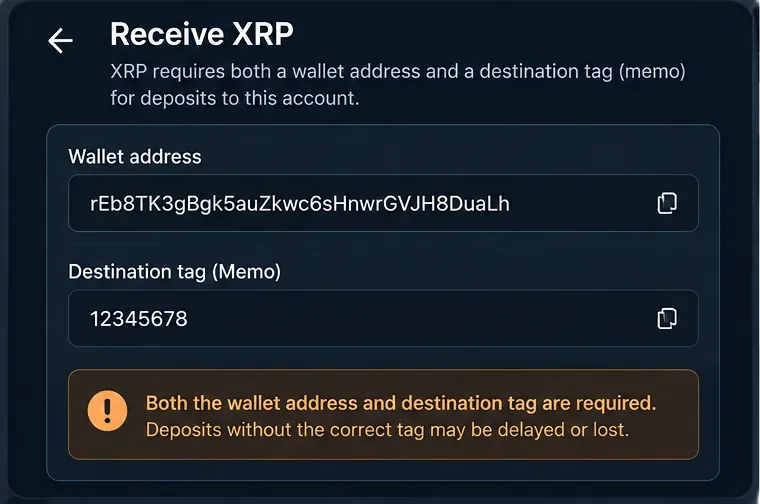
Now extend the hypothetical example. Maya later wants to deposit XRP to an exchange. The exchange displays both an XRP address and a numeric destination tag. Copying only the address is incomplete because the exchange may use one on-chain address for many customers and rely on the destination tag to determine which internal account should receive the funds.
The XRP Ledger’s official documentation explains that destination tags can identify the beneficiary of a payment to a multi-purpose address, such as an exchange account. It also notes that the tag is a 32-bit unsigned integer and that some systems can use an X-address that combines the classic address and tag. See the XRP Ledger documentation on source and destination tags.
Coinbase similarly states that some assets require a destination tag or memo and that the receiving platform determines whether one is required. Its current support page lists XRP as using a numeric tag and advises users to confirm both the address and tag when required. See Coinbase’s destination tag and memo guidance.
Action: if the receiving page displays a memo, destination tag, payment ID, or similar routing value, copy that value exactly as shown. Do not reuse a tag from a previous deposit unless the recipient explicitly says it remains valid.
Illustrative example: an exchange deposit can require both a blockchain address and a separate destination tag used to credit the correct customer account.
Use a four-part preflight check before confirming
Field
What to compare
Best source of truth
Common mistake
Asset
Exact token or coin
Receiver’s deposit page
Sending a similarly named or wrapped asset
Network
Exact supported chain
Receiver’s deposit page and official support docs
Picking the cheapest network without checking support
Token contract / identifier
Full chain-specific token identity, when applicable
Official issuer or protocol documentation
Trusting ticker or logo alone
Memo / tag
Exact routing value and whether it is required
Receiver’s current deposit instructions
Omitting it because the wallet address looks complete
Unknown until you check: whether a specific exchange currently supports a particular asset-network pair, whether a memo is mandatory for that destination, whether a bridged token version is accepted, and what the minimum deposit is. These are platform-specific facts that can change.
Action: do not infer any of those items from an older transaction. Reopen the current deposit page and verify them immediately before sending.
Does a small test transfer solve the problem?
A small test can reduce the size of a mistake, and Coinbase explicitly recommends considering a small test amount when tag or memo requirements are involved. But a test is not a substitute for verification.
For a test to be meaningful, it must use the same asset, same network, same receiving address, and same memo or tag that you plan to use for the larger transfer. The test must also be above the receiving platform’s minimum deposit threshold; otherwise a technically valid transfer may not be credited. Kraken’s missing-deposit checklist specifically tells users to check the network or token standard, minimum deposit, tag or memo, confirmation requirements, and deposit address.
Action: after a successful test, confirm that the receiver actually credited the intended asset—not merely that the transaction appeared on a block explorer—before sending the remaining amount.
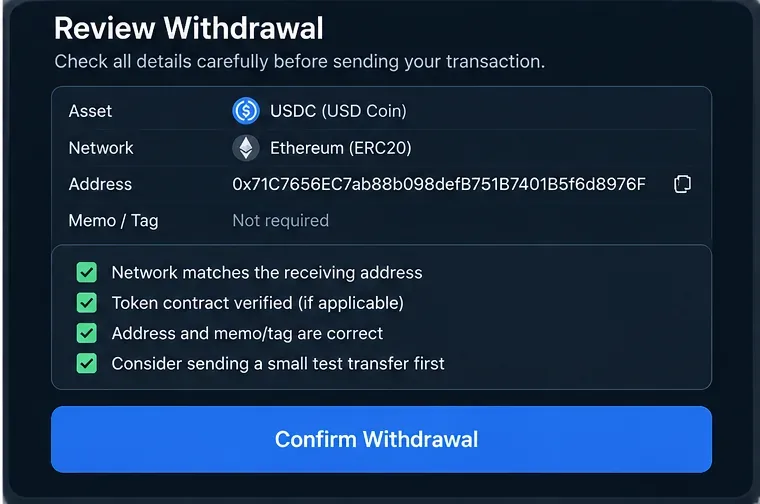
Illustrative final review: verify asset, network, destination address, token identity when applicable, and memo or tag requirements before confirming the withdrawal.
What if you already sent on the wrong network or forgot the memo?
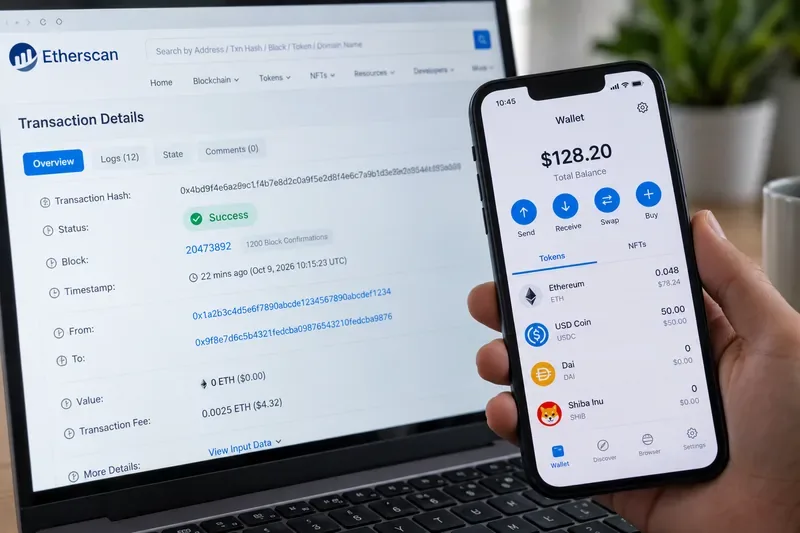
Do not assume that a transaction shown as successful on a block explorer means the receiving exchange can credit it. On-chain success only proves that the blockchain processed the transaction according to that chain’s rules.
Recovery depends on circumstances: the receiving provider may or may not have technical access to the destination address on the chain you used, may or may not support recovery for the token, and may charge a fee or impose minimum-value conditions. If you control the recipient’s private keys in a self-custody wallet, recovery can also depend on whether the wallet supports the chain and token involved. There is no universal recovery procedure.
Action: preserve the transaction hash, sender withdrawal record, asset, network, destination address, token contract if relevant, amount, and memo or tag used. Then contact the receiving platform through its official support channel. Do not send private keys or seed phrases to anyone offering “recovery,” and do not send a second transaction simply to “fix” the first one.
A compact withdrawal checklist
Open the receiving platform first and choose the asset you intend to deposit.
Copy the exact network name shown by the receiver.
On the sender, choose that same network—not merely a network that supports the same ticker.
Verify the destination address carefully; use the platform’s copy or QR function when available.
If token identity could be ambiguous, verify the chain-specific contract or token identifier from the issuer’s official documentation.
If a memo, destination tag, payment ID, or similar field is displayed, copy it exactly.
Check minimum deposit requirements and withdrawal fees before using a small test.
After a test, wait until the receiving platform credits the deposit before sending the rest.
The core lesson from Maya’s hypothetical withdrawal is simple: “correct address” is only one part of a correct transfer. A safe preflight check verifies four separate things—asset, chain, token identity, and recipient-routing data—using the receiver and official issuer or protocol documentation as the authoritative references.