Home
» Ecosystem
»
Liquid Staking Token Discounts: Why Market Price Can Differ From Redemption Value
Liquid Staking Token Discounts: Why Market Price Can Differ From Redemption Value
A liquid staking token (LST) can represent a claim on staked assets and still trade below the amount of underlying crypto it is expected to redeem for. That gap is not automatically a pricing error. It can be the market's way of pricing time, liquidity, protocol-specific withdrawal mechanics, counterparty or smart-contract risk, and the cost of arbitrage.
The key distinction is between redemption value and secondary-market price. Redemption value is what the token's rules say a holder can receive through the protocol's redemption or unstaking process, subject to the protocol's terms and any losses. Market price is what another trader is willing to pay now on an exchange or automated market maker. Those two values can converge, but they do not have to be identical at every moment.
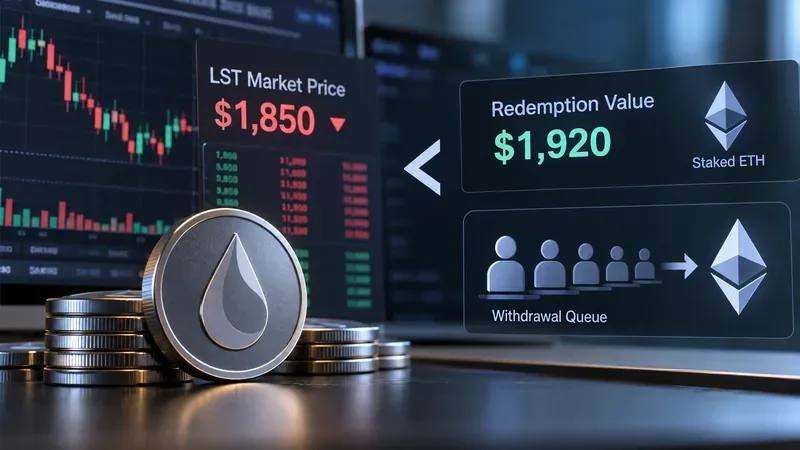
Illustrative example: an LST can trade below its redemption value when immediate liquidity is worth more to sellers than waiting through a withdrawal process. The displayed prices are hypothetical, not current market quotes.
Redemption value is a claim with conditions, not necessarily instant cash
For Ethereum staking, the network itself has withdrawal mechanics and rate limits. Ethereum's official staking documentation explains that validator exits can take variable time depending on how many validators are leaving, and pooled or liquid-staking users normally redeem through their provider rather than directly through the consensus-layer withdrawal system. See the Ethereum staking withdrawals documentation.
That means an LST's redemption value should be read as a protocol-defined claim on underlying assets, not as a guarantee that the holder can turn the token into the underlying asset immediately, at zero cost, under every market condition.
Token design also matters. Ethereum.org notes that some liquid staking tokens are rebasing tokens, where the token balance changes as rewards accrue, while others use an exchange-rate model, where the token balance stays fixed but each token becomes redeemable for more underlying ETH over time. See Ethereum's liquid and pooled staking overview. Comparing an LST directly with 1 ETH without checking its token model can therefore be misleading.
Why can an LST trade at a discount?
1. Waiting has an economic cost
If redeeming takes time, a seller who wants ETH immediately may accept less than the eventual redemption amount. The discount effectively compensates the buyer for waiting and for bearing the risks that exist during that waiting period.
Lido provides a clear example. Its official withdrawal interface says that stETH and wstETH withdrawals use a request-and-claim process. Under normal circumstances Lido estimates that fulfillment can take about 1–5 days, while the actual time can depend on queue size, validator exits and protocol conditions. Lido also explicitly contrasts protocol withdrawal with an instant market swap, noting that the market-based rate can differ from 1:1. See the Lido withdrawal interface and FAQ and the Lido WithdrawalQueue documentation.
The trade-off is straightforward: a market sale can provide immediate liquidity, but perhaps at a discount; protocol redemption may offer a better nominal conversion, but requires waiting and on-chain transactions.
2. The protocol may not have enough immediately available liquidity
Some protocols can redeem only when sufficient unstaked ETH or buffer liquidity is available. Rocket Pool's documentation states that rETH can be traded back to the protocol for ETH plus earned rewards if there is sufficient liquidity available. That condition matters. If protocol liquidity is constrained, the secondary market may become the fastest exit route, and sellers may compete for available buyers by accepting a lower price. See the Rocket Pool protocol FAQ.
For a holder, the relevant question is therefore not merely “What is one rETH worth according to the protocol?” but also “Can I redeem the amount I hold right now, and how long would that take?”
3. Market depth and slippage can widen the apparent discount
A quoted market price is not always the executable price for a large trade. A small swap may clear close to the reference value while a large swap moves through several price levels or materially changes the price in an automated market maker pool. In that situation, the practical discount faced by a large holder can be larger than the headline discount shown on a price screen.
This creates a size-dependent trade-off. A trader needing to exit a small position may reasonably prefer the secondary market for speed. A large holder may save value by splitting trades, waiting for deeper liquidity, using multiple venues, or redeeming through the protocol instead.
4. Arbitrage is not free or instantaneous
In theory, if an LST trades below what it can be redeemed for, an arbitrageur can buy the discounted token, redeem it, and keep the difference. In practice, the trade has costs and constraints: gas, exchange fees, slippage, waiting time, capital lock-up, operational complexity, and protocol-specific limits.
If the gross discount is smaller than those costs, rational arbitrageurs may not close the gap. Even a seemingly attractive discount can persist if the redemption path is slow or uncertain enough.
5. The market is also pricing protocol and staking risk
The underlying stake is not risk-free. Validator penalties or slashing can reduce the assets supporting an LST. Smart-contract failures, governance failures, custody risk, oracle problems, or operational failures can also change the market's assessment of what a claim is worth.
Lido's withdrawal documentation notes that the amount claimable can be lower in the event of significant protocol losses such as slashing and penalties. Its integration guide explains that withdrawal value is normally based on the amount at request time but can be reduced if the protocol has experienced significant losses. See the Lido tokens integration guide.
Coinbase provides another useful distinction. The cbETH white paper separates the token's formulaic conversion rate from its free-market exchange rate, while Coinbase Help says the market may value cbETH below the underlying staked ETH. Coinbase also states that cbETH redemption may take time to complete. See the cbETH white paper and Coinbase's cbETH redemption documentation.
How to measure the discount correctly
Use comparable units. For an exchange-rate LST, first determine how much underlying asset one LST is currently entitled to through the protocol. Then compare the executable market value of that same LST with the value of the underlying asset.
A simple percentage discount can be written as:
Discount = (Redemption value − Market value) / Redemption value × 100%
Suppose one LST is redeemable for underlying assets worth $2,000, while the amount you could actually receive by selling that LST after slippage is $1,960. The effective discount is 2%. But that 2% is only the starting point. You still need to compare it with redemption waiting time, gas, fees, risk and the return you could earn on your capital during the wait.
Swap now or redeem later? Compare the trade-offs
Choice
Main advantage
Main cost or risk
Usually fits
Sell or swap on the secondary market
Fast liquidity
Discount, spread and slippage
Users who prioritize immediate access to the underlying asset or cash
Redeem through the LST protocol
Closer link to protocol-defined redemption value
Waiting time, gas, queue mechanics and protocol risk during the process
Users who can wait and whose expected savings exceed transaction and time costs
Wait before doing either
May avoid selling during temporary stress
Discount can widen; capital remains exposed
Users without an urgent liquidity need and with a view that market stress may normalize
Split the position
Balances liquidity and price execution
More transactions and monitoring
Larger holders who need some liquidity now but can wait with the remainder
When a discount may be more concerning
A modest discount during a period of heavy withdrawals can be consistent with ordinary liquidity and time-value effects. A persistent or rapidly widening discount deserves more investigation, especially if it appears together with unusual protocol announcements, halted redemptions, a sharp increase in withdrawal times, declining pool liquidity, validator losses, custody concerns, or disagreement between official conversion data and the amount users can actually redeem.
The important comparison is historical and operational, not merely numerical. A 1% discount may be unremarkable for one token under temporary congestion but alarming for another token that normally trades within a few basis points of its redemption value. Protocol design and current withdrawal conditions determine the context.
What to verify before buying a discounted LST
Current redemption mechanism: Is redemption on-chain, provider-managed, queued, or liquidity-dependent?
Estimated waiting time: Check the provider's current interface or official documentation rather than assuming normal conditions.
Executable market price: Use a realistic quote for your trade size, including slippage and fees.
Protocol conversion rate: For exchange-rate tokens, confirm the current underlying-per-token rate from the protocol or issuer.
Loss mechanics: Understand whether slashing, penalties, custody losses or other events can reduce redemption value.
Smart-contract and provider risk: A discount can represent genuine risk, not just free yield.
Opportunity cost: Estimate what your capital could otherwise earn or avoid losing while it is waiting to redeem.
What to verify before selling an LST at a discount
First check whether the discount is smaller or larger than the cost of waiting. If protocol redemption is functioning normally and the queue is short, selling at a large discount may be expensive relative to waiting. If liquidity is urgently needed, however, paying that discount may be rational because the value of immediate access can exceed the lost percentage.
Also check trade size. A quoted price for a small order may not apply to a large position. Compare at least the expected net proceeds of the actual market swap with the expected net redemption amount after gas, fees and waiting.
The practical takeaway
Liquid staking tokens combine two different markets: a protocol-level claim on staked assets and a freely traded token with its own supply and demand. A discount appears when the market values immediate liquidity and risk differently from the protocol's eventual redemption claim.
There is no single exit method that is best for every holder. If speed is the priority, the secondary market may be worth the discount. If maximizing underlying asset received is more important and the redemption path is functioning normally, waiting for protocol redemption may be preferable. If the position is large, splitting the exit or comparing multiple venues can reduce execution costs.
As of September 30, 2026, Ethereum withdrawals are available, but pooled-staking redemption speed still depends on provider design, available liquidity and network exit conditions. Before acting on any apparent LST discount, verify the token's current redemption rules from the official provider and compare them with a live, size-appropriate market quote. The discount itself is information; understanding what risk or inconvenience it is pricing is the more important task.