Reconcile the movement before you calculate the gain
Before calculating crypto gains, match deposits and withdrawals that represent the same asset moving between wallets or accounts you own. A properly documented self-transfer generally is not a sale, but the asset carries its existing basis and holding period into the receiving wallet. If one side is missing from an export, or a deposit is treated as a new purchase, your ledger can show a fictional sale, duplicate acquisition, or basis that disappears before a later sale.
For U.S. federal tax reporting, an exchange export is not a complete tax record. The IRS says taxpayers must report income, gains, and losses whether or not they receive Form 1099-DA. Brokers began reporting gross proceeds for 2025 transactions on that form in 2026, while most 2025 statements do not provide basis. This makes your own transfer and lot records important. This article reflects IRS guidance available as of September 30, 2026.
What counts as a transfer to reconcile?
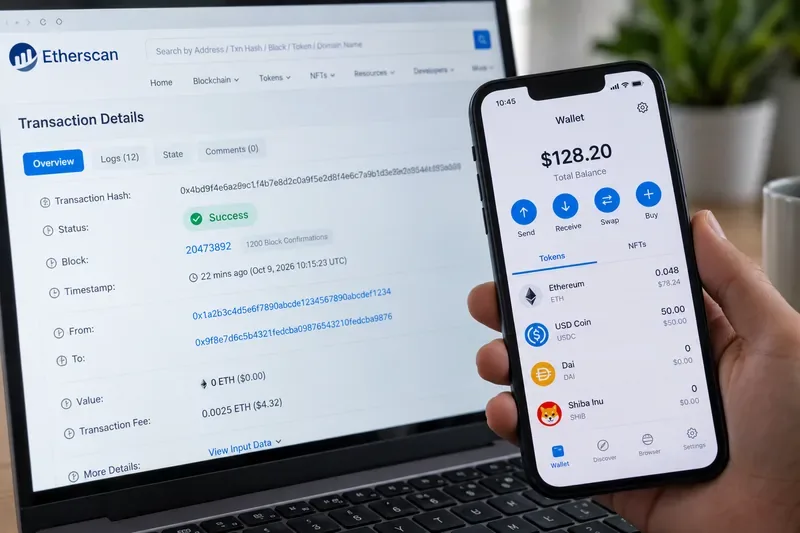
A reconciliation is a documented match between an asset leaving one account and the corresponding asset arriving in another. For a self-transfer, compare asset and network, quantity, transaction hash, date and time, and the addresses or account labels you control. The records may differ in timestamp, symbol, or amount because an exchange batches withdrawals, a wallet records a later confirmation, or a network fee is withheld.
The IRS describes a transfer between wallets, addresses, or accounts belonging to the same taxpayer as generally non-taxable. But digital assets used or withheld to pay a transfer fee can create a separate taxable disposition. A transfer is also not automatically a self-transfer just because it uses your usual exchange or wallet. A gift, payment to another person, bridge operation, token wrap, swap, or movement to an account you do not own may require different treatment.
Choose an export method that fits your records
| Approach | Useful when | Trade-off to check |
|---|
| Exchange CSV exports | You have a few custodial accounts and need a dated, reviewable snapshot. | Providers use different columns and may omit addresses, transfer IDs, or older activity. Keep the raw file and note when it was exported. |
| Read-only API sync | You trade often and want recurring updates across supported exchanges. | Coverage depends on the provider and permissions. A sync can miss older history, unsupported products, or on-chain activity. Compare its totals with exchange statements. |
| Wallet and blockchain records | You control self-custody wallets or need transaction-level evidence. | On-chain data can show activity at an address, but does not by itself prove who controlled the address, why an asset moved, or its tax basis. Keep ownership and acquisition evidence. |
| Manual reconciliation ledger | You have a handful of ambiguous transfers, a closed account, or an isolated mismatch. | It is transparent and easy to annotate, but becomes error-prone at scale. Record the rule applied and preserve evidence for each adjustment. |
A practical combination is to download original CSVs, use a read-only importer if it supports your accounts, and manually resolve exceptions against wallet or exchange records. Treat software’s proposed matches as candidates until the evidence supports them.
A four-pass reconciliation workflow
1. Inventory accounts and preserve source files
List every exchange, hosted wallet, self-custody address, and relevant broker account used during the year, including accounts opened or closed midyear and accounts where an asset passed through temporarily. Export the full history, not just trades. Save statements, withdrawal confirmations, transaction hashes, and a note identifying which addresses belong to you. Record the export date and time zone. Do not overwrite the original download when cleaning columns.
2. Normalize fields while retaining the originals
Build a working table with at least: date and time, time zone, platform or wallet, asset and network, quantity, direction, transaction hash or withdrawal ID, fee asset and amount, and any platform label. Keep original symbols beside a normalized asset name. A ticker alone is not enough if multiple networks or wrapped assets use similar symbols. Convert timestamps to one working time zone while preserving the source timestamp.
3. Pair outgoing and incoming records
Start with the strongest evidence: matching transaction hash, compatible asset and network, and an amount that reconciles after fees. Then check the sending and receiving addresses, timestamps, and ownership notes. A hash may be absent from exchange CSVs, so a withdrawal ID plus a wallet transaction record can support a match. Allow reasonable confirmation-time differences; do not force a match because quantities merely look close.
Example: an exchange export shows a withdrawal of 0.2502 BTC. Your wallet shows a receipt of 0.2500 BTC on the same network, and the records identify the remaining 0.0002 BTC as a network fee. If the hash and address evidence agree, record one movement of 0.2500 BTC between your accounts and a separate fee line. Preserve the original lot history for the 0.2500 BTC; do not label the receipt as a new purchase at that day’s price. Keep the fee’s date, amount, asset, and dollar value for tax review. Fee treatment can depend on the facts and applicable rules.
4. Separate matches, exceptions, and taxable events
Give each movement a status: matched self-transfer, unmatched withdrawal, unmatched deposit, fee difference, internal exchange transfer, or needs review. Do not delete unmatched rows to make totals balance. An unexplained deposit could be a missing transfer, a purchase, income, a reward, refund, or payment; each has different consequences. A withdrawal could be a self-transfer, payment, or sale. Use transaction evidence and ownership facts, and keep a short explanation for each manual classification.
Why “universal FIFO” needs special care
Tax-lot selection is not simply a preference in a software menu. For dispositions on or after January 1, 2025, federal rules generally apply digital-asset basis identification wallet by wallet or account by account. For broker-custodied units, specific identification normally depends on instructions or records made by the required time, subject to temporary relief for eligible taxpayers. If no adequate identification applies, a first-in, first-out (FIFO) ordering rule may apply within the relevant account. Notice 2026-20 extended certain temporary identification relief for an additional year. Check the IRS guidance for the period and facts involved before relying on a software setting.
For assets held before 2025, Revenue Procedure 2024-28 provided a transition method to allocate unused basis to the wallets or accounts holding remaining units as of January 1, 2025, if its requirements are met. A transfer ledger helps show where units were located; it does not itself prove that a historical allocation method was valid. Save allocation worksheets and the records supporting each wallet’s opening units and basis.
Specific identification can preserve a chosen lot when the rules and records are satisfied, but requires traceable records and consistent wallet-level accounting. FIFO is easier to apply when no adequate selection exists, but can produce a different holding period or gain than a valid identified lot. A tax preparer may be useful if you used pooled-basis software before 2025, transferred between many accounts, or lack original acquisition records.
Use Form 1099-DA as a check, not as your ledger
Compare each Form 1099-DA with your reconciled sales and dispositions. The IRS says the form may report proceeds and, in some cases, basis. Transferred-in assets are generally noncovered for broker reporting purposes, so an exchange may not know their original acquisition cost or holding period. A mismatch is a clue to investigate, not proof your records are wrong. If the form itself is incorrect, the IRS directs taxpayers to request a corrected form from the issuer and retain the correspondence.
For capital-asset sales and dispositions, the IRS points taxpayers to Form 8949; other digital-asset income may belong on other forms. A clean transfer match does not decide whether a later sale is short-term or long-term. That still depends on the acquired units, their dates, applicable identification rules, and transaction facts.
Final review checklist
- Every account and wallet used during the year appears in the source records.
- Each claimed self-transfer has evidence connecting both sides and confirming your control of both accounts.
- Fees are recorded separately from principal, including the asset used to pay them.
- Unmatched deposits and withdrawals are explained or clearly marked for follow-up.
- Lot basis and holding period carry through transfers without creating a duplicate purchase or erasing the original acquisition.
- Tax-lot method, wallet or account scope, transition records, and exceptions are documented.
- Exchange totals and Form 1099-DA proceeds have been compared with your complete activity record.
If records cannot establish where a deposit came from, which units left an account, or who controlled the receiving wallet, mark the uncertainty and resolve it before filing. A tax-lot export is only as reliable as the account history and transfer evidence behind it.
Official sources: IRS digital asset reporting and recordkeeping guidance; IRS FAQs on digital asset transactions; Revenue Procedure 2024-28; Notice 2026-20; Understanding Form 1099-DA.
This article summarizes U.S. federal guidance for general education and is not individualized tax advice. State, local, and non-U.S. rules may differ.