Home
» Ecosystem
»
Mantle (MNT) Ecosystem: A Practical Guide to Treasury, Yield, and Layer 2 Growth
Mantle (MNT) Ecosystem: A Practical Guide to Treasury, Yield, and Layer 2 Growth
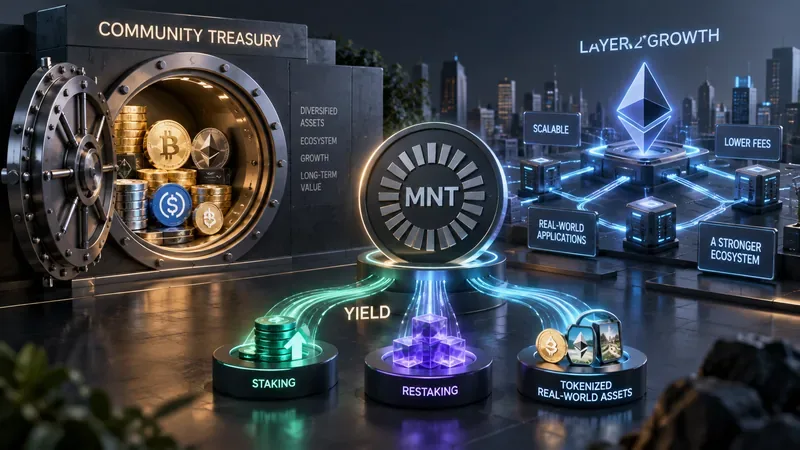
Mantle is easier to understand if you separate it into three connected systems: a community-controlled treasury, a set of yield-bearing assets and financial products, and an Ethereum Layer 2 network where MNT is used for gas and governance. Those systems reinforce one another, but they are not interchangeable. A large treasury does not automatically mean strong network demand, and a high yield does not automatically mean sustainable protocol revenue.
This guide uses first-party Mantle sources and is updated with information available on September 16, 2026. Treasury balances and market-linked values move continuously, so dated figures below should be treated as snapshots rather than permanent numbers.
Mantle combines a community treasury, yield-bearing assets, and Layer 2 infrastructure around MNT; each part has different drivers and risks.
Mantle at a glance
Component
What it does
What to monitor
MNT
Native gas asset on Mantle Network and governance token for ecosystem decisions.
Network activity, governance proposals, treasury-held MNT, and changes in circulating supply.
Mantle Treasury
Community-controlled pool used for strategic investments, liquidity, ecosystem programs, and product development.
Asset mix, MNT concentration, deployment decisions, and transparency of treasury flows.
Mantle Network
Ethereum Layer 2 infrastructure built around the OP Stack with modular data-availability design and ongoing ZK-proof integration.
Usage, fees, application activity, upgrades, bridging, and data-availability assumptions.
mETH / cmETH
ETH staking and restaking products designed to make yield-bearing ETH more usable across DeFi.
Tokenized real-world assets and stable-value instruments used to deepen onchain liquidity and financial applications.
Issuer quality, reserves, regulatory structure, liquidity, counterparties, and composability.
1. The treasury is Mantle’s biggest structural differentiator
Mantle’s current official foundation site describes the treasury as one of the largest community-owned treasuries in digital finance. Its published snapshot showed a total value of $2.413 billion as of September 14, 2026 at 18:35 UTC. The same page reported the following composition:
Why the composition matters more than the headline number
The most important detail is that nearly three quarters of the September 14 snapshot was MNT itself. That means the treasury’s dollar value can rise or fall sharply when MNT moves, even if no assets enter or leave treasury wallets. A $2.4 billion treasury should therefore not be interpreted as $2.4 billion of cash-like dry powder.
For practical analysis, split the treasury into two buckets. First is ecosystem-native exposure, primarily MNT and related Mantle assets. Second is external or more independently priced capital, such as BTC, ETH and stablecoins. The first bucket aligns the treasury with MNT upside, but it also creates concentration. The second is generally more useful for judging how much capital can be deployed without directly selling the native token.
How treasury capital can support growth
MNT holders participate in governance over initiatives including treasury transfers, resource allocation and ecosystem programs. Mantle’s official site explicitly describes token-holder governance as the mechanism for strategic decisions. That gives the treasury several possible roles: providing liquidity, funding builders, supporting ecosystem incentives, anchoring investment products, and earning returns on selected assets. The official Mantle site also highlights an EcoFund, strategic partners, and treasury-supported asset initiatives.
The analytical trap is assuming that every dollar deployed from the treasury creates durable demand. Incentives can attract capital quickly, but sustainable growth requires users and developers to remain after rewards normalize.
2. Mantle’s yield stack has multiple sources of return
“Mantle yield” is not one thing. Different products generate returns from different economic activities and carry different risks. A practical way to evaluate the ecosystem is to classify yield by its source.
ETH staking: mETH
mETH is Mantle’s liquid staking asset for ETH. In simple terms, ETH is staked and users receive a liquid token representing their position. The economic base is Ethereum staking rewards, while the liquid token can be used elsewhere in DeFi instead of leaving the staked ETH completely idle.
This makes mETH useful as a building block rather than merely a passive staking receipt. Mantle has historically focused on integrating mETH into money markets, exchanges, liquidity pools, and other venues. However, the yield is variable: Ethereum validator rewards, protocol fees, token exchange rates, and other conditions can change.
Restaking: cmETH
cmETH extends the idea into restaking. Mantle introduced it as a liquid restaking token intended to make restaked ETH usable across the wider ecosystem. The project’s own explanation of the transition from mETH to cmETH is available in its mETH and cmETH overview.
Restaking may add rewards beyond basic ETH staking, but it also adds another layer of protocol and economic risk. Depending on the underlying integrations, users may face smart-contract risk, slashing or service-level risk, liquidity risk, and changing incentive structures. A higher displayed yield should therefore be decomposed into its components rather than treated as a single risk-free rate.
Stablecoins and tokenized real-world assets
Mantle has also built around stable-value and real-world asset products. Its current foundation site presents the network as infrastructure for institutional onchain finance and reports $816 million in “Real World Capital”, defined there as stablecoin market capitalization plus RWA market capitalization. Mantle also lists integrations and partnerships across tokenized financial assets and stablecoins.
These products can introduce yield sources tied to offchain instruments, treasury securities, credit, or institutional counterparties rather than only crypto-native emissions. That can diversify returns, but it creates different risks: issuer solvency, custody arrangements, legal claims, redemption processes, regulatory restrictions, and the reliability of underlying reserves.
A simple yield checklist
Identify the source: staking rewards, restaking, lending interest, trading fees, token incentives, or offchain assets.
Separate organic yield from subsidies: promotional tokens can make short-term APY look stronger than recurring economics.
Check liquidity: a yield-bearing token is less useful if exiting a large position causes heavy slippage.
Check counterparty layers: every vault, bridge, issuer, custodian, or restaking service adds another dependency.
Do not assume today’s APY persists: Mantle campaigns and DeFi rates can change faster than a static article can be updated.
3. MNT is the link between the treasury and the Layer 2
MNT serves two primary functions that matter for ecosystem analysis. It is used as the native gas token on Mantle Network, and it is the governance asset through which holders participate in ecosystem decisions. Current Mantle V2 source code also documents MNT as the network’s native token rather than ETH for transaction fees.
The latest public codebase describes Mantle V2 as an OP Stack-based system with Mantle-specific modifications, including support for EigenDA-style data availability and a sequence of network upgrades. The repository states that the latest Arsia line aligns Mantle with newer OP Stack forks and introduces a new L1 data-fee model. Developers can inspect the implementation directly in the official Mantle V2 GitHub repository.
Mantle’s public materials have also described a roadmap that combines the OP Stack, EigenDA and zero-knowledge proofs using Succinct’s SP1. The safest way to frame the architecture in 2026 is therefore not as a single static label, but as an evolving modular L2 stack: Ethereum remains the settlement anchor, Mantle runs its own execution environment, data availability is modular, and the proof system has been moving toward ZK-based settlement improvements.
4. How to judge whether Layer 2 growth is real
Treasury size and ecosystem announcements are useful context, but they do not prove that the underlying L2 is compounding organically. For a practical review, track several independent signals.
Capital on the network
The current Mantle Foundation landing page reports more than 200 ecosystem partners and dApps and $816 million of real-world capital. Those are useful indicators of breadth and asset onboarding, but the page does not define every measurement window or methodology in detail. Treat them as first-party ecosystem indicators, not as a substitute for transaction-level analysis.
Recurring user activity
Look for wallets that return after incentive campaigns end, not only one-time campaign participants. A sustainable finance network should show repeated transfers, swaps, borrowing, lending, payments, or asset management activity.
Fee demand and MNT utility
Because MNT pays network gas, genuine application usage creates direct utility for the token. The key question is whether transaction demand keeps growing without requiring proportionally larger token incentives. Low fees are valuable for users, but an L2 still needs enough activity for its fee economy to become meaningful.
Liquidity depth
For Mantle’s strategy, liquidity may be more important than raw transaction count. Deep markets for MNT, stablecoins, mETH, cmETH and tokenized assets can make the chain useful for larger financial applications. Track whether liquidity is concentrated in a few subsidized pools or spread across multiple healthy venues.
Institutional and RWA adoption
Mantle’s 2026 positioning increasingly emphasizes real-world assets and institutional finance. That can broaden the network beyond conventional crypto farming, but it should be judged by assets actually issued, traded or used onchain—not merely by partnership announcements.
5. The feedback loop Mantle is trying to build
The strategic model can be summarized as a loop:
The treasury supplies capital, liquidity, grants, or strategic investments.
Builders and asset issuers launch products on Mantle Network.
Users bring capital into staking, lending, trading, payments, or RWA applications.
More activity increases demand for blockspace, liquidity, and MNT gas.
A stronger ecosystem can create new returns, partnerships, and treasury opportunities.
MNT governance then decides how to recycle resources into the next phase of growth.
This loop is attractive because Mantle has resources to bootstrap both infrastructure and financial products. It is also where the main analytical risk sits: if user demand depends heavily on treasury incentives, growth can reverse when subsidies decline. The long-term test is whether each round of treasury deployment leaves behind deeper liquidity, stronger applications, and recurring users.
6. Main risks to watch
Risk
Why it matters
Treasury concentration
A large portion of reported treasury value is MNT, so the headline dollar value is highly sensitive to MNT price.
Governance and supply
Treasury-held tokens can be deployed through governance, potentially changing incentives or circulating supply over time.
Smart-contract risk
Staking, restaking, lending, bridges and vaults introduce contract dependencies.
Restaking risk
Additional reward layers can introduce slashing, operator, liquidity and protocol-specific risks.
RWA and issuer risk
Tokenized offchain assets depend on legal structures, issuers, custodians, redemption processes and regulation.
Infrastructure risk
Sequencing, bridging, data availability and proof-system upgrades can create operational or security dependencies.
Incentive-driven growth
TVL or user counts can look strong during reward programs and weaken afterward.
7. A practical Mantle due-diligence checklist
Check the latest treasury value and composition instead of repeating an old headline number.
Calculate how much of treasury value comes from MNT versus BTC, ETH, stablecoins and other external assets.
For every yield product, write down the actual source of return and the additional risk layer it introduces.
Track liquidity and recurring activity after incentive programs expire.
Watch whether RWA capital is actually being used onchain rather than simply announced.
Follow network upgrades in the official codebase, especially changes to data availability, proofs, fees and bridging.
Remember that owning MNT does not give a contractual redemption right to a proportional share of the treasury.
Bottom line
Mantle’s ecosystem is distinctive because it combines a sizable community treasury with an MNT-powered Layer 2 and a deliberate focus on yield-bearing assets. As of the September 14, 2026 official snapshot, the treasury was worth about $2.41 billion, but roughly 72.7% of that value was MNT. That concentration is both a source of alignment and a major reason to look beyond the headline treasury number.
The strongest case for Mantle is not simply “large treasury equals valuable token.” It is whether treasury resources can repeatedly create products and liquidity that attract durable users, while mETH, cmETH, stablecoins, RWAs, and other assets make the network useful for real financial activity. The evidence to watch is therefore practical: treasury composition, recurring onchain usage, liquidity depth, sustainable yield sources, governance discipline, and the execution of the Layer 2 roadmap.