Home
» Ecosystem
»
NEAR Protocol Deep Dive: How Chain Abstraction and AI Integration Fit Together
NEAR Protocol Deep Dive: How Chain Abstraction and AI Integration Fit Together
Crypto still asks users to think like infrastructure engineers. Moving from Bitcoin to Ethereum, Solana, or another network can mean changing wallets, switching networks, finding the right bridge, holding the right gas token, and understanding a different signing flow. The problem becomes even harder for AI agents: an autonomous system cannot reliably manage dozens of fragmented wallets and manual bridge steps if every chain exposes a different execution path.
NEAR Protocol’s current strategy is built around reducing that fragmentation. Rather than asking users and AI agents to care which blockchain executes each step, NEAR is developing a set of technologies that let applications express an outcome and coordinate the required cross-chain actions underneath. The project calls this approach chain abstraction. In 2026, NEAR’s roadmap explicitly ties that idea to autonomous AI agents, confidential inference, and cross-chain financial infrastructure.
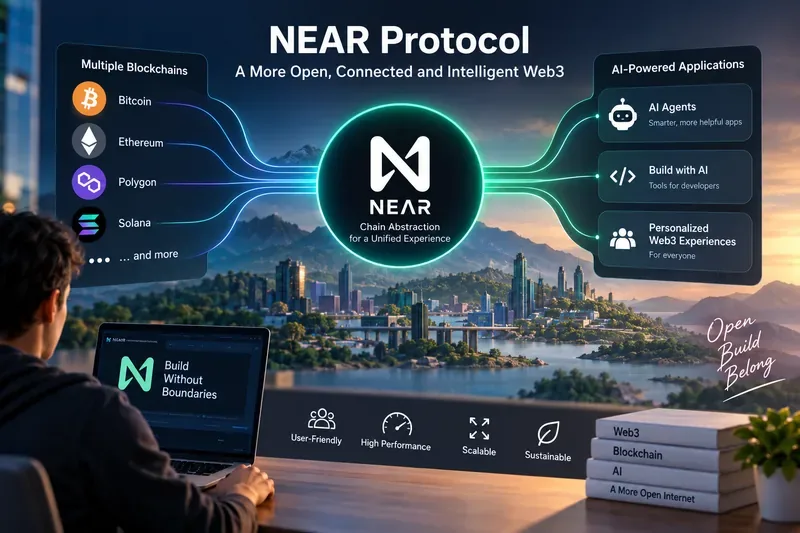
A conceptual view of NEAR’s chain-abstraction thesis: multiple blockchain networks on one side, a shared execution layer in the middle, and AI-powered applications on the other.
The core problem NEAR is trying to solve
Most blockchains work well inside their own boundaries. The friction appears when an application needs to interact with assets or services on several chains. A user may have BTC on Bitcoin, USDC on Base, and another asset on Solana. Traditionally, using all three requires separate accounts or wallet logic, chain-specific transaction formats, different signing curves, multiple gas assets, and often one or more bridge transactions.
NEAR’s official chain abstraction overview frames the goal as hiding that infrastructure complexity from both people and AI. Instead of forcing an application to expose every underlying rail, the application can focus on what the user wants to accomplish.
This is not the same as saying every blockchain becomes NEAR or that assets are automatically moved onto NEAR. The more precise idea is that NEAR provides coordination, signing, routing, and settlement components that can make multi-chain actions feel like a single workflow.
What chain abstraction means in practice
The easiest way to understand chain abstraction is to separate it into three layers: control, execution, and settlement.
Layer
NEAR component
What it is trying to simplify
Control
Chain Signatures
Signing transactions for assets and accounts on external chains
Execution
NEAR Intents
Expressing the desired result without manually choosing every route and transaction
Movement and connectivity
OmniBridge and connected infrastructure
Moving supported assets or liquidity between ecosystems
1. Chain Signatures: one control plane for multiple chains
Chain Signatures are one of the most important building blocks. NEAR describes them as a way for NEAR smart contracts to sign transactions on other blockchains through a multi-party computation, or MPC, network. The practical effect is that an application can coordinate actions on external networks without embedding a separate private key for every chain inside the application.
The official NEAR chain abstraction page explains that this design can support cross-chain execution, including environments that are not native NEAR smart-contract platforms. A separate NEAR Intents chain-abstraction use case describes an MPC network deriving chain-specific addresses from a user’s existing signing setup so that one interface can coordinate assets across supported chains.
That distinction matters. The user is not necessarily moving every asset into a wrapped representation on one master chain. In the intended design, assets can remain on their native networks while control is abstracted through a shared signing layer.
2. NEAR Intents: specify the outcome, not every transaction
Chain Signatures answer the question, “How can an application authorize actions across different networks?” NEAR Intents addresses a different question: “How can a user ask for a result without manually constructing the full route?”
An intent is a statement of the desired outcome. For example, a user might want to exchange one asset for another across chains. Instead of manually choosing a bridge, swapping an intermediate token, managing gas, and executing each transaction in sequence, an intent-based system lets external solvers compete or coordinate to fulfill the request under defined conditions.
The official NEAR Intents site describes the system as a universal liquidity and execution layer for cross-chain markets. As of September 2026, its public site reports support across dozens of chains and billions of dollars in cumulative volume. Those figures are live ecosystem metrics and can change, so they should be treated as a current snapshot rather than permanent specifications.
3. OmniBridge and asset connectivity
Intent-based execution still needs infrastructure that can connect otherwise separate environments. NEAR presents OmniBridge as part of this connectivity layer. The bridge component is not identical to Intents or Chain Signatures: it deals with supported asset movement between networks, while Intents focuses on the user’s requested outcome and Chain Signatures focus on authorization.
This separation is useful because it prevents “chain abstraction” from becoming a vague marketing term. It is better understood as a stack of components that solve different parts of the cross-chain problem.
Why AI agents make chain abstraction more important
A human can tolerate some friction. An AI agent that is expected to operate continuously cannot rely on a person to approve every wallet switch, replenish every gas token, or manually pick a bridge. If autonomous agents are going to pay for services, rebalance assets, settle tasks, or interact with protocols, they need a more uniform transaction layer.
That is why NEAR’s 2026 roadmap explicitly connects two pillars: cross-chain financial infrastructure and autonomous AI agents. In NEAR’s model, chain abstraction provides the execution rails while AI provides the decision-making and automation layer.
The important point is that the AI model itself is not replacing the blockchain. The model can decide what action to request, while blockchain components handle authorization, execution, settlement, and verification.
NEAR AI: more than an on-chain chatbot
NEAR’s AI strategy has expanded beyond simply hosting models or attaching a chatbot to a wallet. The current NEAR AI platform focuses heavily on confidential inference, autonomous agents, and infrastructure that lets software agents perform economic activity.
The NEAR AI platform describes confidential inference as running models inside hardware-enforced trusted execution environments, or TEEs. In this model, the prompt and model execution occur inside an isolated environment intended to prevent the infrastructure operator from reading the data in use.
In August 2026, NEAR AI announced an integration with Intel Trust Authority for independent attestation of confidential inference. According to NEAR AI’s August 12, 2026 announcement, workloads running in Intel TDX environments can return Intel-signed attestation evidence that downstream systems can verify. This is a meaningful distinction from a simple privacy policy: the stated goal is to make the execution environment cryptographically verifiable.
How confidential AI and chain abstraction connect
The two ideas solve different trust problems.
Chain abstraction reduces the operational complexity of interacting with many blockchains.
Confidential inference aims to protect the data used by the AI model while that model is running.
Attestation gives a user or application evidence about the environment in which the model executed.
Intents and Chain Signatures give an agent mechanisms for turning a decision into a cross-chain action.
Put together, an agent could theoretically receive private user instructions, reason inside a confidential environment, produce an intended financial action, and then use chain-abstraction infrastructure to execute that action across supported networks. That is the architectural connection NEAR is pursuing.
However, the pieces should not be conflated. A TEE does not guarantee that an AI agent makes a good decision. Chain Signatures do not guarantee that every external protocol is safe. An intent solver does not eliminate market risk. Each layer addresses a narrower problem.
Shade Agents and autonomous execution
NEAR also highlights Shade Agents as a way to combine AI agents, TEEs, Chain Signatures, and cross-chain execution. The official chain abstraction page describes Shade Agents as AI-powered smart-contract systems designed for verifiable and multi-chain operation.
The attraction is easy to see: an agent could potentially run continuously, maintain private state, and take actions without a centralized custodian holding a traditional hot-wallet key. But this is also where the security model becomes more complex. Users must consider the agent’s code, the permissions granted to it, the TEE implementation, the signing policy, the external protocols it interacts with, and the economic constraints around each action.
A practical example: cross-chain portfolio rebalancing
Consider a user who holds BTC, ETH, and stablecoins across several networks and wants an agent to keep a target allocation. In a traditional setup, the agent may need separate wallet integrations, bridge logic, gas management, and chain-specific transaction signing for every network.
With NEAR’s proposed stack, the workflow can be simplified conceptually:
The user gives the agent a policy, such as maintaining a defined portfolio allocation.
The AI analyzes balances and decides that a rebalance is necessary.
The application expresses the desired outcome as an intent.
Solvers or routing infrastructure find an execution path.
Chain Signatures authorize the necessary transactions on supported external chains.
Assets settle on their respective destination networks.
From the user’s perspective, the interaction can be much simpler than manually coordinating each chain. Under the hood, however, the system still depends on multiple protocols and security assumptions.
What changed in 2026?
The most important development is that NEAR’s AI and chain-abstraction strategies are now visibly converging. The 2026 NEAR roadmap explicitly presents cross-chain finance and autonomous AI agents as complementary infrastructure rather than separate experiments.
NEAR AI also shipped several concrete additions during 2026. Its official blog documents confidential inference updates, agent infrastructure, crypto-based payments for AI services, and independent attestation. For example, a January 2026 release added crypto payments for inference and team workspaces, while the August 2026 Intel Trust Authority integration strengthened the verification story around confidential inference.
These developments do not prove that the entire “agentic economy” vision has been achieved. They do show that the project has moved from a broad narrative toward deployable infrastructure with public products and integrations.
Where the model is strongest
NEAR’s approach is most compelling in situations where users or applications genuinely need to operate across several chains. A single-chain application with no cross-chain requirements may not benefit much from the added abstraction layer.
The architecture is especially relevant for:
Wallets that want to expose multi-chain assets through one user experience.
Cross-chain trading and payment applications.
AI agents that need programmable access to assets on different networks.
Applications that want outcome-based execution rather than manual bridge-and-swap workflows.
Privacy-sensitive AI workloads that benefit from confidential inference and attestation.
What still requires caution
Abstraction reduces visible complexity; it does not eliminate underlying risk. Anyone evaluating NEAR’s chain-abstraction and AI stack should examine several layers separately.
Solver and routing risk
Intent systems depend on the quality of available solvers, liquidity, pricing, and execution guarantees. “One click” does not mean every route is equally efficient or risk-free.
Smart-contract and bridge risk
Cross-chain systems can inherit vulnerabilities from smart contracts, bridge infrastructure, relayers, and connected protocols. The user experience may hide those components, but the security exposure remains.
Agent permissions
An autonomous agent should not automatically receive unlimited authority. Spending limits, allowlists, time limits, revocation paths, and human approval thresholds can be more important than model intelligence.
TEE assumptions
Trusted execution environments provide a hardware-backed isolation model, but they are still a specific security architecture with implementation and supply-chain assumptions. Independent attestation improves verifiability, but users should still evaluate what exactly is measured and what remains outside the trusted boundary.
Changing ecosystem coverage
Supported chains, assets, solvers, models, and integrations change over time. Before building production dependencies, developers should confirm the current compatibility list in the official NEAR and NEAR Intents documentation rather than relying on older articles or screenshots.
How to check whether NEAR’s approach is actually useful for you
A simple self-check is more useful than asking whether chain abstraction is “better” in the abstract.
List the chains you actually need. If your product only operates on one network, abstraction may add unnecessary complexity.
Identify the user-visible friction today. Are users switching wallets, buying gas tokens, bridging assets, or signing several transactions?
Separate custody from execution. Understand who can authorize transactions and where key material or signing authority lives.
Test the failure path. Ask what happens if a solver cannot fill an intent, a bridge pauses, an external chain is congested, or an AI agent produces an invalid action.
Verify current support. Check official NEAR Intents and NEAR AI documentation for the chains, assets, models, and attestation methods you plan to use.
Set explicit agent limits. For AI-driven workflows, define spending caps, permissions, allowed protocols, and human approval conditions before enabling automation.
If those checks show that most of your current complexity comes from cross-chain coordination, NEAR’s architecture is directly addressing the problem. If the main challenge is elsewhere—such as application logic, liquidity depth, or regulatory compliance—chain abstraction alone will not solve it.
Bottom line
NEAR Protocol’s 2026 direction is best understood as an attempt to build a common execution layer for both humans and software agents. Chain Signatures aim to unify authorization across networks. NEAR Intents shifts the user experience from constructing transactions to specifying outcomes. OmniBridge and related connectivity infrastructure help move supported assets. NEAR AI adds confidential inference, verifiable execution environments, and autonomous-agent tooling on top.
The long-term promise is straightforward: users and AI agents should be able to think in terms of assets, goals, and applications rather than blockchain plumbing. The hard part is making that abstraction secure, verifiable, liquid, and reliable across many independent networks. NEAR has shipped meaningful pieces of that stack, but the right way to evaluate it is component by component—not as a claim that cross-chain complexity has disappeared.