You see an alert saying that 5,000 BTC just moved, Bitcoin starts wobbling, and social media immediately calls it a “whale dump.” The practical problem is that the transaction itself does not tell you whether anyone sold. A large transfer can be an exchange deposit, an exchange withdrawal, a custodian reorganizing wallets, an institution moving collateral, or simply one owner shifting coins between addresses.
That distinction matters because Bitcoin trades around the clock across many venues. A blockchain transfer records movement of coins; a market trade records an exchange of assets. Treating the first as proof of the second is one of the easiest ways to misread whale activity.
What Is a Bitcoin Whale?
“Whale” is market slang, not a Bitcoin protocol classification. It generally means a holder or market participant large enough that its transactions or orders attract attention. There is no universally correct BTC threshold. A fixed cutoff can also be misleading because liquidity, Bitcoin’s dollar price, exchange depth, and the holder distribution change over time.
For tracking purposes, a better definition is operational: a whale transaction is a transfer large enough to be unusual relative to recent network activity or large enough to matter relative to the liquidity of the venue where the coins might be traded.
Why a Huge On-Chain Transfer May Not Move the Price
Bitcoin transactions identify inputs and outputs, not the economic intent behind them. One entity can control many addresses, and one transaction can contain multiple outputs, including change returned to the sender. Address labels supplied by analytics services are also interpretations rather than fields embedded in Bitcoin itself.
Bitcoin Core's current release documentation also illustrates why network data must be interpreted carefully: its mempool is the set of transactions a node currently knows about before confirmation, and Bitcoin Core 31.0 changed internal mempool policy and transaction ordering behavior. See the Bitcoin Core 31.0 release notes and the protocol background in BIP 35. A transaction observed before confirmation is therefore evidence of a broadcast transaction, not evidence that coins have already been sold on an exchange.
Step 1: Verify the Transaction Before Reacting
Start with the transaction ID in a reputable Bitcoin block explorer or your own node. Check the BTC amount, timestamp, inputs, outputs, fee, confirmation status, and whether the transfer is still unconfirmed. If an alert only provides a screenshot or a rounded dollar figure, find the underlying transaction before drawing conclusions.
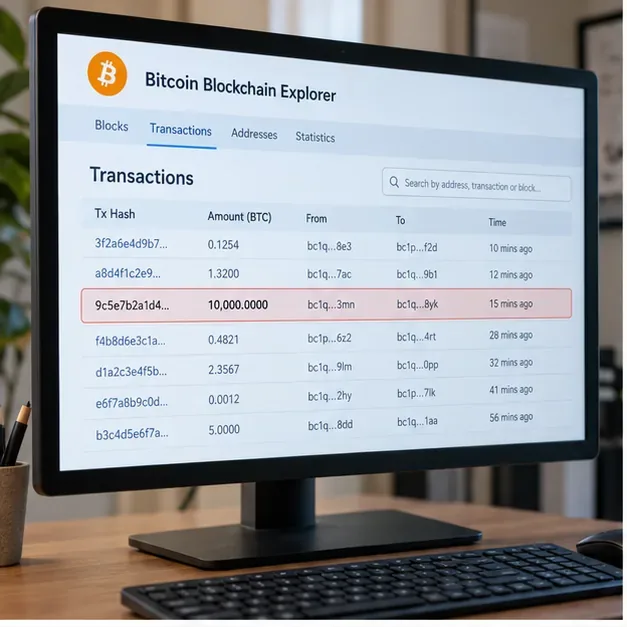
Caption: Start with the underlying transaction record and inspect its amount, inputs, outputs, timing, and confirmation status rather than relying on a social-media alert.
Then ask whether the headline amount represents real economic movement. A transaction with a very large input can return most of the value to a change address. Likewise, a wallet consolidation can combine many old unspent transaction outputs without representing a new investment decision.
Step 2: Determine Where the Coins Appear to Be Going
The destination is usually more informative than the raw size. If credible address attribution indicates that coins moved from a private wallet into a known exchange-controlled cluster, the transfer may increase immediately available exchange supply. That can be relevant to sell-side risk, but it still does not prove a sale occurred.
The reverse pattern can carry different information. A large withdrawal from an exchange to a self-custody address reduces coins visible on that venue, but it is not automatically bullish. The owner may be moving to another custodian, posting collateral elsewhere, changing custody arrangements, or preparing an over-the-counter transaction.
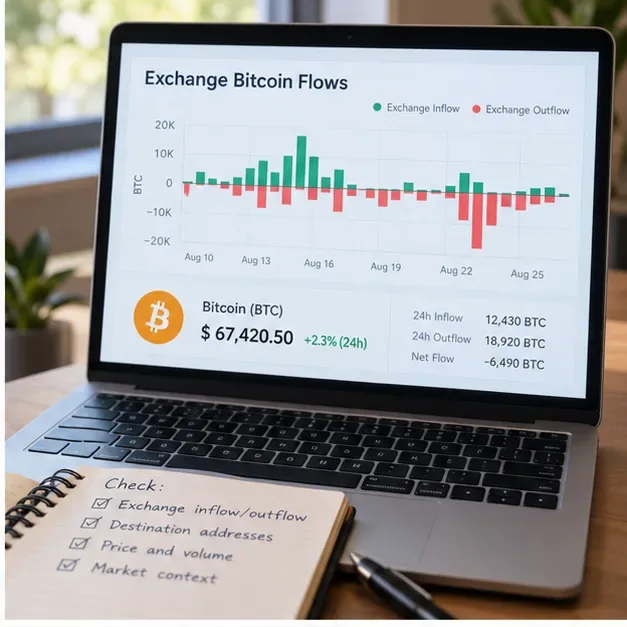
Caption: Compare the large transfer with exchange inflows and outflows, while treating address labels and inferred destinations as evidence that can contain uncertainty.
A useful interpretation table
| Observed pattern | Possible interpretation | What you still need to verify |
|---|
| Private wallet → exchange | Coins may become available to sell | Did spot selling, order-book pressure, or volume actually increase? |
| Exchange → private wallet | Withdrawal or custody change | Is the destination genuinely external and does the entity attribution hold? |
| Large unknown → unknown transfer | Ownership transfer or internal wallet management | Entity labels, subsequent hops, and market response |
| Exchange → exchange | Liquidity, custody, settlement, arbitrage, or client transfer | Whether net exchange balances changed materially |
Step 3: Check Whether the Market Confirms the Story
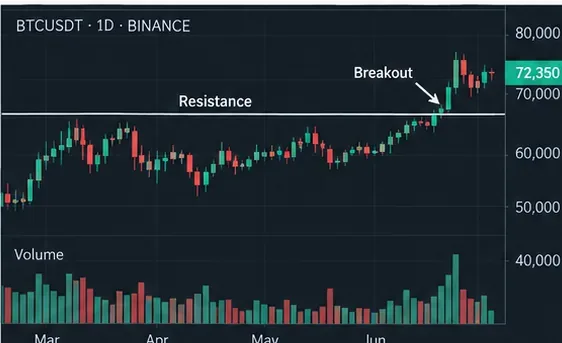
Once you know what moved, look at what traded. Compare BTC spot price, trading volume, bid-ask spread, order-book depth, and price behavior across several major venues around the transaction time. A genuine market-moving sale should normally leave some footprint in traded volume or liquidity, although the footprint can be distributed across exchanges or executed gradually.
This is where the size of the transaction needs context. Ten thousand BTC transferred on-chain is not equivalent to a 10,000 BTC market sell order. Large holders can use limit orders, algorithms, multiple venues, derivatives, or over-the-counter execution specifically to reduce visible market impact.
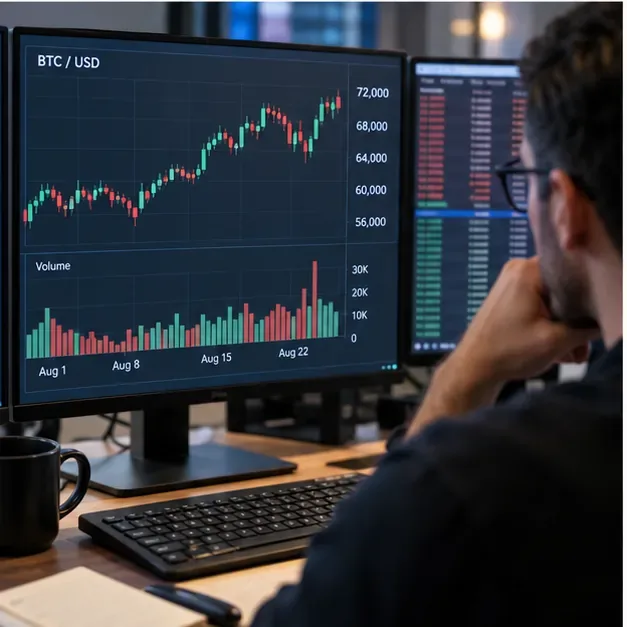
Caption: After identifying a large transfer, check actual price, volume, spreads, and market depth to see whether trading activity confirms the proposed whale narrative.
Step 4: Add Derivatives and Liquidity Context
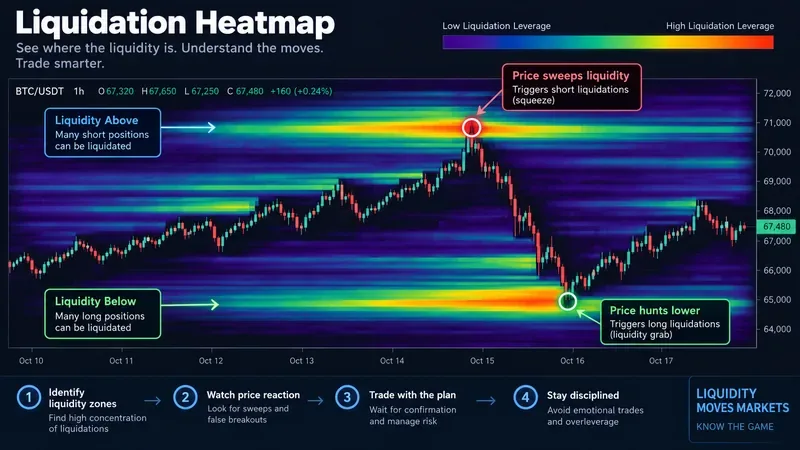
If spot price moves sharply after a whale alert, the whale may still not be the whole explanation. Futures positioning, liquidations, leverage, macroeconomic news, ETF-related flows, and thin liquidity can amplify or even dominate the move. A transfer that would barely matter in a deep market can have more impact during a low-liquidity period.
Regulators explicitly warn that crypto markets can be volatile and subject to manipulation. The U.S. Commodity Futures Trading Commission notes that virtual-currency cash markets can experience volatile swings and manipulation risk, while derivatives can amplify gains and losses. Its virtual currency trading advisory recommends understanding the risks rather than assuming a strategy can reliably predict returns.
So use whale data as a context signal, not a standalone trading trigger. The CFTC also cautions investors against acting on single social-media tips or sudden price spikes in its pump-and-dump advisory. Although that advisory discusses digital-asset manipulation more broadly, the practical lesson applies here: an eye-catching alert is not sufficient evidence for a trade.
Step 5: Follow the Coins After the First Hop
For more advanced analysis, do not stop at the first destination. Watch subsequent transactions. Coins may enter an intermediary wallet and then split among multiple addresses, reach a known service later, or return to an address cluster associated with the original entity.
Be careful with attribution. Blockchain analysis can infer common control using transaction patterns and external labels, but those inferences are not guaranteed. Custodians and exchanges can also hold coins for many customers, so an exchange-controlled address does not reveal which customer owns the economic position.
Step 6: Separate Correlation From Market Impact
Suppose a large exchange inflow appears at 14:00 and Bitcoin falls 2% by 14:30. That sequence is worth investigating, but timing alone does not prove causation. Check whether selling volume rose at the destination venue, whether other exchanges moved simultaneously, whether a news event occurred, and whether leveraged positions were liquidated.
A stronger case combines several independent observations: credible destination attribution, unusually large net inflow, rising spot sell volume, weakening bids or wider spreads, synchronized price movement, and no more convincing competing catalyst. Even then, describe the conclusion probabilistically rather than claiming certainty about an anonymous holder's intention.
Common Whale-Tracking Mistakes
- Calling every exchange deposit a dump. A deposit creates the possibility of selling; it does not document a completed sale.
- Ignoring change outputs. The headline transaction value can overstate the amount that actually changed economic ownership.
- Counting internal exchange transfers as new flows. Exchanges routinely reorganize hot and cold wallets.
- Trusting one address label without corroboration. Attribution databases can be incomplete, stale, or probabilistic.
- Looking only at USD value. A transfer can appear enormous because Bitcoin's price rose even if its BTC size is not historically unusual.
- Assuming whales always move markets immediately. Execution method and available liquidity determine impact more directly than wallet size alone.
How Large Bitcoin Transactions Can Actually Move the Market
The direct mechanism is liquidity consumption. If a large participant sends aggressive sell orders into an order book, those orders consume available bids. When the order is larger than liquidity near the current price, execution reaches progressively lower bids and the traded price falls. Aggressive buying works in the opposite direction.
The indirect mechanism is expectations. Traders who see a credible large exchange inflow may reduce risk or sell before the holder acts. That reaction can move price even if the original coins remain unsold. Conversely, a widely publicized withdrawal can encourage bullish positioning. This feedback effect is why interpretation discipline matters: market participants can react to the signal before its meaning is known.
Arbitrage also limits isolated price moves. Bitcoin trades on multiple venues, so a price dislocation on one liquid exchange can attract traders buying where Bitcoin is cheaper and selling where it is more expensive. That does not eliminate volatility, but it means “one whale, one transaction, one global price move” is usually too simple a model.
Final Self-Check: Is Your Whale Signal Actually Useful?
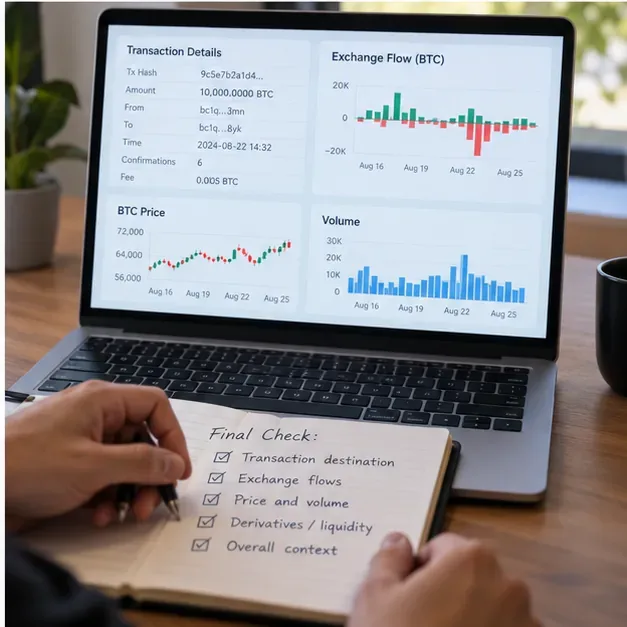
Caption: Before acting, verify the transaction destination, exchange flows, price and volume response, derivatives and liquidity conditions, and the broader market context.
Before you use a whale alert in a decision, run this final check:
- Can you verify the actual transaction ID and confirmation status?
- Did you inspect outputs rather than relying on the headline input value?
- Is the destination label credible, and can you distinguish an exchange deposit from an internal transfer?
- Did net exchange flow change materially rather than just gross transfers?
- Did spot volume, price, spreads, or depth confirm unusual trading pressure?
- Did you check derivatives, liquidations, news, and liquidity for competing explanations?
- Have you followed subsequent hops where attribution is uncertain?
- Are you describing the conclusion as evidence-based probability rather than certainty?
If several answers are “no,” the alert is still an observation, not a trading thesis. If most answers are “yes” and independent market data point in the same direction, the whale transaction becomes more informative—but never deterministic. Bitcoin markets remain volatile, and no on-chain signal can guarantee the next price move.
Bottom Line
Whale tracking is most useful when it slows you down rather than makes you react faster. Verify the transaction, identify the likely destination, compare net exchange flows, confirm the market response, add derivatives and liquidity context, and follow the coins when necessary. The goal is not to predict every move made by a large holder. It is to separate observable blockchain facts from plausible interpretations and unsupported stories.