You keep part of your crypto portfolio in a token labeled “stable” because you want dry powder for the next trade. Then the token slips from $1.00 to $0.97. Within minutes, social feeds split into two camps: one says the peg will recover and the other says to exit immediately. The dangerous assumption is that every stablecoin has the same mechanism—and therefore the same path back to $1.
Algorithmic de-pegs deserve special attention because stability may depend heavily on market incentives, arbitrage, endogenous tokens, liquidity, and confidence rather than a simple contractual claim on highly liquid reserve assets. The practical defense is to understand what actually supports the peg, limit concentration, verify redemption mechanics, and decide in advance what evidence would make you reduce or exit an exposure.
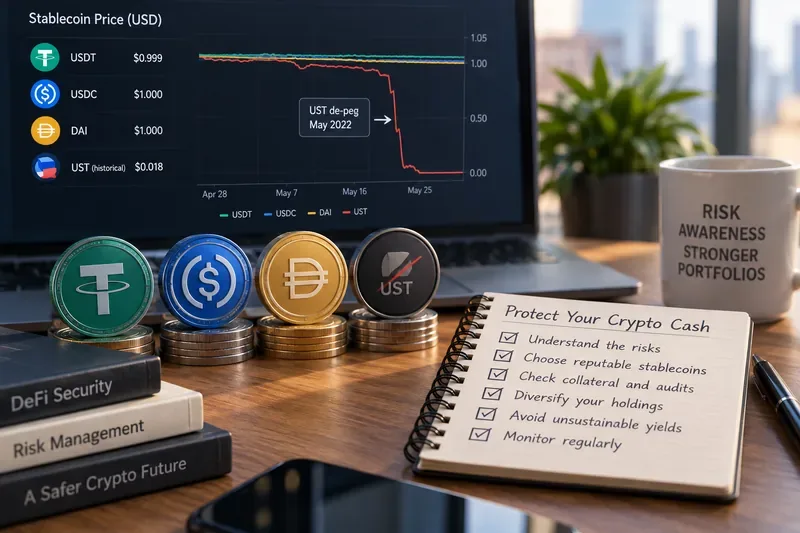
Caption: A stablecoin label does not make every $1 token equivalent; protecting crypto cash starts with understanding the peg mechanism, redemption path, liquidity, and concentration risk.
Why Can an Algorithmic Stablecoin Lose Its Peg So Fast?
A stablecoin needs a mechanism that creates credible demand near its target price. In a traditional reserve-backed structure, that can include a legal redemption claim against an issuer holding eligible reserve assets. In an algorithmic structure, price stability can instead rely substantially on rules that expand or contract supply and on arbitrageurs who are expected to trade when the market price moves away from the target.
The weakness appears when the stabilizing incentive becomes less valuable precisely when confidence is falling. If a stablecoin can be exchanged for another crypto token, for example, a run on the stablecoin can increase issuance or selling pressure in the companion token. Falling value in that token can then weaken confidence in the mechanism, producing a feedback loop.
TerraUSD, or UST, is the defining historical example. The U.S. Securities and Exchange Commission described UST as an algorithmic stablecoin that was intended to maintain its dollar peg through interchangeability with LUNA. The SEC's Terraform Labs litigation release records the agency's case concerning the system. In May 2022, the mechanism failed to restore the peg during the collapse.
What Did the Terra Collapse Actually Prove?
It did not prove that every stablecoin will fail or that every automated mechanism is identical. It demonstrated that a peg can become fragile when market confidence, liquidity, and the value of a linked token are part of the stabilization mechanism.
The SEC's complaint states that UST de-pegged again in May 2022, the algorithm failed to maintain the peg, and UST and Terraform's other crypto assets fell to near zero. The SEC later announced that Terraform Labs and Do Kwon agreed to pay more than $4.5 billion after a jury found them liable for fraud; the agency said the collapse wiped out more than $40 billion in market value. See the SEC's June 2024 settlement announcement.
There is an additional lesson about verification. In December 2024, the SEC said Tai Mo Shan had traded UST during a May 2021 de-peg in a way that misled the market into believing Terraform's algorithmic mechanism was stabilizing the token when large incentivized purchases were contributing to the recovery. The SEC order announcement is a useful reminder that a previous peg recovery does not prove that the advertised mechanism worked as assumed.
Step 1: Identify What Really Holds the Token Near $1
Do not begin with the token's name, yield, or historical chart. Begin with the stabilization mechanism. Ask what a holder can obtain when redeeming one token and who is legally or economically obligated to provide it.
| Structure | Primary support for the peg | Risk to investigate |
|---|
| Fiat/reserve-backed | Issuer redemption plus reserve assets | Reserve quality, custody, legal claim, redemption eligibility, banking access |
| Crypto-collateralized | On-chain collateral and liquidation mechanisms | Collateral volatility, oracle failure, liquidation capacity, smart contracts |
| Algorithmic/endogenous | Supply rules, arbitrage incentives, companion tokens, market confidence | Reflexive price decline, inadequate arbitrage demand, liquidity collapse |
| Hybrid | Combination of reserves, crypto collateral, algorithms, or backstops | Which protection remains usable during stress and in what order |
These categories can overlap. A project may describe itself as decentralized or algorithmic while also holding reserves. Another may use on-chain collateral but still depend on governance and external price feeds. Read the actual mechanism rather than forcing every token into one label.
Step 2: Verify Redemption Rights, Not Just Exchange Liquidity
A token trading at $1 on an exchange is not the same thing as a guaranteed $1 redemption right. Find out whether you personally can redeem directly with the issuer or protocol, what asset you receive, minimum amounts, fees, settlement times, identity requirements, supported jurisdictions, and whether redemption can be paused.
This distinction is central to international regulatory thinking. The Financial Stability Board's 2023 global stablecoin recommendations call for comprehensive disclosure of governance, redemption rights, stabilization mechanisms, operations, risk management, and financial condition. For stablecoins referenced to a single fiat currency, the FSB recommends a robust legal claim and timely redemption at par into fiat.
If you cannot determine who owes you what at redemption, treat that uncertainty as risk rather than assuming secondary-market traders will always buy at $1.
Step 3: Check What Happens When Everyone Wants Out
A stablecoin can appear liquid in normal conditions and become difficult to exit during a run. Evaluate both decentralized and centralized market depth. Look at how much can actually be sold near $1 without large slippage, not merely the token's total daily volume.
Then examine the stress path. If the peg breaks to $0.95, what economically motivates someone to buy? If the answer is “they can redeem for $1,” confirm that redemption remains available at scale. If the answer is “they can mint or receive another token worth $1,” ask what happens if that second token falls rapidly as redemptions accelerate.
A stabilization loop is strongest when its arbitrage profit remains credible during stress. If the value offered to arbitrageurs deteriorates with the peg itself, the mechanism can become reflexive.
Step 4: Treat Yield as a Separate Risk Question
A stablecoin yielding 10% is not simply “cash earning 10%.” Determine who is paying the yield and why. It may come from borrower interest, trading fees, token incentives, leveraged strategies, protocol subsidies, or a combination.
High yield can also encourage concentration: investors move more of their supposedly defensive cash position into the token precisely because the return is attractive. That can turn a stablecoin failure into a portfolio-level event.
Do not compare stablecoin yields before comparing principal risks. If one structure offers materially more yield, ask what additional economic risk finances that difference.
Step 5: Diversify the Failure Mechanism, Not Just the Ticker
Holding three stablecoins is not meaningful diversification if all three depend on the same issuer, custodian, collateral, bridge, exchange, lending protocol, or banking channel. Map dependencies.
For example, splitting a cash allocation between two tokens that are both heavily exposed to the same collateral asset may reduce issuer-specific exposure but leave the core collateral risk intact. Likewise, holding the same stablecoin on three chains can add bridge and smart-contract exposure without diversifying the underlying issuer.
A stronger approach separates risks where practical: different stabilization models, custody arrangements, liquidity venues, and—if appropriate for your needs—some assets outside crypto entirely. The correct mix depends on why you hold “cash”: immediate trading collateral, DeFi use, cross-border settlement, or longer-term capital preservation.
Step 6: Decide Your De-Peg Response Before a Crisis
Do not invent a plan while a token is falling. Define signals that trigger review and signals that trigger action. Price alone should not be the only variable.
A mild temporary deviation can result from venue-specific liquidity. More serious warning signs include direct redemption problems, reserve uncertainty, abnormal companion-token issuance, rapidly falling collateral value, widening prices across multiple independent venues, governance emergency measures, depleted liquidity pools, or official disclosures showing that the stabilization mechanism is impaired.
You can create graduated responses rather than one binary rule. A small deviation might trigger verification. A persistent cross-market de-peg plus impaired redemption might trigger exposure reduction. Evidence that the core stabilization mechanism no longer functions may justify treating the token as a risky asset rather than “cash.”
Step 7: Understand the Cost of Waiting for $1
When a token trades below par, investors often focus on the loss from selling and ignore the risk of a much larger loss from waiting. A move from $1.00 to $0.97 is a 3% decline. If the token later reaches $0.50, recovering to $0.97 requires a 94% gain from $0.50. If it approaches zero, the original peg becomes economically irrelevant.
This does not mean every 1% de-peg should be sold. Reserve-backed stablecoins have experienced temporary market-price deviations and recovered. The point is to reassess the mechanism, redemption, and liquidity rather than using “it must return to $1” as the thesis.
Step 8: Reduce DeFi Layers Around Your Cash Reserve
A stablecoin in your wallet has one risk profile. The same token deposited into a lending protocol, wrapped through a bridge, placed in a liquidity pool, and used as collateral for a leveraged position has several additional failure points.
If the purpose of an allocation is capital preservation or rapid access to trading funds, ask whether each extra layer is necessary. Smart-contract exploits, oracle failures, bridge incidents, liquidations, withdrawal queues, and protocol governance can turn a stablecoin problem into a larger loss.
During a de-peg, leveraged positions can be especially dangerous because collateral values and liquidation thresholds can change faster than a holder can manually respond.
What Should You Monitor Regularly?
- Price across multiple venues: distinguish a local liquidity problem from a broad de-peg.
- Direct redemption: check whether redemptions operate normally and at the expected value.
- Reserve or collateral information: review current official disclosures rather than old screenshots.
- Market depth: estimate what your own position could exit for, not the quoted price for a tiny trade.
- Supply changes: sudden expansion can matter, especially when linked to a stabilization token.
- Governance and emergency changes: watch official channels for changes to minting, redemption, collateral, or risk parameters.
- Dependency health: monitor important custodians, bridges, or collateral assets that the stablecoin relies on.
How Do You Self-Check Whether Your Crypto Cash Is Protected?
Write down each stablecoin you hold and answer these questions without relying on marketing language:
- What exactly keeps this token near its target price?
- Can I redeem directly, and what legal or protocol claim do I have?
- What assets or tokens ultimately absorb losses?
- Could the stabilization asset fall because people are redeeming the stablecoin?
- How much could I sell today within 0.5% or 1% of the target price?
- What percentage of my liquid portfolio depends on this one mechanism?
- Is my yield coming from sustainable economic activity or temporary incentives?
- What would make me reduce exposure, and what would make me exit?
- Have I added lending, bridge, leverage, or smart-contract risks to money I call “cash”?
If you cannot answer the first four, the immediate improvement is research, not optimization. If one token or one stabilization mechanism dominates your liquid reserves, the next improvement is concentration control. If your exit plan depends on a single exchange or a single liquidity pool remaining open during stress, improve the exit path before chasing additional yield.
Bottom Line
The central risk of an algorithmic de-peg is not simply that a token can trade at $0.99 instead of $1. It is that the mechanism intended to restore the peg can weaken as confidence and liquidity disappear, creating a feedback loop at exactly the moment holders need stability most.
Protecting crypto cash therefore requires more than watching a price chart. Understand the stabilization mechanism, verify redemption rights, test liquidity assumptions, separate yield from safety, diversify underlying failure modes, limit unnecessary DeFi layers, and establish a response plan before a de-peg begins.
No stablecoin structure eliminates risk. The goal is to know what can fail, how quickly it can affect your holdings, and what evidence tells you that your original “cash” assumption is no longer valid.
Risk note: This article is educational and does not constitute individualized financial advice. Stablecoins, smart contracts, exchanges, custodians, collateral assets, and blockchain networks can fail or become illiquid, and historical peg recovery does not guarantee future redemption or price stability.