Home
» News
»
Sui vs. Aptos in 2026: Which Move-Based Layer 1 Fits You Best?
Sui vs. Aptos in 2026: Which Move-Based Layer 1 Fits You Best?
Updated September 15, 2026: Sui and Aptos remain the two most prominent Layer 1 networks built around Move-derived smart-contract technology, but choosing between them is increasingly about architecture and application fit rather than shared ancestry. Sui is leaning into an object-centric model, Mysticeti consensus, payments, DeFi, Bitcoin finance, gaming, and agentic applications. Aptos continues to evolve its Block-STM-based execution stack through frequent mainnet upgrades, including 2026 activations for concurrent fungible balances and new confidentiality and encrypted-mempool infrastructure.
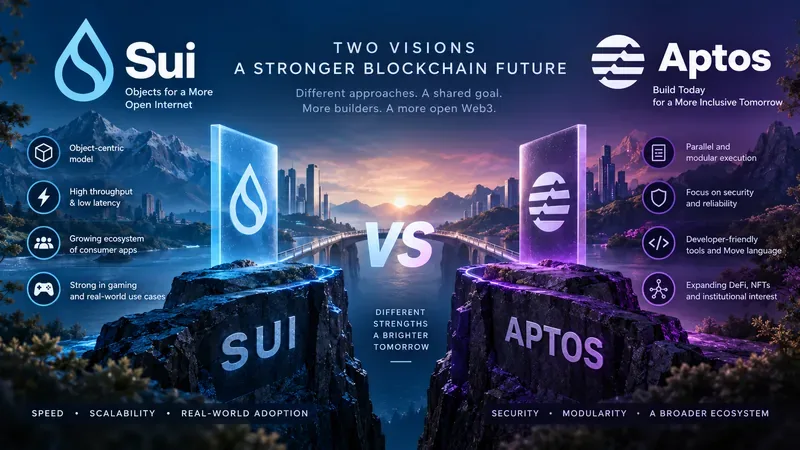
Sui and Aptos share Move roots but make different architectural choices around state, parallel execution, and the applications their ecosystems emphasize.
Are Sui and Aptos really competing for the same developers?
Yes, but not as directly as the “Move chain versus Move chain” label suggests. Both appeal to developers who want a resource-oriented smart-contract language, parallel execution, proof-of-stake security, and a high-performance Layer 1. Yet the way applications express state and concurrency differs enough that a serious team should prototype rather than assume code portability.
Sui's official documentation describes it as an asset-oriented platform powered by Move, with objects forming a fundamental state abstraction. Aptos supports Move modules, resources, objects, fungible assets, sponsored transactions, keyless accounts, orderless transactions, and other chain-specific primitives. Start with the official Sui documentation and official Aptos developer documentation.
Which architecture is easier to reason about?
Sui is especially compelling when your application naturally decomposes into independent objects. The Sui platform paper explains that transactions operate on owned or shared objects and that execution involving different shared objects can be parallelized. This can map cleanly to assets such as game items, credentials, collectibles, positions, or other state with explicit ownership.
Aptos takes a different route. Its Block-STM engine performs optimistic parallel execution: transactions execute concurrently, conflicts are detected, and conflicting work can be re-executed. The Aptos white paper emphasizes that Block-STM can extract inherent parallelism without requiring users to provide advance hints about all data locations a transaction will read or write. Read the Aptos Foundation white paper.
The practical tradeoff is important. Sui encourages developers to think about object relationships and ownership as part of application architecture. Aptos lets the execution engine discover parallelism optimistically across an ordered workload. Neither makes contention disappear: applications that repeatedly mutate the same hot state can still face bottlenecks.
Which chain has the stronger consensus and finality story?
Both are designed for fast Byzantine fault-tolerant settlement, but Sui's current architecture puts particular emphasis on Mysticeti. The published Mysticeti research describes a DAG-based consensus protocol that reaches a three-message-round latency bound and adds a fast path for asset transfers. See the Mysticeti research paper.
Sui Foundation's September 2026 builder material reports roughly 390-millisecond settlement under its current network design. That is a first-party operational claim, so teams considering latency-sensitive deployment should benchmark their own transaction type, region, RPC provider, and load rather than treat one average as a universal service-level guarantee.
Aptos's architecture pipelines transaction dissemination, block ordering, parallel execution, batch storage, and ledger certification. Block-STM is the execution component, not the entire consensus mechanism. That distinction matters because comparing “Mysticeti versus Block-STM” as if they were identical layers is technically misleading.
Which is faster: Sui or Aptos?
There is no defensible universal winner from a single TPS number. Throughput depends on workload complexity, contention, hardware, batching, transaction construction, and whether a benchmark measures execution alone or full end-to-end settlement.
The Aptos white paper, for example, reports an execution-only Block-STM experiment using 10,000-transaction blocks and an in-memory database. Under its stated setup, Block-STM achieved a 16x speedup over sequential execution with 32 threads at low contention and more than 8x under high contention. Those are useful component results, but the paper explicitly identifies the benchmark as execution-only rather than end-to-end.
Sui has also publicized very large 2026 experimental numbers. A July AI-agent livestream reportedly peaked above six million transactions per second, but Sui explains that the result came from programmable tunnels—offchain channels that ultimately settle to mainnet. It should not be compared directly with ordinary Layer 1 smart-contract TPS. For production selection, benchmark your own application.
Does Move make switching between Sui and Aptos easy?
It makes the learning curve smaller, not the migration trivial. Developers familiar with Move concepts such as modules, abilities, resource safety, and explicit asset semantics will recognize common ideas. Platform APIs and state models still diverge.
Sui Move is deeply tied to Sui objects, ownership types, programmable transaction blocks, and its framework. Aptos Move integrates with Aptos accounts, framework modules, object and fungible-asset standards, and its own transaction APIs. A production dApp also depends on wallets, SDKs, RPC services, indexers, bridges, oracles, and ecosystem contracts, none of which become portable merely because both chains use Move.
Which is better for DeFi?
Choose based on the financial primitive you actually need. Sui's current DeFi push includes DeepBook, gasless transfers for supported stablecoins, and Hashi's Bitcoin-finance initiative. On September 2, 2026, Sui described DeepBook as its onchain liquidity layer spanning spot, margin, and prediction-market functionality. It also said Hashi had not yet shipped to mainnet, an important limitation when evaluating Bitcoin-related plans. See Sui's September 2026 DeFi overview.
Aptos offers a mature fungible-asset framework and continues to modify it at protocol level. Aptos governance records show that CONCURRENT_FUNGIBLE_BALANCE was enabled on mainnet on August 24, 2026. For high-concurrency financial applications, that is more meaningful than relying only on older descriptions of Aptos. Verify current deployments through the Aptos governance portal.
Which is better for games and consumer apps?
Sui's object-centric architecture deserves an early test when users own many distinct assets. Its ecosystem also exposes zkLogin for Web2-style authentication and programmable transaction blocks that can compose multiple actions atomically. Sui has continued to position gaming and consumer applications as important use cases.
Aptos should not be dismissed for consumer products. Its official developer stack includes sponsored transactions, Keyless accounts, onchain randomness, orderless transactions, and object primitives. For a consumer team, the decisive test is rarely abstract architecture. Measure onboarding completion, signing friction, sponsored-transaction behavior, wallet compatibility, indexing latency, mobile SDK quality, and recovery UX.
What changed on Aptos in 2026 that buyers and builders should know?
Aptos has maintained a rapid governance-driven upgrade cadence. By September 15, the official governance portal shows framework v1.48.0 executed in August, concurrent fungible balances enabled later that month, and an encrypted-mempool framework initialized with ChunkyDKG Shadow V1. Earlier in April, AIP 143 enabling APT for confidentiality was executed.
Aptos governance also approved a proposal for a 2.1 billion APT hard supply cap in March 2026. The proposal itself states that code implementation would follow approval, so the governance vote should not be presented as proof that every implementation step was complete on the execution date. This is a useful example of why investors should distinguish proposals, votes, code deployment, and effective token economics.
What changed on Sui in 2026?
Sui's visible ecosystem expansion has moved beyond generic “high-performance L1” messaging. Its August 2026 Overflow hackathon reported 747 submitted projects from 58 countries, with tracks covering Agentic Web, DeFi & Payments, Walrus, and DeepBook. Hackathon submissions are evidence of builder participation, not proof of lasting users or revenue. See the official Overflow 2026 results.
Institutional infrastructure is another focus. In August, Sui announced tZERO support for digital-security issuance, transfer agency, custody, trading, and settlement. Sui is also emphasizing agentic commerce, stablecoin settlement, post-quantum signatures, and decentralized data infrastructure. These developments broaden the ecosystem thesis, but announced integrations should be distinguished from measured production adoption.
Which chain should a developer choose today?
If your priority is...
Start with...
Reason to test it first
Asset-heavy object workflows
Sui
Objects are fundamental to its state and execution model
Optimistic parallel execution across complex workloads
Aptos
Block-STM dynamically discovers concurrency
Onchain order-book and Sui-native financial primitives
Sui
DeepBook is integrated into its ecosystem strategy
Current fungible-asset concurrency features
Aptos
Concurrent fungible balances were activated in August 2026
Gaming or independently owned digital items
Sui first, then benchmark Aptos
Sui's object model maps naturally to distinct assets
Consumer onboarding
Prototype both
Sui has zkLogin; Aptos has Keyless and sponsored transactions
Move familiarity
Prototype both
Language concepts transfer, ecosystem integrations do not
What should investors compare before choosing SUI or APT?
Do not convert a technology comparison directly into an investment conclusion. Network architecture is only one input. Investors should separately evaluate token supply, staking and validator economics, unlocks, treasury behavior, governance, liquidity, durable fee generation, application retention, stablecoin activity, and whether ecosystem usage creates demand for the native token.
The same caution applies to ecosystem statistics. TVL can rise because token prices rise. Transaction counts can be dominated by low-value activity. Hackathon entries can disappear after judging. Announced partnerships may take time to produce onchain usage. A stronger thesis combines technical capability with recurring economic activity.
So who wins the battle of the Move-based Layer 1s?
There is no universal winner. Sui offers the more distinctive object-first architecture and a current ecosystem narrative centered on fast settlement, payments, DeFi, Bitcoin finance, gaming, data infrastructure, and autonomous agents. Aptos offers a flexible Move environment centered on Block-STM parallel execution and a fast-moving framework whose 2026 governance history demonstrates continuing work on concurrency, privacy, and transaction infrastructure.
For builders, the right decision is empirical: implement one representative state-changing workflow on both networks and test latency, contention, developer effort, indexing, wallet UX, gas behavior, and ecosystem dependencies. For investors, judge SUI and APT as separate economic assets rather than proxies for which engineering design sounds more elegant.
Research note: This comparison was checked against official Sui documentation and research, Sui Foundation updates, Aptos developer documentation, the Aptos Foundation white paper, and Aptos onchain governance records available September 15, 2026. Benchmarks and ecosystem activity are workload- and time-dependent and should be independently rechecked before a deployment or investment decision.