Home
» News
»
Modular vs. Monolithic Blockchains: Celestia, EigenLayer, and What Comes Next
Modular vs. Monolithic Blockchains: Celestia, EigenLayer, and What Comes Next
Blockchain architecture is moving away from a simple “one chain does everything” debate. The more useful question is which functions should stay together, which can be separated, and what new risks appear when a system becomes modular. That matters because execution, settlement, consensus, data availability, proving, sequencing, and shared security can now be combined in many different ways.
As of September 2026, there is no universal winner. Monolithic chains can offer a tighter security and operational model, while modular systems can specialize individual layers and scale different resources independently. Celestia is one of the clearest examples of a specialized data-availability network. EigenLayer plays a different role: it is not simply “another modular blockchain,” but a restaking and shared-security framework that can help additional services bootstrap economic security. Ethereum itself increasingly operates as an L1-plus-L2 system rather than fitting neatly into a purely monolithic label.
What does “monolithic vs. modular” actually mean?
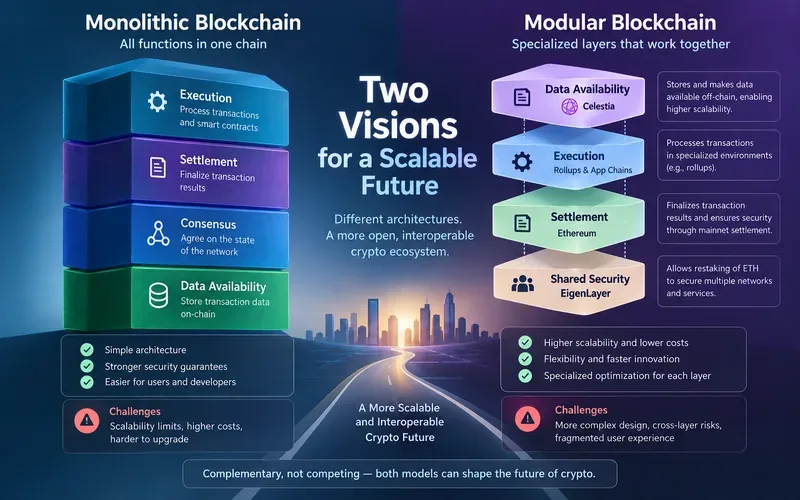
A monolithic blockchain handles the major protocol functions inside one integrated base system. Those functions usually include transaction execution, settlement, consensus, and data availability. The architecture is easier to reason about because the same chain defines the rules, orders activity, verifies state transitions, and makes transaction data available.
A modular blockchain architecture separates some of those jobs into specialized layers. One network may execute transactions, another may provide data availability, and another may provide settlement or security. Celestia’s documentation describes the modular model as one in which execution and settlement can live above a base layer focused on consensus and data availability. Its current documentation also explains data availability sampling, or DAS, which lets light nodes check whether block data has been published without downloading every byte of the block. See the Celestia data availability documentation.
A conceptual comparison of integrated and modular blockchain stacks. The diagram is meant to show how responsibilities can be grouped or separated; actual security guarantees depend on each protocol and configuration.
Is modular automatically better than monolithic?
No. Modularity is a design tool, not a guarantee of better performance or stronger security. Separating functions can let each layer optimize for a narrower job, but it also creates interfaces between layers. Those interfaces introduce additional assumptions: bridges may fail, sequencers may censor, data may be unavailable when needed, proofs may be delayed, or an application may depend on several systems with different trust models.
Monolithic designs reduce some of that cross-layer complexity because the same validator set and protocol rules often govern more of the stack. The trade-off is that every full node may need to handle more work, which can make raw throughput harder to increase without raising hardware or bandwidth requirements.
Action for readers: when comparing two chains, do not stop at transactions per second or fees. Write down where execution happens, where data is published, where final settlement occurs, who can reorder transactions, and which component can cause the system to halt or lose funds.
Where does Celestia fit in the modular stack?
Celestia is best understood as a specialized consensus and data-availability network. Applications and rollups can publish data to Celestia while running execution elsewhere. This changes the scaling problem: instead of asking one base chain to execute every application transaction, Celestia focuses on making block data available and verifiable.
Its key technique is data availability sampling. Celestia erasure-codes block data, and light nodes sample small portions of that data with proofs. Successful sampling gives confidence that the complete block data is available. Celestia also uses namespaced Merkle trees so applications can retrieve and prove the completeness of data relevant to their own namespace rather than downloading unrelated application data.
That does not mean “data availability” is the same thing as permanent storage. Celestia’s own documentation explicitly distinguishes proving that new block data was published from keeping historical data forever. Its current retrievability documentation notes that light-node sampling uses a seven-day rolling window under the present pruning model, so developers still need a plan for long-term historical retrieval. See the Celestia retrievability and pruning documentation.
Action for builders: if you are considering Celestia for a rollup or app chain, define your historical-data strategy separately from your real-time data-availability strategy.
Is EigenLayer a modular blockchain like Celestia?
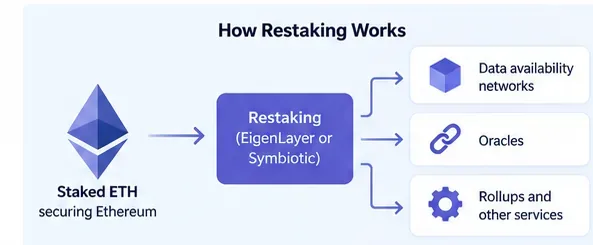
Not in the same sense. This is a common simplification worth correcting. EigenLayer’s core idea is restaking: Ethereum-related stake can be opted into additional validation duties for external services. Those services have historically been called Actively Validated Services, or AVSs. The goal is to let new infrastructure use shared cryptoeconomic security instead of always creating a completely separate validator economy from scratch.
EigenLayer therefore belongs in the modular conversation as a security and coordination primitive rather than simply as a data-availability chain. Eigen Labs described its 2024 mainnet rollout as the launch of a restaking protocol intended to expand cryptoeconomic security for additional services. See the official EigenLayer 2024 Year in Review. The current EigenCloud documentation also positions EigenLayer AVSs as a way to build verifiable services through its developer tooling; see the EigenCloud documentation.
EigenDA is a useful example of how that shared-security model can support modular infrastructure. It is a data-availability service built in the EigenLayer ecosystem, while EigenLayer itself is the broader restaking and security framework. An older but still useful official Eigen Labs architecture explanation describes EigenDA as a data-availability store built on EigenLayer and shows how a rollup can use EigenDA for data while still using Ethereum for other parts of the stack. See the official EigenDA integration overview.
Action for readers: separate “EigenLayer” from “EigenDA” in your mental model. One is the broader shared-security/restaking framework; the other is a specific data-availability system in that ecosystem.
What is Ethereum now: monolithic or modular?
Ethereum is a good example of why the binary label is becoming less useful. Ethereum L1 still integrates execution, consensus, settlement, and native data availability at the base layer. But the ecosystem’s scaling strategy has increasingly moved user execution to L2 rollups while Ethereum provides settlement, security, and data capacity.
The Ethereum Foundation has explicitly described Ethereum as an L1-plus-L2 system. In March 2026, it wrote that the platform should be understood as a mutually reinforcing relationship between L1 and a differentiated network of L2s, while also acknowledging that fragmentation is a major downside of a multichain environment. See the Ethereum Foundation’s L1 and L2 platform strategy.
This is also visible in Ethereum’s data roadmap. EIP-4844 introduced blob space for rollups, making it cheaper to publish L2 data without treating every byte like ordinary execution calldata. Ethereum’s official documentation explains that rollups depend on data availability for independent verification and that blob data is temporary rather than permanent historical storage. See Ethereum.org’s data availability documentation.
What are the biggest trade-offs between the two approaches?
Question
Monolithic approach
Modular approach
Where are core functions handled?
Mostly inside one integrated base protocol.
Split across specialized layers or services.
Scaling strategy
Increase capacity of the base system while keeping functions together.
Scale execution, data availability, proving, or security independently.
Security analysis
Often fewer external dependencies to audit.
Must analyze the weakest relevant layer and the interfaces between layers.
Developer flexibility
More constrained by base-layer design choices.
Can mix execution environments, DA systems, settlement layers, and security services.
User experience
Can be simpler when assets and applications stay on one chain.
May create bridge, wallet, liquidity, and cross-chain fragmentation.
Upgrade path
Changes may require coordination across the integrated protocol.
Individual modules can evolve independently, but compatibility becomes an extra concern.
Does modularity weaken security?
Sometimes, but not necessarily. The important issue is whether a modular system preserves the security properties users think they are getting. A rollup that publishes data to one network, settles on another, uses a centralized sequencer, and depends on a separate bridge has multiple failure domains. A bug or governance compromise in one critical component can matter even if the settlement chain itself remains secure.
On the other hand, specialization can improve security when a layer is designed specifically for one job and exposes clear verification rules. Shared-security systems can also reduce the need for every new service to bootstrap an entirely independent validator set. The result depends on implementation, stake distribution, operator diversity, slashing conditions, proof systems, bridge design, upgrade keys, and operational decentralization.
Action for investors and users: look for a published threat model and a clear description of who can upgrade contracts, stop withdrawals, censor transactions, or replace operators. “Secured by Ethereum,” “uses Celestia,” or “built on EigenLayer” is not enough detail by itself.
What remains uncertain?
Several major questions are still unresolved. First, it is not yet clear which modular services will develop durable fee markets. A technically efficient layer still needs enough demand to pay for operators, bandwidth, storage, proving, and ongoing development.
Second, cross-chain and cross-layer user experience remains difficult. Ethereum’s own 2026 platform strategy identifies fragmentation as a core problem. Better interoperability may hide much of the complexity from users, but hiding complexity is not the same as removing trust assumptions.
Third, modular systems can shift centralization rather than eliminate it. Execution may be decentralized while sequencing is concentrated; data availability may be decentralized while proof generation is concentrated; or security may be economically pooled while operator participation remains clustered.
Finally, “modular” itself covers many architectures. A sovereign rollup using Celestia is not the same as an Ethereum L2 posting blobs to Ethereum, and neither is the same as an AVS using EigenLayer security. Claims about modular blockchains should therefore be evaluated stack by stack.
So which architecture should developers choose?
Choose based on the application’s bottleneck and security requirements, not the label. A high-value financial application may prefer a tightly coupled settlement and data-availability path even if it costs more. A gaming or social application may value cheap execution and high data throughput more heavily. An app chain may want custom execution rules while outsourcing data availability and security.
A practical evaluation should answer five questions before choosing a stack:
What must remain live for users to transact and withdraw?
Where is transaction data published, and for how long can it be retrieved?
Who orders transactions, and can that party censor or reorder them?
What cryptographic or economic mechanism verifies correct behavior?
Which governance keys or upgrade mechanisms can change those assumptions?
Will the future of crypto be modular?
The most plausible direction is hybrid rather than winner-take-all. Monolithic chains are unlikely to disappear because integrated execution and security can be valuable. At the same time, specialized data-availability networks, rollups, shared-security services, proving systems, and interoperable execution layers are giving developers more ways to assemble blockchain infrastructure.
Celestia demonstrates the case for specializing data availability. EigenLayer demonstrates the case for treating economic security as a service that can be reused by additional systems. Ethereum shows how a base chain can remain integrated while evolving into a broader modular L1-plus-L2 platform.
The important shift is not that every blockchain must become modular. It is that developers no longer have to accept one fixed architecture. The next phase of crypto is likely to be defined by how well projects combine specialization with verifiable security, clear failure boundaries, sustainable economics, and a user experience that does not require people to understand every layer underneath.