Home
» News
»
Bitcoin Ordinals and BRC-20 Tokens: A Beginner’s Guide to Demand, Fees, and Network Impact
Bitcoin Ordinals and BRC-20 Tokens: A Beginner’s Guide to Demand, Fees, and Network Impact
Bitcoin Ordinals and BRC-20 tokens changed what people can do with Bitcoin blockspace. Instead of using the network only to move bitcoin, users can also attach digital content to individual satoshis and use inscriptions as the data layer for experimental token systems. For a newcomer, the important question is not simply whether these assets are popular. It is how they work, what you need before interacting with them, why they can influence transaction fees, and which mistakes can turn an experiment into an expensive one.
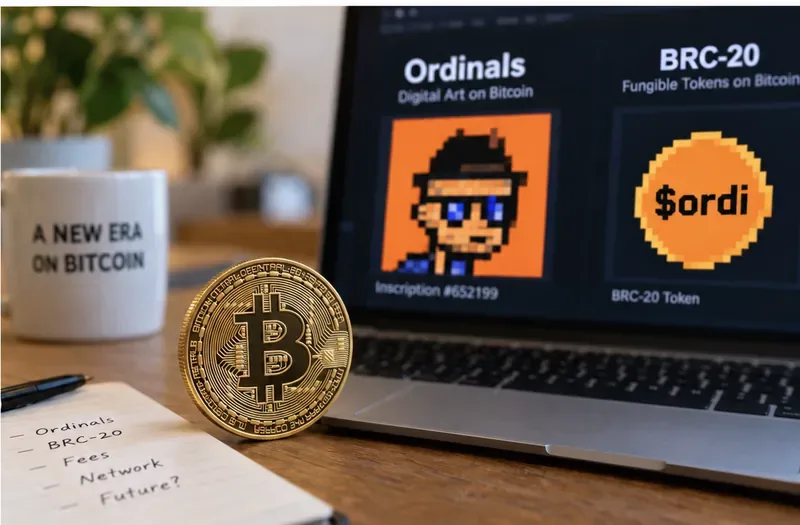
A Bitcoin-themed workspace illustrating how Ordinals and BRC-20 activity shares the same Bitcoin blockspace used by ordinary transactions.
Start with the basics: what are Ordinals?
A bitcoin can be divided into 100,000,000 satoshis, often shortened to sats. Ordinal theory is a convention for numbering and tracking individual satoshis. It does not add a new consensus layer, sidechain, or separate native token to Bitcoin. The Ordinal Theory Handbook describes the system as a way to assign ordinal numbers to sats and follow them as transactions move those sats from inputs to outputs.
An inscription attaches content to a satoshi. That content can be text, an image, code, or another supported data type. According to the official Ordinals inscription documentation, inscription content is stored on-chain in Taproot script-path spend scripts and revealed through a Bitcoin transaction. This is why people sometimes describe inscriptions as Bitcoin-native digital artifacts.
It helps to separate two ideas. Ordinals are the sat-numbering and tracking convention; inscriptions are the content associated with particular sats. They are related, but they are not interchangeable terms.
Then understand BRC-20: a token protocol built on inscriptions
BRC-20 is an experimental fungible-token protocol that uses Ordinals inscriptions. “Fungible” means individual units are intended to be interchangeable, much like one unit of a conventional token is meant to be equivalent to another unit of the same token.
The original BRC-20 experiment used small JSON-formatted inscriptions to describe operations such as deploying a token definition, minting units, and preparing transfers. The protocol’s creator explicitly called BRC-20 an experiment and warned against treating the design as a finished standard. That warning remains useful context; see the original BRC-20 experiment document.
The biggest conceptual difference from a smart-contract token is that Bitcoin itself does not maintain a native BRC-20 account balance for you. Specialized indexers scan Bitcoin transactions, interpret valid BRC-20 inscriptions according to protocol rules, and reconstruct token balances and events. Open-source projects such as the Open Protocol Indexer illustrate this model.
What should a beginner prepare before interacting with either system?
You do not need to become a Bitcoin protocol engineer, but you should understand four things before spending money.
A compatible wallet matters. Ordinary Bitcoin wallets may not provide inscription-aware coin control. The Ordinals documentation warns that a wallet which does not understand an inscription can later spend the UTXO containing it as part of a normal Bitcoin transaction. Review the Ordinals collecting guidance before moving valuable inscriptions.
Fees are paid in BTC. Even if you are minting or transferring a BRC-20 token, the underlying activity consists of Bitcoin transactions. You therefore need bitcoin for transaction fees.
Blockspace is scarce. Bitcoin transactions compete for inclusion in blocks. Higher demand can push the market fee rate upward.
BRC-20 balances depend on protocol interpretation. Use tools and services that follow the same current BRC-20 rules, and verify what an indexer recognizes before assuming a transfer or mint is valid.
How do Ordinals and BRC-20 create demand for Bitcoin blockspace?
Every inscription must ultimately be represented by Bitcoin transaction data. BRC-20 activity adds another layer of demand because deployment, minting, and transfers are expressed through inscriptions and transactions. When many users try to perform these actions at once, they compete with ordinary BTC payments and every other transaction seeking confirmation.
This is the key link between token demand and network impact: popularity does not create a separate lane. It increases demand for the same underlying settlement resource.
Bitcoin’s fee market is demand-driven. The Bitcoin developer guide on transactions explains that transaction fees depend on signed transaction size and current demand for space in mined blocks. Miners can prioritize transactions that offer more attractive fee rates. In modern wallets, fee rates are commonly expressed in satoshis per virtual byte, or sat/vB.
Why can fees rise during an Ordinals or BRC-20 rush?
Imagine that available blockspace is a recurring auction. A quiet mempool—the pool of valid transactions waiting to be confirmed—means users may be able to submit relatively low-fee transactions and still get confirmed. When demand rises, more transactions compete for the same near-term block capacity. Users who want faster settlement tend to offer higher fee rates, while lower-fee transactions may wait.
Ordinals and BRC-20 are not uniquely capable of causing congestion. Any source of transaction demand can do it. Their significance is that they introduced additional categories of users who may value Bitcoin blockspace for reasons other than transferring BTC. Academic research and Bitcoin engineering discussions have documented how inscription-style data use can consume substantial witness space while remaining valid under Bitcoin’s rules.
The practical lesson is important: an Ordinals boom can raise fees, but high fees are not guaranteed merely because Ordinals exist. Fee pressure depends on how much inscription and token activity is occurring at the same time as all other Bitcoin demand.
What is the network impact beyond higher user fees?
1. Miners can receive more transaction-fee revenue
Transaction fees are paid to miners. More competition for blockspace can therefore increase the fee component of miner revenue during busy periods. This is economically relevant because Bitcoin’s block subsidy declines over time, making transaction fees an increasingly discussed component of long-term miner incentives.
2. Blocks can carry more non-payment data
Inscriptions use witness data in Bitcoin transactions. That means blocks can contain significant amounts of digital-artifact or protocol data in addition to conventional payment activity. The content is on-chain, so full archival history grows as those transactions accumulate.
3. The UTXO effect is different from the raw data effect
A UTXO, or unspent transaction output, is a spendable piece of bitcoin created by a previous transaction. Large inscription data is placed in transaction witness data rather than becoming a giant spendable output. Bitcoin engineering discussions have therefore distinguished blockchain data growth from direct UTXO-set growth. Those are related resource questions, but they are not the same thing.
4. Fee competition may change user behavior
When on-chain fees are expensive, users may delay low-priority transfers, consolidate UTXOs during quieter periods, use wallets with better fee estimation, or move suitable payment activity to systems such as the Lightning Network. Conversely, when fees are low, users may find experimentation with inscriptions more economical.
A simple first interaction: observe before you transact
For most beginners, the safest first step is not minting a token. It is learning to read the system.
Inspect an inscription. Use an Ordinals-aware explorer and identify its inscription ID, content type, transaction, and current sat location.
Look at the underlying Bitcoin transaction. Notice that the artifact is anchored in an ordinary Bitcoin transaction structure rather than a separate blockchain.
Check current fee conditions. Your wallet should estimate fees, but understanding sat/vB helps you judge whether a transaction is urgent or worth postponing.
Compare BRC-20 information across reputable indexers. If different services disagree, do not assume the most favorable balance or status is correct.
Use a small amount first. Protocol-specific wallet behavior, marketplace flows, and transfer inscriptions can be less forgiving than a simple BTC payment.
This observation-first approach teaches you the three layers involved: Bitcoin provides the transaction and blockspace layer, Ordinals provides inscription and sat-tracking conventions, and BRC-20 indexers interpret particular inscriptions as token operations.
Common mistakes to avoid
Do not assume an inscription is the same as an NFT smart contract. An inscription is content associated with a sat under Ordinals conventions. Ownership and transfer mechanics follow Bitcoin UTXOs rather than an ERC-721-style contract.
Do not assume BRC-20 balances are enforced natively by Bitcoin consensus. Bitcoin validates the underlying transactions, while the BRC-20 state is reconstructed by indexers that apply meta-protocol rules.
Do not send valuable inscriptions from a wallet without sat-aware coin control. A normal wallet may treat the containing UTXO as ordinary spendable bitcoin. The Ordinals handbook specifically cautions users about this risk.
Do not judge the fee from the dollar amount being transferred. Bitcoin transaction fees are driven primarily by transaction weight or virtual size and the fee market, not by whether the asset is “worth” $10 or $10,000.
Do not confuse temporary congestion with permanent network failure. A backlog means transactions are competing for near-term confirmation. It can increase waiting times and prices, but the mempool and fee market adjust as blocks are mined and demand changes.
Do not treat experimental token demand as a guarantee of investment value. Technical use of Bitcoin blockspace proves that transactions occurred; it does not establish the economic value, liquidity, or durability of a particular inscription or token.
How to read demand and fee conditions more intelligently
Instead of asking only “Are Ordinals popular?”, watch several signals together: the number and size of pending transactions, prevailing fee rates, recent block fullness, the share of activity associated with inscriptions, and whether BRC-20 minting or trading activity is accelerating. No single metric tells the whole story.
A rising fee rate alongside a growing mempool indicates genuine competition for blockspace. If inscription activity rises while the mempool remains quiet, the incremental demand may still fit comfortably within available capacity. Likewise, a fee spike can occur for reasons unrelated to Ordinals, such as broad market volatility that triggers a surge of exchange deposits and withdrawals.
What should a newcomer remember?
Ordinals expanded the set of things users can anchor to Bitcoin by associating on-chain content with individual sats. BRC-20 then demonstrated how inscriptions could support an experimental fungible-token state interpreted by off-chain indexers. Both rely on normal Bitcoin transactions, so their users compete in the same blockspace market as everyone else.
That shared market explains the relationship between demand, fees, and network impact. Heavy activity can increase fee pressure and miner fee revenue while adding more data to the blockchain. Quiet periods can make the same activity much cheaper. For beginners, the best preparation is to understand UTXOs, sat/vB fees, inscription-aware wallets, and the role of indexers before buying, minting, or transferring anything.
Information checked against primary protocol documentation and Bitcoin developer resources in September 2026. BRC-20 remains a meta-protocol whose rules and ecosystem tooling can evolve, so verify current protocol documentation and wallet behavior before transacting.