Home
» News
»
Bitcoin Mining Profitability and Hashrate Trends for Late 2026
Bitcoin Mining Profitability and Hashrate Trends for Late 2026
Data snapshot: September 14, 2026. Bitcoin mining economics can move quickly, so the figures below should be treated as a decision snapshot rather than a forecast.
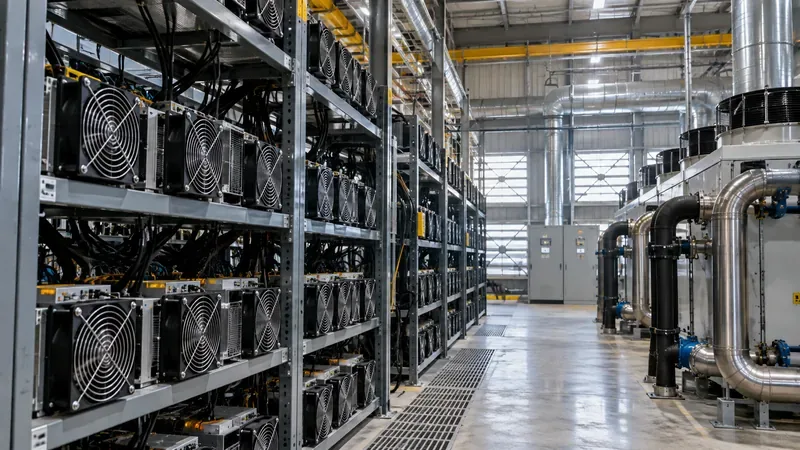
A modern mining facility illustrates the core late-2026 trade-off: more hashrate only creates value when hardware efficiency, power cost, cooling, and uptime keep operating costs below mining revenue.
Late 2026 is a difficult environment for Bitcoin miners to summarize with a simple “profitable” or “unprofitable” label. Network hashrate remains extremely high, transaction-fee income is modest, and newer ASICs have widened the efficiency gap between modern fleets and older machines. At the same time, profitability still varies sharply with electricity contracts, cooling design, uptime, pool fees, financing, and the market price of bitcoin.
Late-2026 mining conditions at a glance
Luxor’s Hashrate Index reported on September 14 that Bitcoin’s seven-day average network hashrate was about 943 EH/s, while the 30-day average was 928 EH/s. The latest difficulty adjustment, on September 5, increased difficulty 1.31% to 127.45T. Its September 14 estimate pointed to another increase of about 5.26% around September 19, although that estimate was not a confirmed future adjustment and can change as blocks arrive.
At the same snapshot, USD hashprice was about $39.25 per PH/s per day, versus a 30-day average of $38.04. Hashprice is a useful shorthand for gross mining revenue per unit of hashrate, but it is not profit. Luxor’s six-month forward market was pricing an average hashprice of about $36.92 per PH/s per day for September 2026 through February 2027. That forward price is a market signal, not a guaranteed future revenue level. See the September 14, 2026 Hashrate Index mining metrics.
Transaction fees were also contributing relatively little. Luxor reported a seven-day average of 0.0183 BTC in fees per block and said fees represented 0.59% of total block rewards over the week. Bitcoin’s protocol makes miner revenue the combination of the block subsidy and transaction fees; the Bitcoin developer guide on proof of work and block rewards explains that relationship. For miners, the practical implication is that late-2026 economics are still dominated by the subsidy and bitcoin price rather than by a large, dependable fee tail.
Why hashrate can stay high even when margins look thin
Hashrate is not a direct profitability gauge. It measures computational power committed to the network. Bitcoin adjusts mining difficulty every 2,016 blocks toward its target block interval, so sustained additions of efficient hashrate tend to raise the competitive threshold for everyone. The Bitcoin protocol documentation describes this difficulty-adjustment mechanism.
That creates an important late-2026 trade-off. A miner can add a much more efficient machine and improve its own cost per terahash while simultaneously contributing to a network in which aggregate competition remains intense. Industrial operators may also run through low-revenue periods because their power contracts, hedges, fleet age, capital structure, or curtailment economics differ from those of a home miner.
Practical action: do not use a rising hashrate chart alone as evidence that a new miner will earn an acceptable return. Model your machine against hashprice, efficiency, all-in electricity cost, expected uptime, and a range of difficulty outcomes.
ASIC efficiency is increasingly the dividing line
Hardware specifications show how wide the operating-cost gap has become. BITMAIN lists the air-cooled ANTMINER S21 XP at 270 TH/s, 3,645 W, and 13.5 J/TH. The S21 Pro is rated at 234 TH/s, 3,510 W, and 15 J/TH. By comparison, the older S19j Pro family is rated around 29.5 J/TH. At the leading edge, BITMAIN’s hydro-cooled S23 Hyd. is rated at 580 TH/s, 5,510 W, and 9.5 J/TH.
Example ASIC
Rated hashrate
Rated power
Efficiency
Approx. gross revenue/day at $39.25 PH/day
Power-only break-even rate*
S23 Hyd.
580 TH/s
5,510 W
9.5 J/TH
$22.77
17.2¢/kWh
S21 XP
270 TH/s
3,645 W
13.5 J/TH
$10.60
12.1¢/kWh
S21 Pro
234 TH/s
3,510 W
15 J/TH
$9.18
10.9¢/kWh
S19j Pro 104T
104 TH/s
3,068 W
29.5 J/TH
$4.08
5.5¢/kWh
*Illustrative calculation using the September 14 spot hashprice. It ignores pool fees, downtime, cooling and auxiliary loads, demand charges, taxes, repairs, hosting charges, financing, and hardware depreciation. It is therefore not a true profit break-even price.
Practical action: compare machines in J/TH first, then calculate total site-level watts per delivered TH/s. A nominally efficient ASIC can lose part of its advantage if the facility adds substantial cooling and power-distribution overhead.
Which mining approach fits which situation?
1. Existing operator with very cheap power
If your all-in marginal energy cost is low, keeping older equipment online can still make sense even when newer hardware is far more efficient. The relevant question is not whether an S19-class unit is outdated; it is whether its expected revenue exceeds the avoidable cost of operating it. However, older equipment leaves less room for hashprice declines or difficulty increases.
Best fit: operators with sunk hardware cost, inexpensive power, and the ability to curtail quickly. Watch: maintenance cost and the opportunity cost of rack space.
2. Capacity-constrained industrial miner
If megawatts, rack positions, or interconnection capacity are scarce, efficiency becomes more valuable. Replacing a 29.5 J/TH machine with a sub-15 J/TH design can deliver substantially more hashrate from the same power envelope. Hydro systems can push efficiency further, but they introduce facility-level requirements. For example, the S23 Hyd. manual specifies three-phase 380–415 V input and a coolant loop, so it is not a drop-in substitute for every air-cooled installation.
Best fit: operators optimizing revenue per MW rather than minimizing equipment purchase price. Watch: infrastructure conversion cost, deployment time, spare parts, and cooling-system reliability.
3. Home or small-scale miner
Retail electricity can erase mining margins quickly. Noise, heat, electrical capacity, pool fees, and downtime also matter more than a calculator that considers only ASIC watts. For many households, purchasing bitcoin directly provides price exposure without operating hardware, while mining offers a different objective: producing bitcoin through physical infrastructure and potentially using the waste heat.
Best fit: users with unusually low electricity cost, a productive use for heat, suitable wiring, and a non-financial reason to mine. Watch: do not compare mining solely with “free” bitcoin accumulation; include hardware cost and the alternative of buying BTC.
4. Buyer considering the newest hardware
The newest ASIC can have the strongest operating margin but still produce a poor investment return if its acquisition and infrastructure costs are too high. A 9.5 J/TH unit has a large energy advantage over a 29.5 J/TH unit, but ROI depends on the price paid for that efficiency and how long the machine operates before the economics change.
Best fit: buyers who can model total installed cost and value the extra hashrate per MW. Watch: payback calculations that freeze bitcoin price, difficulty, and hashprice for several years.
Three variables matter more than a single bitcoin price target
Electricity and site cost. Power is usually the most visible operating expense, but the useful number is the all-in cost to run the fleet: energy, demand charges where applicable, cooling, transformers, labor, repairs, pool fees, and hosting overhead.
Hashprice. Hashprice compresses bitcoin price, network difficulty, subsidy, and transaction-fee conditions into revenue per unit of hashrate. It is especially useful for scenario analysis. At $39.25/PH/day, a 270 TH/s machine produces about $10.60 of gross daily mining revenue before costs. At the September 14 six-month forward average of $36.92, the same hashrate corresponds to about $9.97 per day before costs. Neither figure is guaranteed.
Efficiency and uptime. J/TH determines how much electricity is required for a given amount of hashing, while uptime determines how much of the machine’s theoretical production you actually deliver. A highly efficient machine sitting offline earns nothing.
What the late-2026 trend does—and does not—tell us
Verified: as of September 14, the seven-day hashrate average was roughly 943 EH/s, difficulty was 127.45T after the September 5 adjustment, spot hashprice was about $39.25/PH/day, and recent transaction-fee contribution was small relative to total block rewards.
Conditional: modern sub-15 J/TH hardware has materially more room to absorb low hashprice than older roughly 30 J/TH hardware, but whether an upgrade is economically superior depends on acquisition price, facility cost, financing, and expected operating life.
Unknown: the exact Q4 2026 bitcoin price, future fee spikes, subsequent difficulty adjustments, and realized network hashrate cannot be known in advance. Even the September 19 difficulty estimate was only an estimate at the September 14 snapshot.
Practical action: build at least three cases—stress, base, and upside—and update them after each difficulty adjustment rather than relying on one year-end forecast.
A simple late-2026 decision checklist
Record the ASIC’s measured wall power and delivered hashrate, not just the nameplate values.
Calculate all-in electricity and facility cost per kWh.
Use current hashprice for the starting case and a lower hashprice for the stress case.
Include pool fees, expected uptime, repairs, cooling loads, and curtailment.
Separate operating break-even from hardware payback; they answer different questions.
For upgrades, compare profit per MW and profit per rack position, not only profit per machine.
Recalculate after major bitcoin-price moves and every difficulty adjustment.
Bottom line
Bitcoin mining in late 2026 is best viewed as an efficiency-and-power-cost competition rather than a simple bet on bitcoin’s price. Network hashrate near the 900-plus EH/s range and a spot hashprice around $39/PH/day leave very different margins for a 9.5 J/TH hydro miner and a roughly 30 J/TH older air-cooled unit. Cheap power can extend the life of older fleets; constrained power capacity can make premium efficiency worth paying for; and home miners need to account for retail electricity, heat, noise, and hardware depreciation.
The most defensible choice is therefore conditional: keep older hardware when marginal operating economics remain attractive, upgrade when scarce power or rack capacity makes efficiency valuable enough to justify the capital cost, and avoid new mining investment when the model only works under optimistic bitcoin-price or difficulty assumptions. Re-run the numbers frequently—late-2026 mining profitability is a moving target.