Forex Session Overlap in Local Time: The 2026 DST Shift

See how U.S. and U.K. daylight saving dates shift the London–New York forex overlap, with 2026 local-time examples and a practical conversion method.
A recent U.S. disclosure change is relevant to anyone comparing how brokers handle stock orders. The SEC’s amended Rule 605 execution-reporting requirements reached their compliance date on August 1, 2026, after the Commission extended the date in September 2025. The amendments broaden which firms and orders are covered and expand the execution statistics that must be reported, including information about certain orders outside regular hours and non-marketable limit orders. These reports can help investors assess execution quality over time; they do not promise a particular fill or price on an individual trade. See the SEC’s Rule 605 disclosure update.
The basic decision in a fast market remains the same: a market order prioritizes getting a trade done at prices available when it reaches the market, while a limit order sets a worst acceptable price and accepts the chance of waiting or not trading. New investors can make a better choice by first checking the quote and market conditions, then deciding which matters more: fill likelihood or price control.
A bid is a displayed price at which a buyer is willing to purchase; an ask (or offer) is a displayed price at which a seller is willing to sell. The difference is the bid-ask spread. The order book is the collection of buy and sell orders at different prices on a trading venue. The best displayed bid and ask are only for the available size at those prices; a larger order may trade against several price levels.
A market order tells a broker to buy or sell at the best prices available when the order is handled. It generally offers the strongest likelihood of prompt execution, but does not lock in the last-traded price or the quote you saw. In a thin or rapidly changing market, portions of one order can fill at different prices. A limit order tells a broker to buy only at the limit price or lower, or to sell only at the limit price or higher. If the market does not reach the limit while the order is active, it may not execute; it can also fill only partly.
For a buy, a limit above the current ask may be “marketable” and can seek an immediate fill while capping the maximum price. A sell limit below the current bid can similarly be immediately executable while setting a minimum. This is sometimes called a marketable limit order. It is a compromise, not a guarantee: available liquidity and routing matter, and the order can remain partly or wholly unfilled if prices move beyond the limit.

Look at the current bid, ask, spread, displayed size, and whether the market is open for regular trading. A recent last-trade price is historical; it is not a promise that your order can execute there. In a fast market, quotes can change between the moment you read them and the time your broker routes the order. A quote also applies only to its displayed size and venue.
Check whether the stock is unusually volatile, thinly traded, or trading around a major announcement. During extended-hours sessions, liquidity can be lower and spreads wider; order availability and handling also vary by broker. The SEC explains that an online order travels to the broker, which chooses a market or other execution venue, and that execution takes time. Read your broker’s rules for eligible hours and order types.

Before entering quantity, decide the maximum you are willing to pay or the minimum you are willing to accept. If a fill is more important than controlling the exact price, a market order may fit a small order in a liquid security during normal conditions. If crossing a price boundary would make the trade unacceptable, use a limit order and accept that it may not fill.
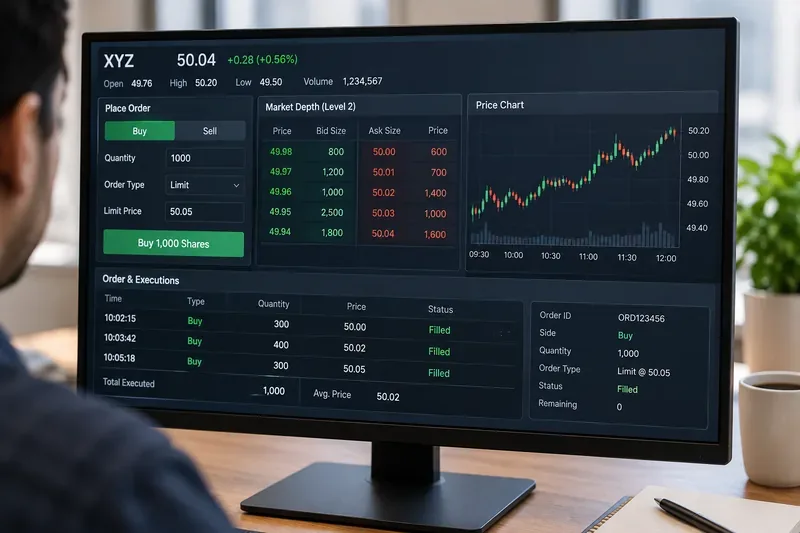
For example, suppose a stock is quoted at $49.95 bid and $50.05 ask, and the displayed size is modest. A market buy for more shares than are offered at $50.05 may continue to higher asks as it reaches available liquidity. A buy limit at $50.10 caps the execution price at that amount, but any shares offered above $50.10 remain unavailable to that order. This is an illustrative example, not live market data.
Choose quantity as carefully as order type. A market order for a large position can consume multiple price levels; a limit order for the same amount may fill only the portion available at or below (for a buy) or at or above (for a sell) its limit. If the risk of a partial position matters, decide in advance what you will do with a partial fill rather than assuming the order is all-or-none.

Slippage is the difference between a reference price—such as the quote when you decided to trade—and the actual execution price. It can be unfavorable when the market moves against the order, but a fill can also receive price improvement. In a fast market, the reference quote can become stale, the spread can widen, or displayed orders can disappear before the order arrives. Compare the actual average fill with a clearly defined reference price, and include spread and fees when reviewing total execution cost.
Queue priority describes how a venue ranks resting orders when several are waiting to trade. On Nasdaq’s displayed equity limit orders, price is considered first and displayed orders at the same price are executed in the order they were received; non-displayed shares are handled after displayed shares at that price. That is a venue-specific example, not a universal rule for every exchange, asset class, broker, or order type. Some markets use different allocation models or priority classes, and brokers may route orders to different venues.
If your limit order joins the back of a same-price queue, a quote touching your limit does not necessarily mean your order will fill. Orders ahead of yours may consume the available incoming liquidity, or the market may move away first. A more aggressive price may improve priority or make the order immediately executable, but it also gives up some price advantage. Check the venue and broker rules rather than assuming queue position from the displayed price alone.

Review the symbol, buy or sell direction, share quantity, order type, limit price if applicable, and time-in-force. A time-in-force instruction controls how long an order can remain active; common choices include day-only and good-till-canceled, though availability and duration depend on the broker and product. Do not assume an unfilled order expires immediately, and do not assume a cancellation has taken effect until the broker confirms it.
After sending the order, check its status: open, partially filled, filled, canceled, or rejected. For a partial fill, note the filled quantity and average price before changing or replacing the remaining order. The SEC warns investors not to submit a duplicate order just because the first order’s status is unclear; the original may already have executed. Confirm cancellation before placing a replacement, and inspect the final trade confirmation for quantity, price, and fees.
There is no order type that is best in every market. A market order is generally more suitable when prompt execution is the priority and the security is liquid enough that the likely spread and market impact are acceptable. A limit order is generally more suitable when price control is essential and missing the trade is an acceptable outcome. A marketable limit can set a price boundary while seeking immediate execution, but its cap can still prevent some or all of the order from filling.
For U.S. stocks, the SEC’s order-types bulletin and FINRA’s order-type overview explain the basic trade-off: market orders offer greater fill likelihood without a guaranteed execution price; limit orders control the acceptable price but do not guarantee execution. The SEC’s current order-execution guide also explains broker routing and why price improvement is possible but not guaranteed.
If you compare brokers, review their order-routing disclosures and Rule 605 execution reports where available. The new reporting framework can make more execution-quality information comparable, but its measurements are defined by rule and do not replace your own review of spreads, liquidity, order size, and market conditions. For queue priority, consult the specific venue’s current rules; Nasdaq describes its displayed-order approach on its equities trading page.
Keep the decision simple: decide your acceptable price and urgency before sending the order. In a fast market, that small pause helps prevent a market order from exceeding your price expectations or a limit order from being mistaken for a guaranteed trade.
Scope note: Order mechanics and protections vary across securities, exchanges, broker-dealers, and trading sessions. This guide describes common U.S. stock-order concepts and is educational, not a recommendation to trade.
See how U.S. and U.K. daylight saving dates shift the London–New York forex overlap, with 2026 local-time examples and a practical conversion method.
See how the 30-day wash-sale window, partial share matches, basis adjustments, Form 8949, broker reporting, and section 475(f) affect active traders.
Learn why a single stock order can be partially filled at different prices and times, how liquidity and queue priority drive fills, and what to check before trading.
VWAP measures the volume-weighted average for a defined session; anchored VWAP starts from a chosen event. Learn when each benchmark is the better fit.
Compare market and limit orders in fast markets. Learn how fill likelihood, slippage, price limits, and queue priority affect execution—and what to check before trading.
Understand how volume profile defines the value area, VAH, VAL, and POC, what these levels can reveal, and why settings and data sources change the reading.
Learn how correlation and beta differ, why assets with the same correlation can have different market sensitivity, and what each measure leaves out.
Learn what FX forward points are, how interest-rate differentials and cross-currency basis shape them, and why a forward rate is a hedge price—not a spot forecast.
Learn how to calculate currency carry trade returns by combining interest income, exchange-rate movement, rollover financing, spreads, and commissions in a worked example.
Learn how nominal and real Treasury yields differ, why real yields often matter more for gold, and how both rates affect growth stock valuations.