Home
» Knowledge
»
Crypto Scalping Strategies for Beginners: Trading Small Price Moves Without Letting Costs Win
Crypto Scalping Strategies for Beginners: Trading Small Price Moves Without Letting Costs Win
Crypto scalping is a short-term trading style that tries to capture many small price movements rather than waiting for one large move. A scalper may hold a position for seconds or minutes, sometimes a little longer, and may place multiple trades in one session. The concept sounds simple, but the arithmetic is unforgiving: the expected price move must be large enough to cover trading fees, the bid-ask spread, slippage, and losing trades.
For a beginner, the first goal should therefore not be “trade faster.” It should be learn to recognize when a small move is actually tradable after costs. This guide walks through what you need to know, what to prepare, how to execute a basic scalping process, and which mistakes tend to make small losses compound.
Important: no scalping strategy guarantees profit. Frequent trading can magnify costs and mistakes. If leverage is involved, losses can accelerate quickly; the U.S. Commodity Futures Trading Commission warns that leverage amplifies both gains and losses and can lead to losses beyond the amount initially committed in some products. See the CFTC advisory on virtual-currency trading risk.
What should a beginner understand before trying crypto scalping?
Start with four market terms. The bid is the highest price currently offered by buyers. The ask is the lowest price currently offered by sellers. The difference is the spread. Slippage is the difference between the price you expected and the average price at which your order actually executes.
These are not minor details. If a coin has a 0.10% spread and you cross that spread to enter, then cross it again to exit, the trade may already be fighting a meaningful cost before exchange fees are included. On a strategy looking for a 0.20% move, even seemingly small costs can consume most of the expected edge.
You also need to understand maker and taker orders. A maker order rests on the order book and adds liquidity. A taker order executes immediately against existing liquidity. Coinbase Advanced explains that immediately filled orders are charged as taker orders, while orders that rest on the book and are later matched can be charged as maker orders. Coinbase also notes that market orders are taker orders and may fill at multiple prices. See the Coinbase Advanced order-types documentation and Coinbase Advanced fee documentation.
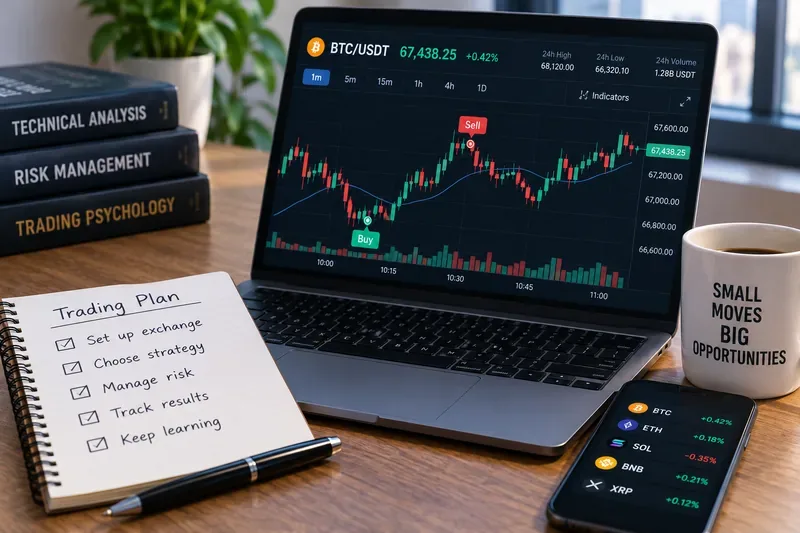
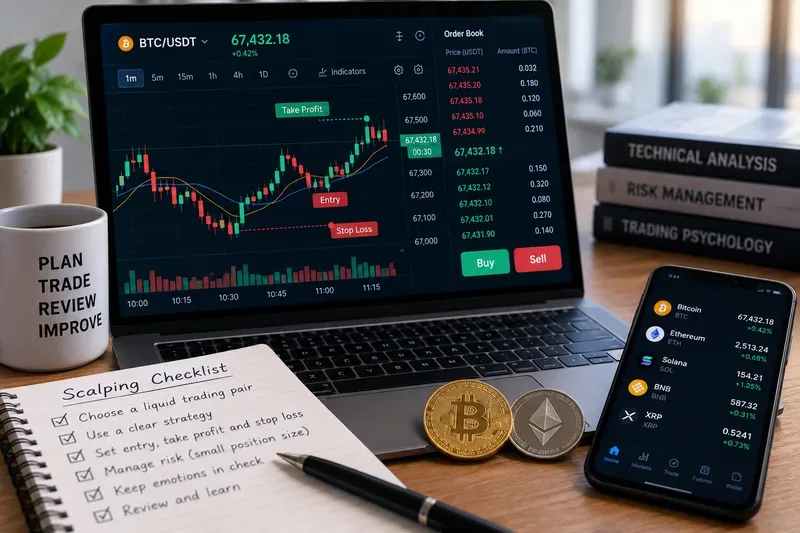
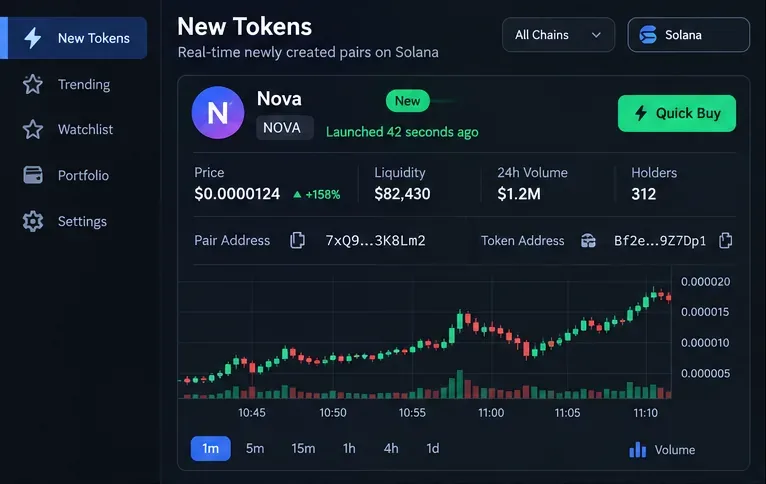
Begin with a written plan and a liquid market. The screen illustrates the kinds of information a scalper watches—price structure, volume, and an entry/exit idea—rather than a live trade recommendation.
What should you prepare before the first live trade?
Choose one liquid pair
Beginners often scan dozens of coins because more movement appears to mean more opportunity. For scalping, that can be counterproductive. Thin markets can have wider spreads, shallow order books, and abrupt slippage. Start with one highly liquid pair available on your chosen exchange so you can learn how its order book and intraday rhythm behave.
Check the fee schedule before calculating targets
Scalping makes fee math unusually important because the gross target per trade is small. As of September 2026, Kraken Pro's published spot schedule starts at 0.40% maker and 0.80% taker for its first standard tier, with lower rates at higher qualifying tiers. Kraken notes that fees depend on the market, maker/taker status, and qualifying volume or assets on platform. Those numbers are an example of why a strategy that tries to capture only a few tenths of a percent may be uneconomic for some accounts.
Do this before selecting an entry. For example, if a practice account is $2,000 and you decide the maximum loss on one trade is $4, position size should be derived from the distance to the stop. If your stop is 0.20% away, a $2,000 notional position would risk about $4 before fees and slippage. If the stop must be 0.50% away, the same $4 risk implies a much smaller position.
The formula is straightforward:
Position size = maximum dollar risk ÷ stop distance as a decimal.
This is a risk budget, not a prediction that the stop will execute perfectly. Fast markets can gap or move through stop levels.
Before entering, define the invalidation point as well as the profit target. A scalper should know the loss condition before clicking Buy or Sell.
How do you execute a basic crypto scalp?
A beginner-friendly process can be reduced to four decisions: market condition, setup, order type, and exit.
Step 1: Trade only when the market condition matches the setup
Do not treat every minute as tradable. A simple approach is to classify the market as trending, ranging, or unusually volatile. A trend-following scalp works better when short-term highs and lows are progressing in one direction. A mean-reversion scalp—the attempt to buy a short-term dip or sell a short-term spike back toward an average—requires a range that is actually holding.
You can use a moving average, volume, prior swing highs and lows, or the order book as supporting information, but avoid stacking indicators until a chart always seems to produce a signal. Indicators describe price; they do not remove execution risk.
Step 2: Wait for a specific trigger
A setup should tell you what must happen before you enter. Examples include a pullback that holds above a prior breakout level, a failed attempt to break the bottom of a range, or a short-term moving-average reclaim accompanied by improving volume.
The trigger matters because “price looks like it may go up” is not reproducible. If you cannot describe the entry in one sentence, it will be hard to test later.
Step 3: Pick the order type deliberately
A market order prioritizes execution rather than price. A limit order specifies the maximum price you will pay to buy or the minimum price you will accept to sell. Coinbase states that market orders execute against the best available liquidity and can fill at several prices, while limit orders can remain unfilled if the market never trades at your chosen level.
For scalping, this is an explicit trade-off: a limit order may reduce price and fee costs if it receives a maker fill, but missing the fill can mean missing the move. A market order may get you in immediately, but the spread, taker fee, and slippage can make a small target unattractive.
Order selection is part of the strategy. A limit order can improve price control, while an immediately executing order trades certainty of execution for potentially higher costs.
Step 4: Exit according to the plan, not the last candle
Set the profit-taking level and loss threshold before entry. If your venue supports a bracket or take-profit/stop-loss structure, it can help encode both exits. Coinbase describes bracket orders as paired profit and downside levels, while warning that downside protection is not guaranteed during extreme volatility. See the official Coinbase order-types page.
For a scalp, the exit is usually more important than squeezing out an extra few basis points. If the expected move was 0.50% and price reaches the planned target, turning it into an open-ended swing trade changes the strategy after the fact.
Three simple crypto scalping strategies to practice
1. Pullback in a short-term trend
Identify a market making a sequence of higher highs and higher lows. Rather than chasing a fresh high, wait for price to pull back toward a prior breakout level or short-term average. Enter only if the pullback stabilizes and your predefined trigger appears. Place the stop below the level that would invalidate the short-term trend.
Works best when: volume and direction are reasonably consistent and the spread is tight.
Avoid when: a major announcement has just produced chaotic candles or the trend is already extremely extended.
2. Range bounce
When price repeatedly rejects the same support and resistance area, a scalper can look for entries near the range edge and exits closer to the middle or opposite edge. The important word is repeatedly. One touch does not define a reliable range.
Works best when: volatility is contained and liquidity is sufficient around both edges.
Avoid when: volume expands sharply as price approaches the boundary, because that can precede a breakout.
3. Breakout-and-retest scalp
Instead of buying the instant price breaks resistance, wait for a break and then a retest. If the former resistance holds as support, the entry has a nearby invalidation level. This often produces cleaner risk math than chasing the initial breakout candle.
Works best when: the breakout occurs with real participation and the retest does not immediately collapse back into the old range.
Avoid when: liquidity is thin or the breakout is driven by a single isolated spike.
How do you know whether a scalp is worth taking after costs?
Calculate the trade using net, not gross, expectations. Suppose you expect a 0.60% move. If your combined entry and exit trading fees are 0.20%, the effective spread and slippage cost another 0.10%, and your average losing trade is 0.40%, the gross 0.60% target is not the number that matters. Your expected advantage must survive all of those deductions over many trades.
A useful pre-trade checklist is:
What is the current spread?
What maker or taker fee will this order likely pay?
How much slippage is plausible for this order size?
Where is the stop, and what is the dollar risk?
Is the profit target comfortably larger than the round-trip friction?
If the trade loses, will you still be within the session loss limit?
Scalping performance is driven by the whole process—setup quality, execution cost, risk size, and review—not by the chart pattern alone.
What mistakes should new scalpers avoid?
Overtrading. More trades do not automatically produce more edge. Every extra trade adds another opportunity to pay fees, cross the spread, and make an execution mistake.
Using leverage too early. Leverage can make a tiny move meaningful, but it also compresses the distance between a normal market fluctuation and a damaging loss. Learn the mechanics with spot or simulated trading before adding liquidation risk.
Widening the stop after entry. If a trade becomes invalid at a specific price, moving the stop farther away usually converts a small planned loss into an unplanned larger one.
Ignoring partial fills. A limit order can fill only part of the requested size. Coinbase's order-management documentation notes that orders may be partially filled depending on market availability. Know the actual filled amount before calculating your exit. See Coinbase Advanced order management.
Trading illiquid coins because they move more. Large candles are not automatically opportunity. If the order book is thin, the price you can exit at may be much worse than the chart suggests.
Judging a strategy after five trades. A small sample can be dominated by luck. Track enough trades to estimate win rate, average win, average loss, fees, and slippage under the same rules.
How should a beginner practice before scaling up?
Start with a simulated account or the smallest live size that still lets you observe real fees and execution. Pick one pair and one strategy. Log every trade with the setup, entry, stop, target, fee, actual fill, result, and whether you followed the rule.
After 30 to 50 trades, calculate:
Win rate: winning trades divided by total trades.
Average win and average loss: use net results after fees.
Profit factor: gross profits divided by gross losses.
Average cost per round trip: fees plus observed slippage.
Rule adherence: the percentage of trades where you actually followed the plan.
A profitable-looking gross strategy can become unprofitable after costs. Conversely, a modest win rate can work if average wins are sufficiently larger than average losses and friction is controlled.
Bottom line
Crypto scalping is not primarily about predicting every tiny move. It is about repeating a narrowly defined setup while controlling transaction costs and losses. A beginner has a better chance of learning the method by trading one liquid market, knowing the exact fee schedule, using small fixed risk, choosing order types deliberately, and reviewing every execution.
The most important number is not how many winning trades you make in a day. It is whether the strategy produces a positive result after spreads, fees, slippage, and losses over a meaningful sample. If that number is not positive, increasing speed or size will usually magnify the problem rather than solve it.