Home
» Knowledge
»
Analyzing Token Distribution: How to Identify Potential Insider Wallets
Analyzing Token Distribution: How to Identify Potential Insider Wallets
Token distribution can tell you much more than whether a cryptocurrency has a few large holders. A useful analysis asks a harder question: are apparently separate wallets actually connected to the project team, deployer, treasury, market maker, early investors, or one another?
The important word is potential. A blockchain address is pseudonymous, and a large balance alone does not prove that a wallet belongs to an insider. Exchange wallets, liquidity pools, bridges, vesting contracts, custodians, burn addresses, and protocol treasuries can all appear among the largest holders. The goal is therefore to build a documented evidence chain, not to attach a definitive identity to an address based on one clue.
This reference focuses on EVM-style token analysis because Ethereum-compatible explorers expose especially useful contract and transfer data. The same reasoning can be adapted to other chains with their native explorers and analytics tools.
Quick reference: what signals are actually useful?
Signal
What it can indicate
What it does not prove
Large token allocation
Concentration of voting power, liquidity risk, or supply control
That the holder is a team member
Direct funding from deployer
Operational or economic relationship
Common ownership by itself
Tokens received near launch
Early allocation, treasury movement, vesting, or coordinated distribution
Improper activity
Same first funder across wallets
Possible wallet cluster or shared operational setup
That every wallet has the same beneficial owner
Contract owner/admin role
Privileged technical control
Ownership of every token held by related contracts
Synchronized transfers or trades
Possible coordinated behavior
Coordination unless other evidence supports it
Verified address label
Useful identity or category context
Permanent or infallible attribution
1. Start with the holder list, then remove addresses that distort the picture
Begin with the token contract, not the ticker symbol. Copy the contract address from the project's official documentation or another authoritative source and confirm that the chain is correct. On Ethereum and supported EVM chains, Etherscan's token holder list endpoint returns holder addresses and balances for an ERC-20 contract. As of September 2026, that endpoint is a paid API feature, and Etherscan's documentation notes that Free-tier endpoints affected by its July 1, 2026 change return at most 1,000 records per request; where an endpoint is paginated, use every required page rather than treating the first response as the full holder set.
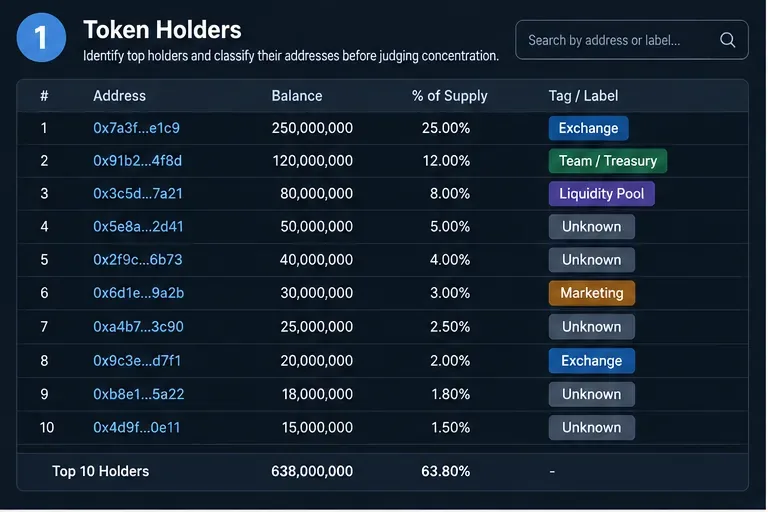
Next classify obvious infrastructure. A top-holder table without labels can be misleading because a liquidity pool or exchange hot wallet may hold more tokens than any individual. Etherscan explains that its public name tags and labels add context such as a known organization, project, or address category. Treat these tags as evidence to review, not an automatic verdict.
Example holder table with hypothetical values. Classify exchanges, liquidity pools, treasury wallets, and other known infrastructure before interpreting concentration among unknown wallets.
Calculate concentration two ways
Record the share owned by the top 1, top 5, top 10, and top 20 holders. Then calculate the same figures after excluding clearly identified infrastructure such as burn addresses, exchange custody, and automated liquidity contracts. The second view is often more useful for evaluating discretionary control.
Do not automatically exclude a treasury or vesting contract. Those balances may be economically important even when the tokens cannot move immediately. Instead, classify them separately and inspect the contract rules, unlock schedule, and controlling addresses.
2. Trace the deployer, owner, and privileged roles
A token's deployment history gives you a strong starting address for relationship analysis. Etherscan documents a contract-creation endpoint that returns the contract creator and creation transaction. From there, inspect whether the deployer also funded early wallets, received tokens, interacted with vesting contracts, or controlled liquidity setup.
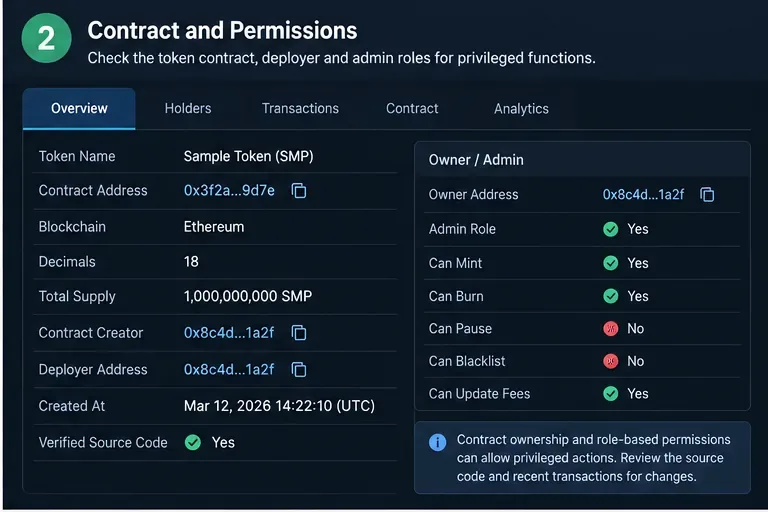
Then read the verified contract and identify administrative authority. OpenZeppelin's current access-control documentation explains common ownership and role-based patterns: an owner or role holder can be permitted to perform restricted functions, potentially including minting, pausing, or other administrative operations depending on the contract. For a proxy-based system, also identify proxy admin, implementation ownership, multisig, timelock, and any AccessControl roles rather than assuming the deployer remains in control.
Example permission review. A deployer address is only the beginning; current ownership, role assignments, multisigs, proxies, and privileged functions may reveal who retains technical control.
A wallet with an admin role is highly relevant to insider analysis because it has a documented relationship to the protocol. But even that does not prove the wallet's beneficial owner. The admin may be a multisig, security council, service provider, or governance executor.
3. Follow token transfers and first funding relationships
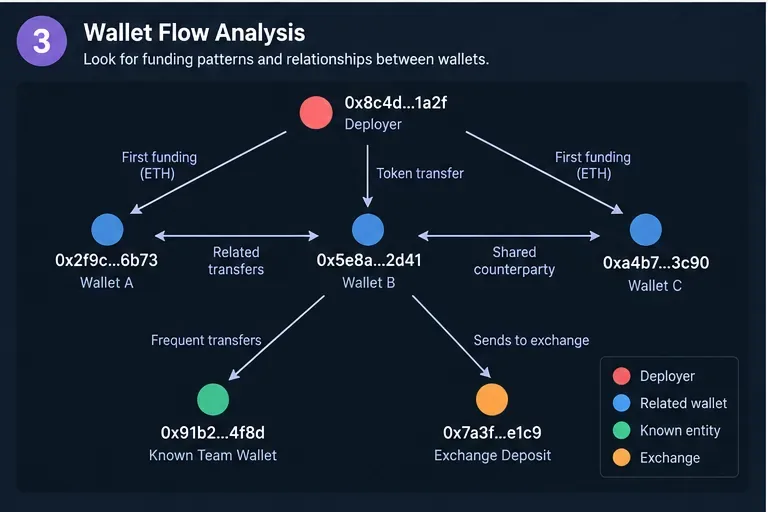
Once you have candidate wallets, build a small relationship graph. For each address, record:
who first funded it with the chain's native gas token;
who sent its first project-token allocation;
whether several candidate wallets were funded by the same address;
whether transfers occurred in the same block or a narrow time window;
frequent counterparties;
links to the deployer, treasury, vesting contract, or known team wallet;
later deposits to the same exchange or custodian.
Etherscan's ERC-20 transfer endpoint can be filtered by address and token contract to reconstruct token movements. Normal transaction history is also useful for native-token funding and contract calls. If you use a commercial analytics service, Nansen's official related-wallet workflow explicitly describes clustering with labels, first-funder relationships, signer or deployment links, counterparties, and other behavioral connections.
Example relationship map. Several independent links are more informative than a single transfer: common funding, repeated transfers, deployer ties, and known counterparties can strengthen a wallet-cluster hypothesis.
Why the first funder matters
Fresh wallets need native currency to pay transaction fees. If five newly created wallets all receive their first gas funding from the deployer and then receive project tokens shortly afterward, that is a meaningful relationship signal. It is still not conclusive: a centralized exchange, faucet, relayer, or shared operations wallet can create the same pattern. Check the funder's label and transaction history before drawing a conclusion.
4. Compare timing and behavior, not just balances
Insider-linked wallets can be split deliberately so that no individual address looks dominant. Behavioral analysis helps detect that possibility. Look for wallets that become active within minutes of one another, acquire identical or patterned amounts, interact with the same contracts in the same sequence, or repeatedly send tokens among themselves.
Also compare their behavior around important project events such as token generation, vesting unlocks, liquidity additions, migrations, or announced distributions. Use block timestamps and transaction hashes in your notes. Avoid claiming that a wallet traded on nonpublic information unless you have direct evidence; on-chain timing can show correlation, not a person's knowledge or intent.
5. Use labels and entity clustering as supporting evidence
Address labels can save hours, especially when a wallet belongs to a major exchange, market maker, fund, protocol, or public entity. Nansen's address-label documentation describes both entity and behavioral labels, while its broader documentation explains that related addresses can be grouped into entities using proprietary research and heuristics.
That qualifier matters. Third-party labels are not raw blockchain facts. Save the label, source, and date you observed it, and independently verify important claims where possible. A label can change as new evidence becomes available.
How should you score a suspected insider relationship?
A rigid numerical score can create false confidence, so use evidence tiers instead. A practical approach is to distinguish direct evidence, strong linkage, and weak correlation.
Evidence tier
Examples
How to use it
Direct
Project publicly identifies the wallet; wallet is a contract owner/admin; verified treasury or vesting contract
Document the exact source and role
Strong linkage
Direct deployer funding plus early allocation; repeated transfers with known team wallets; shared first funder plus matching behavior
Describe as likely related or part of the same operational cluster, with caveats
Weak correlation
Large balance, similar trade timing, same exchange destination, low transaction count
Keep as a lead until stronger evidence appears
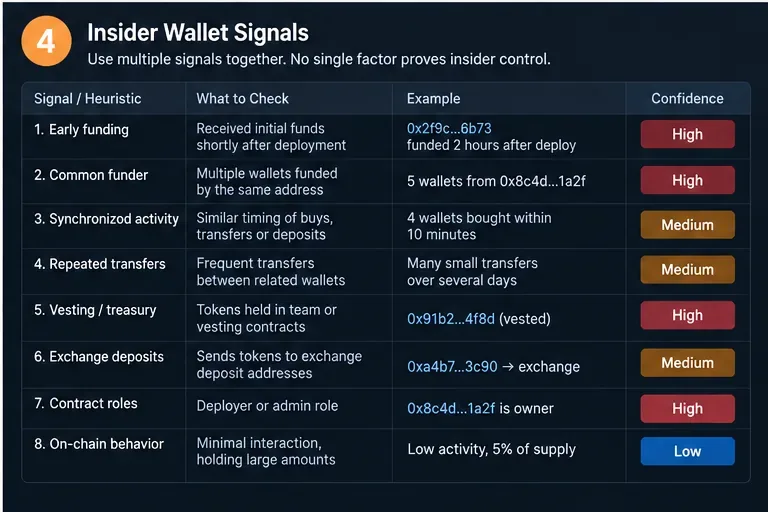
Example signal checklist. No single heuristic establishes insider control; combine independent signals and retain the transaction evidence behind each conclusion.
Practical checklist before calling two wallets related
Confirm the exact token contract and chain.
Export or review enough holders to avoid a first-page sampling error.
Separate exchanges, liquidity pools, bridges, burn addresses, treasuries, and vesting contracts from ordinary wallets.
Identify the contract creator and current privileged roles.
Trace native-token first funding as well as ERC-20 transfers.
Verify third-party labels against public sources when the attribution matters.
Save transaction hashes, block numbers, timestamps, and the date of your analysis.
State alternative explanations for each suspicious-looking pattern.
Use language such as “potentially related,” “linked by funding,” or “consistent with common control” unless ownership is actually verified.
Common mistakes that produce false positives
Calling every whale an insider. Large holders may be exchanges, funds, market makers, staking or bridging contracts, or early public buyers.
Counting a liquidity pool as discretionary supply. Pool balances are governed by the pool's mechanics and liquidity providers; they should be classified separately from a single wallet's freely controlled balance.
Assuming one transfer proves ownership. Payroll, grants, OTC transactions, airdrops, market-making inventory, and routine treasury operations all create direct transfers.
Ignoring proxies and multisigs. The deployer may no longer control the token. Current authority can sit behind a proxy admin, timelock, governance contract, or multisig.
Trusting labels without a timestamp. Labels are valuable context but can be incomplete, revised, or based on proprietary heuristics.
What a defensible conclusion looks like
A strong token-distribution analysis separates facts from inference. For example: “Wallet A holds 4.2% of supply, received its first gas funding from the deployer, received tokens from the treasury two hours after deployment, and has repeatedly transferred tokens with Wallet B. These facts support treating A and B as a potentially related cluster. Public ownership of either wallet has not been verified.”
That formulation is more useful than simply calling an address an “insider wallet.” It tells the reader what is observable, what relationship is inferred, and what remains unknown. In on-chain research, that distinction is the difference between a reproducible analysis and a guess.