Home
» Ecosystem
»
Chainlink (LINK) CCIP Ecosystem: How Cross-Chain Interoperability Is Taking Shape in 2026
Chainlink (LINK) CCIP Ecosystem: How Cross-Chain Interoperability Is Taking Shape in 2026
Cross-chain interoperability is becoming less about moving a wrapped token from Chain A to Chain B and more about making applications, assets, and financial workflows behave coherently across many networks. Chainlink’s Cross-Chain Interoperability Protocol (CCIP) is one of the infrastructure layers competing to become a common standard for that job.
As of September 15, 2026, Chainlink’s official CCIP page advertises access to more than 70 blockchains, while its documentation and release notes show that supported networks and token integrations continue to change. That growth matters, but the more important question is what developers and asset issuers can actually do with the network today—and what trade-offs remain.
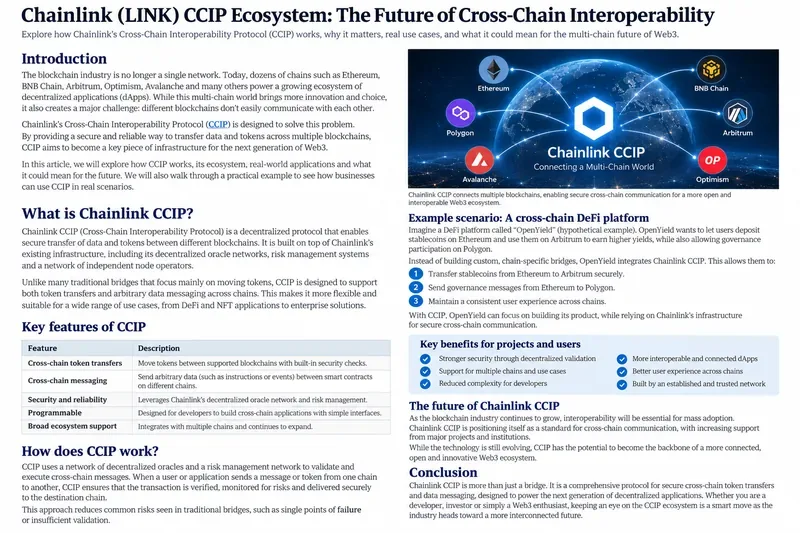
Chainlink CCIP is designed as a shared interoperability layer for cross-chain messages and token transfers; the surrounding networks in this illustration represent the broader multi-chain environment rather than a complete list of current integrations.
A hypothetical example: one lending product, three chains
Consider a fictional DeFi application called “HarborLend.” This is an illustrative example only, not a real deployment, testimonial, or measured performance result.
HarborLend has its main governance contracts on Ethereum, a lower-cost lending market on an L2, and a tokenized collateral product available on another supported chain. The team wants users to deposit collateral on one chain, trigger a borrowing action on another, and keep governance state synchronized without maintaining a separate custom bridge stack for every network pair.
With CCIP, the team could design the workflow around standardized cross-chain messages and token transfers. The source-chain contract would send a message through CCIP, the destination application would receive the verified instruction, and—where token movement is needed—the transfer could be coupled with executable data. Chainlink describes this model as programmable token transfers. The exact contracts, supported routes, fees, token pools, and security configuration would still need to be checked against the current CCIP documentation before production use.
What CCIP actually provides
CCIP is not simply a user-facing bridge. It is an interoperability protocol and developer infrastructure for sending data and value across supported blockchains. Its core use cases can be grouped into three practical categories.
Capability
What it means in practice
HarborLend example
Cross-chain messaging
A smart contract on one supported network can send instructions or data to an application on another.
Ethereum governance sends an approved parameter update to the lending market on another chain.
Token transfers
Assets can move across supported routes using token-pool mechanisms configured for the asset.
Collateral is moved to the chain where the lending position is managed.
Programmable token transfers
A transfer can carry instructions that the destination application uses after delivery.
The destination contract receives collateral and then executes a predefined deposit action.
Chainlink positions CCIP as a defense-in-depth system built on decentralized oracle network infrastructure rather than a single relayer or single validator. That architecture is relevant because bridge security has historically been one of the highest-risk areas in crypto. Still, “more security layers” should not be interpreted as “risk-free.” Application bugs, misconfigured contracts, compromised token administration, economic assumptions, and unsupported route changes can all create failure modes outside the narrow message-delivery layer.
Cross-Chain Tokens change the asset-issuer side of the equation
An important part of the current CCIP ecosystem is the Cross-Chain Token (CCT) standard. Chainlink describes CCTs as cross-chain-native tokens that developers can onboard in a self-service manner while retaining ownership of their token contracts, token pools, and custom logic. The official overview also highlights burn-and-mint designs, zero-slippage transfers for supported pool configurations, programmable transfers, and optional token developer attestation.
For HarborLend, this matters if its collateral token is issued by the project itself. Instead of relying on an unrelated third-party wrapped representation, the issuer can design the token’s cross-chain behavior directly and preserve more control over minting, burning, lock-and-release logic, limits, and verification policies.
The practical lesson is that cross-chain architecture should be chosen at the asset-design stage, not added as an afterthought. Teams evaluating CCTs should review the current Chainlink CCIP and CCT overview and confirm which mechanisms are available for their token and destination networks.
Why the ecosystem is expanding beyond DeFi
CCIP’s long-term significance depends on whether interoperability becomes shared infrastructure for both crypto-native applications and regulated financial systems. Chainlink is explicitly pursuing both markets.
Its official CCIP materials describe use cases for asset managers, custodians, banks, financial market infrastructures, tokenized funds, cross-border settlement, and central-bank digital currency connectivity. The company also lists work involving organizations such as Swift, ANZ, SBI Digital Markets, and other financial institutions. These examples do not prove that CCIP will become the universal standard, but they show where Chainlink is positioning the protocol: as infrastructure that can bridge public chains, private systems, and institutional workflows.
That institutional strategy is also tied to operational assurance. Chainlink states that CCIP and its data services have undergone SOC 2 Type 2 examination, while Chainlink Labs maintains an ISO/IEC 27001 information-security program covering CCIP. Readers evaluating those claims for procurement or compliance should consult the current security and certification page, because certificates and audit periods can expire or be renewed.
What is changing in 2026?
The ecosystem is not static. Chainlink’s CCIP release notes show frequent additions and deprecations. In September 2026 alone, the changelog recorded new network support and token additions as well as deprecations on some testnets. That is a reminder that a chain being supported at one point does not guarantee that every lane, testnet, token, or feature remains available indefinitely.
Chainlink’s Q1 2026 review also reported strong growth in CCIP transfer volume, active tokens, and fee revenue. Those figures are company-reported metrics rather than independently audited market-share statistics, so they are most useful as directional evidence of usage growth rather than proof of industry dominance. The original figures and methodology context are available in Chainlink’s Q1 2026 review.
For developers, the tooling has also broadened. The current CCIP Tools documentation lists a TypeScript SDK and CLI plus multi-chain support spanning EVM environments and non-EVM ecosystems. The exact supported SDK version and chain set should be checked in the live CCIP Tools reference before integrating.
Where LINK fits—and where investors should be careful
LINK is the native token associated with the broader Chainlink network, but the investment case for LINK should not be reduced to a simple claim that “more CCIP usage automatically means a higher token price.” Protocol adoption, fee design, staking economics, treasury behavior, token supply, market liquidity, regulation, and speculative demand can all affect value differently.
For that reason, the strongest way to evaluate the “LINK CCIP ecosystem” is to separate two questions. First: is CCIP gaining useful integrations, supported networks, assets, and transaction activity? Second: how does that usage translate into sustainable demand or economic value for LINK under the current protocol design? The first can be studied through technical documentation and usage data. The second requires token-economic analysis and should not be inferred from ecosystem headlines alone.
When CCIP may be a good fit
Multi-chain applications: teams that need contracts on different networks to coordinate state or instructions.
Asset issuers: projects that want controlled cross-chain token movement without creating a separate bridge integration for each destination.
DeFi protocols: lending, staking, stablecoin, and liquidity applications that need token movement plus destination-chain execution.
It may be less attractive when a project only lives on one chain, when the required source-destination route is not supported, when custom sovereignty requirements conflict with the protocol’s model, or when the application cannot accept dependencies on external interoperability infrastructure.
A practical evaluation checklist
Return to HarborLend. Before its developers commit to CCIP, they should verify the exact source and destination networks, supported token mechanism, message-size and execution constraints, fee model, rate limits, failure and recovery paths, contract upgrade strategy, monitoring tools, and operational controls. They should also test destination execution failures and manual recovery procedures rather than validating only the happy path.
Most importantly, the team should use the current CCIP release notes and official directory/documentation as deployment-time sources of truth. Interoperability infrastructure changes quickly, and stale assumptions about network support can become production risks.
Is CCIP the future of cross-chain interoperability?
It is too early to call any single protocol the final interoperability standard. The market includes competing bridge designs, messaging protocols, native chain connections, intent systems, and institution-specific infrastructure. What makes CCIP notable in 2026 is its combination of broad chain coverage, programmable messaging and token transfers, issuer-focused CCT tooling, and a strategy that spans both DeFi and traditional finance.
If the multi-chain world keeps fragmenting across L1s, L2s, appchains, private ledgers, and tokenized financial networks, developers will need fewer bespoke connections and more reusable standards. CCIP is clearly designed around that thesis. Its future will depend not on the number of logos on an ecosystem page, but on security under real load, developer experience, economics, reliability, and whether applications such as our hypothetical HarborLend can use one interoperability layer without giving up the controls they need.