Home
» Project analysis
»
Pendle Explained: Principal Tokens, Yield Tokens and What Happens at Maturity
Pendle Explained: Principal Tokens, Yield Tokens and What Happens at Maturity
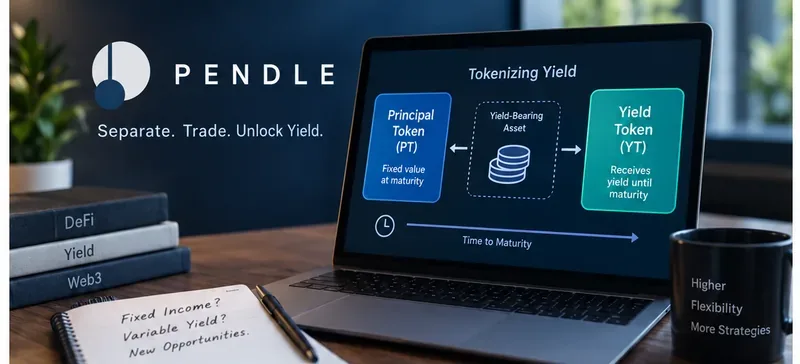
Pendle turns future yield into something that can be traded separately from principal. In its current official documentation, the core mechanism remains straightforward: a yield-bearing asset is standardized, split into a Principal Token (PT) and a Yield Token (YT), and tied to a defined maturity date. That structure matters because PT and YT do very different jobs before maturity—and they have very different outcomes once maturity arrives.
This article focuses on those durable mechanics rather than treating Pendle as a moving news story. For current contract addresses, supported networks, market availability, rates, and incentives, always check the live Pendle interface and the official Pendle documentation, because those details can change.
A yield-bearing asset can be separated into a principal claim and a yield claim, with both positions linked to the same maturity date.
The basic idea: separate principal from future yield
A yield-bearing token combines two economic components in one position: the capital value of the asset and the yield it may generate over time. Pendle separates those components so they can be held or traded independently.
The protocol first uses a Standardized Yield token, or SY, as a common wrapper for supported yield-bearing assets. Pendle's developer documentation describes SY as the standardized interface used for yield-bearing positions inside the protocol. The SY position can then be tokenized into PT and YT. See Pendle's yield-tokenization contract documentation for the underlying mechanism.
A useful mental model is:
PT is the claim on principal at maturity.
YT is the claim on eligible yield and rewards generated up to maturity.
Before maturity, an equal amount of PT and YT can represent the two separated pieces of the original yield-bearing position. Pendle's beginner documentation summarizes the relationship as the principal component plus the yield component making up the full position. The precise accounting asset matters, though, so it is safer to read the market's asset description than to assume every PT redeems into the token symbol that appears most prominent in the market name.
What is a Principal Token (PT)?
PT represents the principal side of the position. Pendle's PT documentation describes it as economically similar to a zero-coupon bond: PT is generally acquired below the value it can redeem for at maturity, and that discount is what produces the fixed-yield effect for a buyer who holds to maturity.
Suppose a PT is priced at 0.95 units of its accounting asset and can be redeemed for 1 unit at maturity. Ignoring fees, slippage, taxes, depegging, contract risk, and reinvestment choices, the difference between 0.95 and 1 is the economic source of the fixed return. The exact annualized rate depends on the purchase price and the amount of time left until maturity.
Importantly, a PT holder has given up the variable yield stream attached to the original yield-bearing asset for the remaining term. Pendle routes that yield exposure to YT instead. So “fixed yield” does not mean risk-free return; it describes the payoff structure if the relevant contracts and underlying assets perform as expected.
What is a Yield Token (YT)?
YT represents the yield side of the position. According to Pendle's YT documentation, holding YT gives exposure to the yield generated by the underlying position until maturity. Depending on the market and underlying protocol, YT may also receive supported rewards or points.
YT is typically much cheaper than buying one full unit of the underlying yield-bearing asset because it buys only the future yield claim for a limited period. That creates leveraged sensitivity to yield outcomes: a relatively small change in realized yield can translate into a much larger percentage change in the economics of the YT purchase.
That leverage works in both directions. If the yield ultimately collected is lower than what the market price of YT implied at entry, the buyer can lose money even though the underlying protocol continued producing positive yield. A high quoted underlying APY by itself is therefore not enough to judge whether YT is attractive.
Why implied yield matters
Pendle markets price expectations about future yield. The implied yield is not a promise from the protocol; it is a market-derived rate embedded in PT and YT pricing. A simplified way to interpret it is that the market is setting a hurdle for future realized yield.
For a YT buyer, the key question is whether the yield and eligible rewards received before maturity justify the price paid for YT. For a PT buyer, the relevant economics are the discount paid today relative to the maturity redemption value, again subject to market and protocol risks.
Because prices move, a trader does not have to hold either token to maturity. Pendle's academy materials note that PT and YT can be traded before maturity, so realized profit or loss may come from an early exit rather than the final maturity payoff. See the official yield-tokenization basics.
What happens to PT at maturity?
Maturity is the point at which the principal and yield claims stop behaving symmetrically. For PT, maturity activates the principal redemption condition. Pendle states that PT becomes redeemable for the relevant accounting asset at the specified redemption relationship for that market. Its general PT documentation describes this as 1:1 with the accounting asset.
The phrase accounting asset is important. It is the asset against which the yield-bearing token appreciates or is measured. Pendle's glossary defines the accounting asset and explains that it appears in brackets at the end of a market name. For some integrations, the token actually delivered during redemption can involve the corresponding yield-bearing form or wrapper, so the market description should be checked before assuming the exact output token.
If a user does nothing immediately after maturity, Pendle's official FAQ says the matured PT remains redeemable. However, it no longer earns additional yield merely by sitting there, so leaving capital unredeemed can create an opportunity cost.
What happens to YT at maturity?
YT has the opposite outcome. Its economic purpose is to collect yield only until the stated maturity date. Once that date is reached, there is no remaining future yield period attached to that YT. Pendle therefore describes matured YT as having zero value.
This does not mean yield earned before maturity disappears. Pendle documents that accrued YT yield and eligible rewards can be claimed, including after the market has matured. What expires is the right to receive new yield after the maturity cutoff.
The practical consequence is simple: a YT position should not be evaluated by asking what the token itself will be worth at maturity. Its terminal token value is designed to go to zero. The relevant question is whether the total yield and eligible rewards collected over the holding period, plus any proceeds from selling before maturity, exceed what the user paid and the associated transaction costs.
PT versus YT at a glance
Feature
Principal Token (PT)
Yield Token (YT)
Main economic claim
Principal at maturity
Yield and supported rewards until maturity
Typical entry logic
Buy principal at a discount to maturity value
Buy future yield exposure for a fraction of the underlying position's value
Variable yield from underlying
Generally forgone
Captured until maturity
At maturity
Redeemable according to the market's accounting-asset terms
No remaining future-yield value
Can be sold before maturity?
Yes, subject to available market liquidity and price
Yes, subject to available market liquidity and price
A simple maturity example
Imagine a hypothetical Pendle market with 90 days remaining. One PT represents a principal claim that will be redeemable for 1 unit of the market's accounting asset at maturity. The PT trades today at 0.97 units. The related YT represents the right to the eligible yield generated by one unit of the underlying position during those remaining 90 days.
If an investor buys PT and holds it to maturity, the basic fixed-yield economics come from paying 0.97 now for a claim that redeems at 1 later. If another investor buys YT, the outcome depends on the actual yield and eligible rewards received during the remaining term relative to the price paid for YT. At maturity, PT still has its redemption claim, while YT has no future yield left to capture.
This example is intentionally simplified. Real markets include fees, slippage, changing implied yield, smart-contract risk, underlying-protocol risk, asset-price or depeg risk, liquidity conditions, and sometimes incentive programs whose value is uncertain.
What risks should you check before buying PT or YT?
Pendle's contracts do not remove the risks of the protocols and assets they integrate with. Its security page lists audits and notes that the protocol interacts with third-party systems. Audits reduce some forms of implementation risk, but they do not guarantee that a protocol or an integrated asset cannot fail.
Underlying-protocol risk: the yield source can be exploited, paused, restructured, or otherwise impaired.
Smart-contract risk: Pendle contracts, SY integrations, and external contracts can contain vulnerabilities.
Asset risk: a stablecoin can depeg, a liquid-staking token can trade away from its reference asset, or an accounting relationship can change.
Liquidity and price risk: exiting before maturity may require accepting slippage or a market price materially different from the entry price.
Yield-estimation risk: current or historical APY may not match yield realized over the remaining term.
Reward and points uncertainty: points can have uncertain or zero realized monetary value even when they influence demand for YT.
How to read a Pendle market before acting
Start with the maturity date, then identify the accounting asset, current PT and YT pricing, implied yield, underlying yield, and the source of that underlying yield. Next, check exactly which rewards or points are included, whether the market has enough liquidity for the position size, and what token you should expect on redemption. Finally, read the underlying protocol's own documentation and risk disclosures rather than relying on the Pendle market screen alone.
The most important distinction to remember is not “fixed versus variable” in isolation. It is principal claim versus time-limited yield claim. PT is built to preserve the principal-side redemption at maturity. YT is built to consume its economic life as time passes, because the remaining window for earning future yield keeps shrinking.
Bottom line
Pendle does not create yield from nothing; it separates an existing yield-bearing position into two tradable claims. PT concentrates the maturity value of principal, while YT concentrates the yield and eligible rewards generated before maturity. At maturity, PT becomes redeemable under the market's accounting-asset terms, while YT stops earning new yield and has no remaining future-yield value.
That maturity behavior is the key to understanding almost every Pendle strategy. If you know what the accounting asset is, what the maturity date is, what yield YT actually receives, and what risks sit underneath the market, the rest of the protocol becomes much easier to reason about.