Home
» Project analysis
»
Jupiter Explained: Solana Swap Routing, Fees, Governance and Aggregator Risks
Jupiter Explained: Solana Swap Routing, Fees, Governance and Aggregator Risks
Jupiter’s most important 2026 change is not simply that it added another routing feature. The project has been moving from “find the highest quote” toward “estimate what the user is actually likely to receive.” In March 2026, Jupiter launched Swap API V2; in May it described Metis v8 as routing on estimated execution rather than quoted price; and in June it published JIT Swap, an approach intended to reduce the gap between an off-chain route calculation and the state of liquidity when the transaction actually executes. Those changes matter because the quality of a swap should be judged by the final tokens received, total cost and execution reliability—not by a headline quote alone. See Jupiter’s official developer changelog, its Metis v8 execution explanation and the JIT Swap technical note.
For a user, the practical question is therefore not “Does Jupiter show the best route?” but “Did this route produce a good result under the conditions that existed when my transaction landed?” That distinction is the right starting point for understanding Jupiter as a Solana swap aggregator.
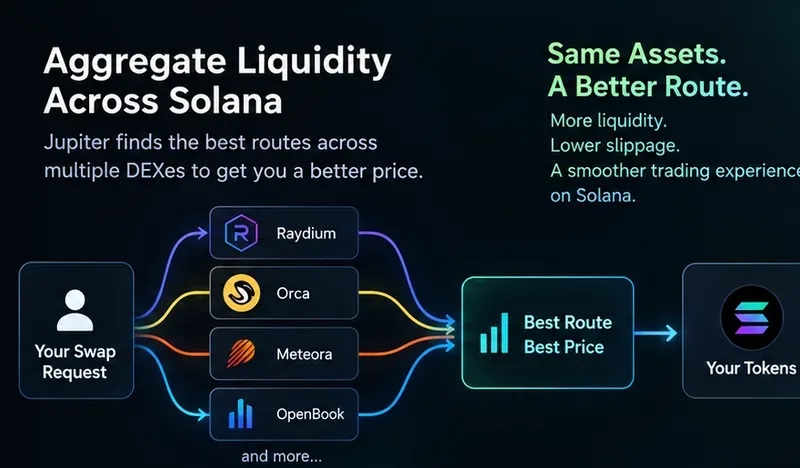
Conceptual routing diagram: a swap request can be evaluated across multiple Solana liquidity venues before a route is selected for execution. The diagram is explanatory rather than a live quote or interface screenshot.
What Jupiter actually does for a Solana swap
Jupiter sits between a trader and the liquidity available across Solana. Instead of forcing the user to inspect individual automated market makers, concentrated-liquidity pools, order-book-style venues or market makers one by one, a routing engine compares possible paths and constructs a transaction intended to deliver a competitive outcome.
The route does not have to be a single hop. A larger order may be split across pools or may pass through an intermediate token when that produces a better expected result. This is why a Jupiter quote can contain a route plan rather than one named exchange. Jupiter’s developer documentation historically exposed route plans, price impact and output thresholds through Metis; the older Metis Swap V1 flow is now marked deprecated in favor of Swap API V2, which is the important version distinction for developers in 2026. Jupiter documents that migration in its official Metis integration guide.
Jupiter also distinguishes between a routing primitive and a managed execution engine. Its January 2026 developer comparison describes Metis as the lower-level routing option for builders who need custom instructions, CPI or control over broadcasting, while Ultra combines routing with slippage estimation, transaction submission and other execution infrastructure. The same source says Ultra can meta-aggregate multiple routing engines and RFQ liquidity, rather than relying on a single pool graph. That means “Jupiter routing” is not one static algorithm in every product surface. The exact path can depend on the API, execution mode, pair, trade size and available liquidity. See Jupiter’s official Ultra versus Metis comparison.
Why the highest quote is not always the best swap
A quote is a snapshot. Between quote calculation and transaction execution, other trades can move pool balances, a concentrated-liquidity position can move out of range, an arbitrageur can update prices, or network congestion can delay inclusion. That produces quote-to-execution drift.
Jupiter’s Metis v8 write-up says the router uses observed execution data and on-chain simulation to estimate the price a route is likely to deliver, rather than choosing solely by the nominal quote. Its JIT Swap work addresses the same problem from another direction: the closer route selection is to actual execution, the less time there is for the market state to diverge. These are meaningful mitigations, but they are not guarantees. Market state can still change and Solana transactions can still fail.
A strong outcome should therefore be evaluated using several signals together:
Final amount received: compare the confirmed wallet output with the amount shown before signing.
Price impact: large impact is a warning that the trade is consuming meaningful available liquidity.
Slippage or quote deviation: repeated unfavorable deviation can indicate volatile or shallow markets.
Execution success: several failed attempts are a quality problem even if the theoretical quote looks attractive.
Total cost: include network fees, priority fees, venue economics and any Jupiter or integrator fee that applies.
Route complexity: more hops and external programs can add execution dependencies.
What fees can a Jupiter swap include?
There is no single number that describes every Jupiter swap fee. The all-in cost can contain several separate components, and their treatment depends on the execution product and route.
Cost component
What it represents
What to verify
Solana transaction fee
The base network cost for submitting the transaction.
Wallet confirmation and transaction details.
Priority fee or tip
Extra payment intended to improve transaction landing during congestion.
Whether it is automatic, capped or manually configured.
DEX or liquidity-source fee
Trading economics charged by pools or other liquidity sources in the selected route.
Expected output and route details rather than assuming every venue has the same fee.
Jupiter execution fee
Certain managed Jupiter products can charge a platform fee.
The exact product and current fee shown before execution.
Integrator fee
A wallet, app or third-party integration can add its own fee where supported.
The fee disclosure from the interface you are actually using.
Jupiter’s January 2026 Ultra-versus-Metis documentation stated that Ultra’s platform fee was 5–10 basis points at that time. That statement should not be generalized into “every Jupiter swap costs 5–10 bps.” Metis and custom Swap API integrations can have different economics, and integrators can add fees. Jupiter’s June 2026 changelog also notes that JupiterZ routes gained support for integrator fees. Because fee configuration can change, the transaction preview and current official documentation are better evidence than an old fixed percentage.
For developers, there is also a separate API-platform pricing model. Jupiter’s Developer Platform pricing covers request limits and paid API plans. Those subscription or usage charges are not the same thing as the on-chain swap costs paid by an end user.
How JUP governance works
JUP is the governance token associated with Jupiter. Holding JUP in a wallet is not, by itself, the same as having active voting power. Jupiter’s current governance site says users stake JUP to obtain voting power, vote on active proposals and can begin a seven-day unstaking process; it also says voting remains possible during that unstaking period. The safest source for the current mechanics is the official Jupiter voting portal.
Jupiter also uses Active Staking Rewards, or ASR, to reward eligible staking participation. For example, the official Q2 2026 campaign page specified a 50 million JUP pool and calculated eligibility using time-weighted average stake, with a stated minimum average stake for that campaign. Those details are campaign-specific and should not be assumed to remain unchanged indefinitely; historical campaign rules are available on Jupiter’s Q2 2026 ASR page.
Governance should also be separated from day-to-day routing operations. A governance token can give stakers a formal voice on proposals, treasury or ecosystem questions without implying that token holders directly approve every router update, every fee parameter or every liquidity-source integration. For a current decision, check the live proposal and its stated implementation scope rather than inferring authority from the existence of JUP voting.
The main aggregator risks users should understand
1. The route can become stale
Liquidity changes quickly. Even a high-quality quote can become inaccurate before the transaction lands. Jupiter’s newer routing and JIT work are specifically designed around this problem, which is evidence that quote-execution drift is a real system constraint rather than an edge case that software can simply eliminate.
2. Slippage protection can protect value by causing failure
A tight slippage threshold can prevent a bad fill, but it can also cause the transaction to fail when prices move. A loose threshold improves the chance of execution but gives the trade more room to settle at an unfavorable price. There is no universally correct setting. For a liquid stable pair, a very wide tolerance may be unnecessary; for a volatile or thin token, an unrealistically tight tolerance may make execution unreliable.
3. Jupiter inherits risk from downstream programs
An aggregator is not one isolated smart contract. A route can invoke external DEX programs and token programs. Jupiter’s official error documentation notes that DEX program errors can arise from any AMM invoked through the route. That means routing across more venues can improve price discovery while also increasing the number of external dependencies touched by a transaction.
4. Better routing cannot fix bad liquidity
If a token has shallow or fragmented liquidity, an aggregator can search more intelligently but cannot manufacture depth that does not exist. Large price impact, a small number of viable routes, unusually wide quote changes or repeated “no route” conditions are signs to reduce trade size, wait for better conditions or reconsider the trade method.
5. MEV mitigation is not an absolute shield
Jupiter describes Ultra and Jupiter Beam as using managed transaction-submission infrastructure and MEV protections. Those measures can reduce exposure, but users should not interpret “MEV protection” as a promise that extraction, adverse selection or unfavorable movement is impossible. The relevant outcome remains the confirmed execution.
6. An aggregator adds infrastructure dependency
Jupiter’s router, APIs and managed execution services are additional layers between the wallet and Solana liquidity. API outages, route-selection bugs, stale data or execution-service degradation can affect swaps even when the underlying DEX pools remain live. For higher-value trades, it is reasonable to compare the route, expected output and fees against at least one direct venue before signing.
When should you change your approach?
A normal aggregator flow is most useful when there are several liquid venues and the trade is small enough that routing can find competitive execution without major market impact. You should consider a different approach when the evidence changes.
If price impact is unusually high, reduce the order size or compare staged execution with a single large swap.
If quotes move materially every few seconds, treat the market as unstable and avoid relying on an old route.
If transactions repeatedly fail, do not solve the problem only by widening slippage; inspect congestion, priority fees, token mechanics and route liquidity.
If the route touches unfamiliar or illiquid assets, verify token mint addresses and the actual route before signing.
If you need custom instructions or full execution control, Jupiter’s developer materials position Swap API/Metis-style tooling differently from the managed Ultra flow.
If the trade is large relative to pool depth, a limit-style or time-sliced strategy may provide more control, though it introduces its own timing and execution risks.
What a good Jupiter swap should look like
The best practical test is outcome quality. A good result is one where the confirmed amount is close to the expected amount, price impact is reasonable for the trade size, the transaction lands without repeated retries, and the total fees are understandable before signing. A routing engine can improve the probability of that outcome, but it cannot remove market risk, liquidity risk or smart-contract dependencies.
As of September 30, 2026, Jupiter’s documented direction is toward more execution-aware routing: Swap API V2, Metis v8, real-time slippage estimation, managed submission and JIT-style route updates all reflect that goal. The useful takeaway is not that Jupiter makes swaps risk-free. It is that the relevant benchmark has shifted from “best displayed quote” toward “best verified execution outcome.” Users should judge Jupiter—and any Solana aggregator—on that basis.