Home
» Project analysis
»
Arbitrum Orbit explained: who runs the chain, where fees go and how upgrades work
Arbitrum Orbit explained: who runs the chain, where fees go and how upgrades work
Arbitrum Orbit is a framework for launching a dedicated Arbitrum-based chain with its own operators, economics and governance choices. If you are new to Orbit, the most important thing to understand is that “built with Arbitrum” does not mean “run by the Arbitrum DAO.” A project launching an Orbit chain chooses who operates core infrastructure, where the chain settles, how data availability works, which token pays gas, which addresses receive fees and who has authority to approve upgrades.
As of September 2026, Arbitrum’s official documentation increasingly uses the broader term “Arbitrum chains” for this product line, while “Orbit” remains the widely recognized name. The official docs describe these chains as configurable systems for execution, gas tokens, data availability, governance and validation. See the Arbitrum documentation.
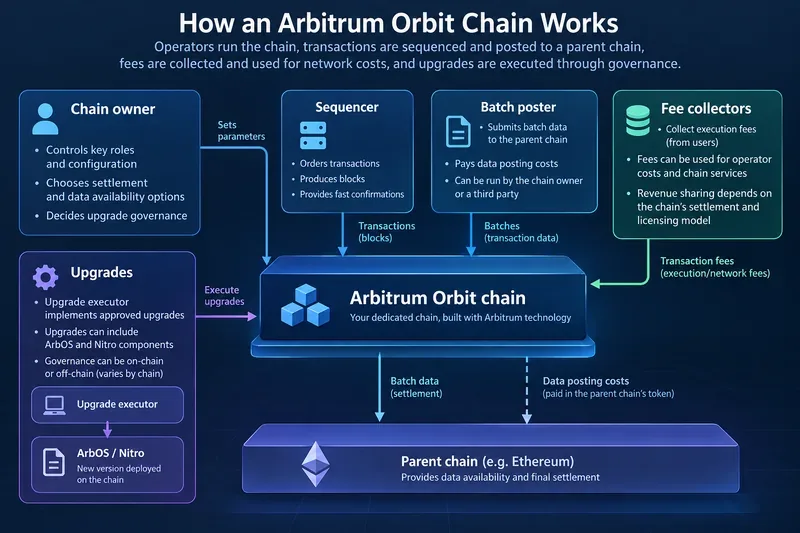
An Orbit chain has chain-specific operators and governance: the sequencer orders transactions, the batch poster publishes data to a parent chain, configurable fee accounts receive protocol fees, and the chain owner controls the upgrade path.
Start with the mental model: an Orbit chain is its own chain
An Orbit chain is not simply a smart contract application running inside Arbitrum One. It has its own chain ID, execution environment, node software and chain-level configuration. It can be deployed as a Layer 2 that settles to Ethereum or as a Layer 3 that settles to another chain such as Arbitrum One. The exact topology matters because it affects transaction costs, security assumptions, bridging and who pays the parent-chain posting bill.
A useful term to learn first is parent chain. This is the chain on which the Orbit chain’s rollup contracts live and to which the Orbit chain posts the information needed for settlement. For a Layer 3, the parent may be Arbitrum One rather than Ethereum directly. The official L3 rollup quickstart shows this concretely: an L3 can deploy contracts to Arbitrum Sepolia, fund a batch poster and validator there, and run its own Nitro node.
Who actually runs an Arbitrum Orbit chain?
There is no single universal operator. A production chain normally has several distinct roles, and one company may run all of them or distribute them across different parties.
1. The chain owner controls privileged configuration
The chain owner is the account or governance-controlled address with administrative authority over chain-level settings exposed by ArbOS, Arbitrum’s operating-system layer. The current ArbOwner interface includes functions for managing chain owners, changing the network and infrastructure fee accounts, adjusting gas-pricing parameters and scheduling ArbOS upgrades. You can inspect the authoritative interface in Offchain Labs’ ArbOwner contract interface.
This makes the owner address one of the first things a user, integrator or auditor should identify. The important question is not merely “Who built the chain?” but “Who controls the owner authority now?” That authority could be held by a project wallet, a multisig or a more elaborate governance system. The wrapper around the owner varies by chain, so it should be verified chain by chain rather than assumed.
2. The sequencer orders transactions
The sequencer receives user transactions, orders them and produces the fast view of the chain that applications normally use. In a simple deployment, the same Nitro node can sequence blocks, post batches and validate. Production deployments may separate those functions for availability and operational security.
The sequencer is operationally important, but it is not supposed to be the only path into the chain. Arbitrum includes a delayed-inbox and force-inclusion mechanism designed to let transactions bypass an uncooperative sequencer after the required delay. That distinction matters: a sequencer outage can degrade UX without necessarily giving the sequencer unlimited power over the protocol state.
3. The batch poster pays to publish chain data
The batch poster takes compressed transaction data from the child chain and submits it to the parent chain or configured data-availability system. It needs funds on the parent chain to pay posting costs. In Arbitrum’s own L3 quickstart, the operator explicitly funds the batch-poster address before the chain can keep publishing data.
4. Validators check the state transition
Validators independently track the chain and participate in the rollup validation process. Their exact responsibilities depend on the chain’s rollup configuration and protocol version. From a newcomer’s perspective, the key point is that “sequencer” and “validator” are different roles even if one machine handles both in a test setup.
5. AnyTrust chains add a Data Availability Committee
If the chain uses AnyTrust rather than posting all transaction data to its parent chain, it relies on a Data Availability Committee (DAC). DAC members run Data Availability Servers that store data and provide it on demand. This introduces additional trust and operational assumptions that do not exist in the same form for a conventional rollup. The official DAC configuration guide explains that committee members operate these servers while the chain owner configures the committee information in the chain.
Where do transaction fees go?
The short answer is: not to one universal wallet. Orbit fees have several economic jobs, and the destination is configurable.
Fee or cost
What it pays for
Who ultimately receives or bears it
Execution / network fee
Computation and congestion on the Orbit chain
A configured network fee account
Infrastructure fee
Optional chain-level infrastructure revenue
A configured infrastructure fee account
Parent-chain data cost
Publishing batches or data commitments
Paid by the batch poster and accounted for by the protocol’s parent-chain pricing mechanism
AEP revenue share, when applicable
Arbitrum Expansion Program licensing economics
A portion of net protocol revenue goes to the Arbitrum ecosystem
ArbOS exposes both a network fee account and an infrastructure fee account, and the chain owner can change those addresses. That is a direct reason not to assume that every gas payment goes to Offchain Labs, the Arbitrum Foundation or the Arbitrum DAO.
Parent-chain costs are a different bucket. The batch poster must spend the parent chain’s native token to publish data. Arbitrum’s pricing system is designed to collect data-related fees from users and compensate for those posting costs over time. The exact amount changes with compression, demand and the parent chain’s fee market, so a single static percentage is not a reliable description.
What about the 10% Arbitrum revenue share?
This is where context matters. The Arbitrum Foundation’s September 2026 progress update states that Arbitrum chains settling outside Arbitrum One and Arbitrum Nova return 10% of net protocol revenue to the Arbitrum ecosystem under the Arbitrum Expansion Program. The same update explains that chains settling to Arbitrum One contribute through the fees they pay to that chain. See the Foundation’s H1 2026 progress report.
That 10% figure should therefore not be described as “10% of every user gas fee on every Orbit chain.” It is a licensing/revenue-sharing rule based on net protocol revenue for the chains covered by that program. The chain still has its own operating expenses, fee recipients and settlement costs.
How do upgrades work?
Orbit upgrades are chain-specific, not automatically imposed just because Arbitrum One upgrades. The official ArbOS upgrade guide is explicit that Arbitrum chain owners have discretion over whether and when to upgrade their ArbOS version. See How to upgrade ArbOS on your Arbitrum chain.
A typical upgrade has three layers:
Update Nitro software. Validators and other nodes must run a Nitro release compatible with the target ArbOS version.
Update parent-chain rollup components when required. An ArbOS release may require a new WASM module root and, for some releases, upgraded Nitro contracts on the parent chain.
Schedule activation inside the chain. The chain owner invokes the upgrade path through the chain’s upgrade executor and the ArbOwner precompile, specifying the new ArbOS version and activation timestamp.
The upgrade executor is a contract used to execute privileged upgrade actions. The Arbitrum docs note that it is the designated owner of the Rollup contract on the parent chain, so the chain owner initiates the relevant call through that executor. In practical governance terms, this means you should inspect who controls the chain-owner authority and whether that control is protected by a multisig, timelock or other process.
What should you verify before using an Orbit chain?
You do not need to become a rollup engineer, but a short checklist can prevent most category errors.
Identify the parent chain. Is this Orbit chain settling to Ethereum, Arbitrum One, another Arbitrum chain or a different supported parent?
Check the data-availability mode. Is it a rollup that posts data to the parent chain, or AnyTrust with a DAC?
Confirm the gas token. Arbitrum chains can use ETH or a custom ERC-20 as their native gas currency.
Find the current chain-owner addresses. These reveal who has privileged configuration authority at the protocol level.
Check who runs the sequencer and batch poster. Operational control affects uptime and censorship-resistance assumptions.
Inspect fee-recipient configuration. Do not infer fee destinations from the chain’s brand.
Understand upgrade governance. Ask who can trigger the upgrade executor, whether there is a delay, and where upgrade announcements are published.
Common mistakes to avoid
Assuming the Arbitrum DAO runs every Orbit chain
It does not. Orbit gives each chain its own operator and owner configuration. Arbitrum supplies technology and ecosystem infrastructure, but the project deploying the chain determines much of the day-to-day control structure.
Assuming every fee goes to the Arbitrum DAO
Execution fees, infrastructure fees, data-posting costs and licensing revenue are separate concepts. Some fee destinations are explicitly configurable by the chain owner.
Assuming upgrades happen automatically
Orbit chain owners must coordinate node software, parent-chain contracts and ArbOS activation. A chain can therefore be on a different ArbOS release schedule from Arbitrum One.
Ignoring AnyTrust’s extra trust assumptions
An AnyTrust chain can be cheaper because it normally relies on its DAC instead of posting all transaction data to the parent chain. That trade-off should be evaluated explicitly rather than treated as an implementation detail.
The practical takeaway
The best way to evaluate an Arbitrum Orbit chain is to separate the technology stack from the specific chain’s governance. Arbitrum Nitro and ArbOS provide the machinery, but the chain owner controls important parameters, operators run the sequencer and batch-poster infrastructure, fee destinations can be configured, and upgrades are activated through chain-specific owner authority.
For a newcomer, that leads to one reliable habit: before depositing meaningful value, verify the parent chain, data-availability model, chain owners, operator setup, fee collectors and upgrade process from that chain’s own official documentation and on-chain configuration. Those details tell you far more about how a particular Orbit chain behaves than the Orbit label alone.